
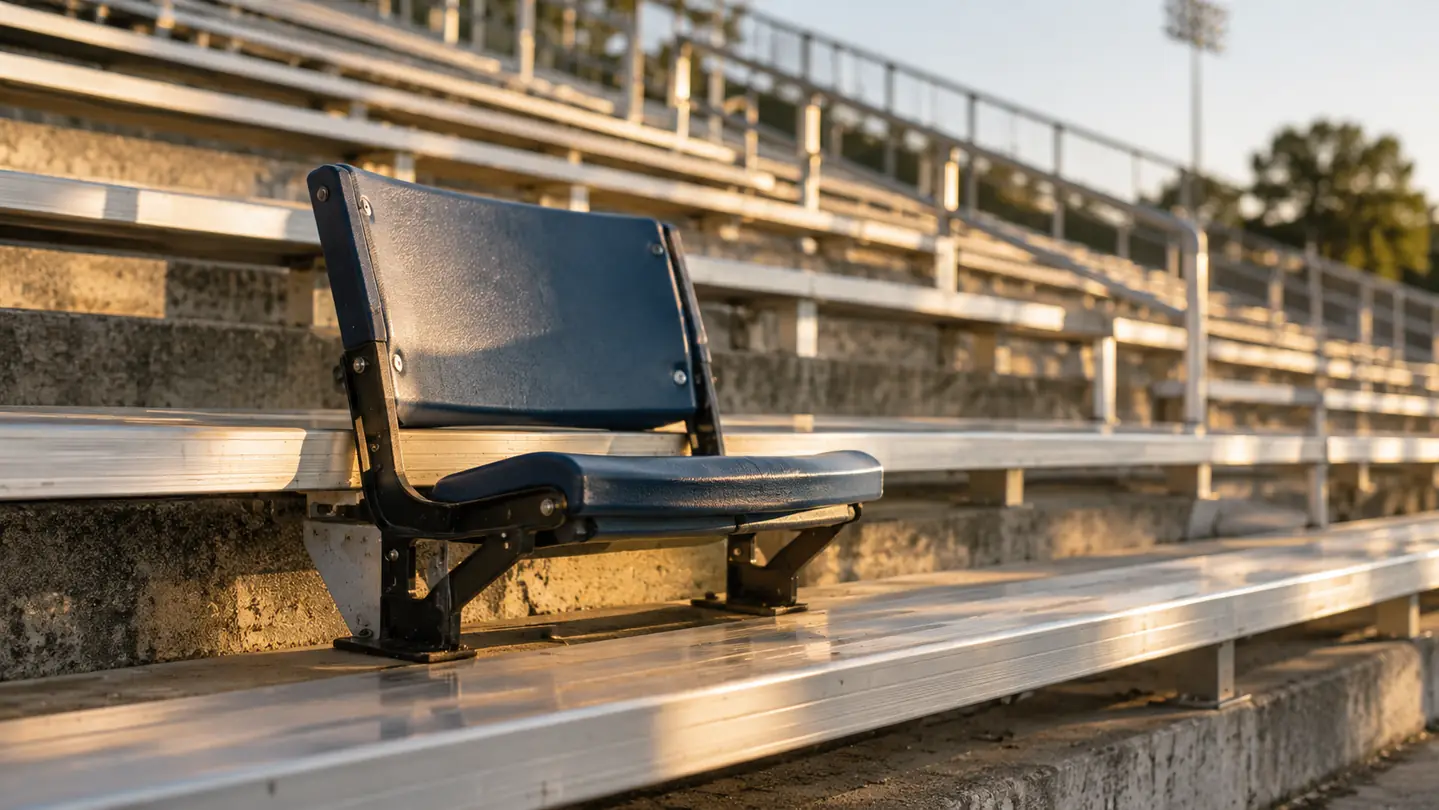
By the fourth quarter of a late November home game, the aluminum bench had stopped pretending to be a seat. I am 61 years old, I have had football tickets in this family for a long time, and my lower back had been filing complaints since halftime. I bought a SPORT BEATS stadium seat with back support before the next home game, then used it through a full football season and most of a baseball summer. This is the honest accounting, including the parts I did not like.
I am not going to tell you a folding seat fixes a bad back. It does not, and anyone who says so is selling rather than reviewing. What it does is put real foam between you and cold metal for three hours, and give you a backrest so you are not slumped forward with your elbows on your knees by the second quarter. The only question worth arguing about is whether carrying one more item to the gate is worth that. For me it was, and the math is simple enough. I sit on aluminum maybe twenty times a year.
The Quick Verdict
Sturdy, genuinely comfortable, and it survived a cold season in a garage. The backrest stops the slump but stops at your mid back, and there are no armrests.
Amazon Check Today's Price →If your back starts complaining at halftime, start here
Folds flat, carries hands free on a padded shoulder strap, and the steel frame is rated to 250 pounds. This is the seat I used all season, home and away.
Amazon Check Today's Price on Amazon →How I've Used It
My routine is nothing special. I get to the gate about forty minutes early because I would rather sit than stand in a line, and I carry the seat folded on my shoulder. It folds flat, and there is a built-in handle so I am not fumbling with it when they check bags at the entrance. At 6.6 pounds in the Regular size it is not a burden on the walk in from the parking lot. I would not want to hike a mile with it, but in all the games I have been to, I have never once had to.
The Regular measures 17 inches wide by 12 inches deep with a 16.5 inch backrest. I am 5 foot 11 and about 205 pounds and it fits me with room on either side. The Large goes to 18.5 inches wide with an 18.5 inch back, and if you are a bigger man than I am, that is the one to order. Do not guess at it. The sizing exists so the seat lines up with a standard bleacher without hanging off the front edge, and an overhang is exactly what makes a folding seat tip when you lean.
One Saturday in October I learned the opening drill the hard way. The seat does not come open with one hand. The frame wants to stay folded, so you set it on the bench, hold the back upright with one hand, and flip the seat down with the other. Ten seconds once you know it. A man two rows below me fought his for a minute and a half with a crowd coming up the stairs behind him, and I felt for him. That is not a knock on this seat, it is how anything with a hinge works, and it is the reason I still get there early.
Joan comes with me to a few baseball games in the summer and she has her own opinion, which is that the cushion matters more than the back. She is not wrong. The 2.8 inch foam is the reason I stopped shifting around in the fifth inning. There is a real difference between a thin pad with a cover stitched onto it and actual foam that pushes back, and I have owned both.
What the Build Actually Is
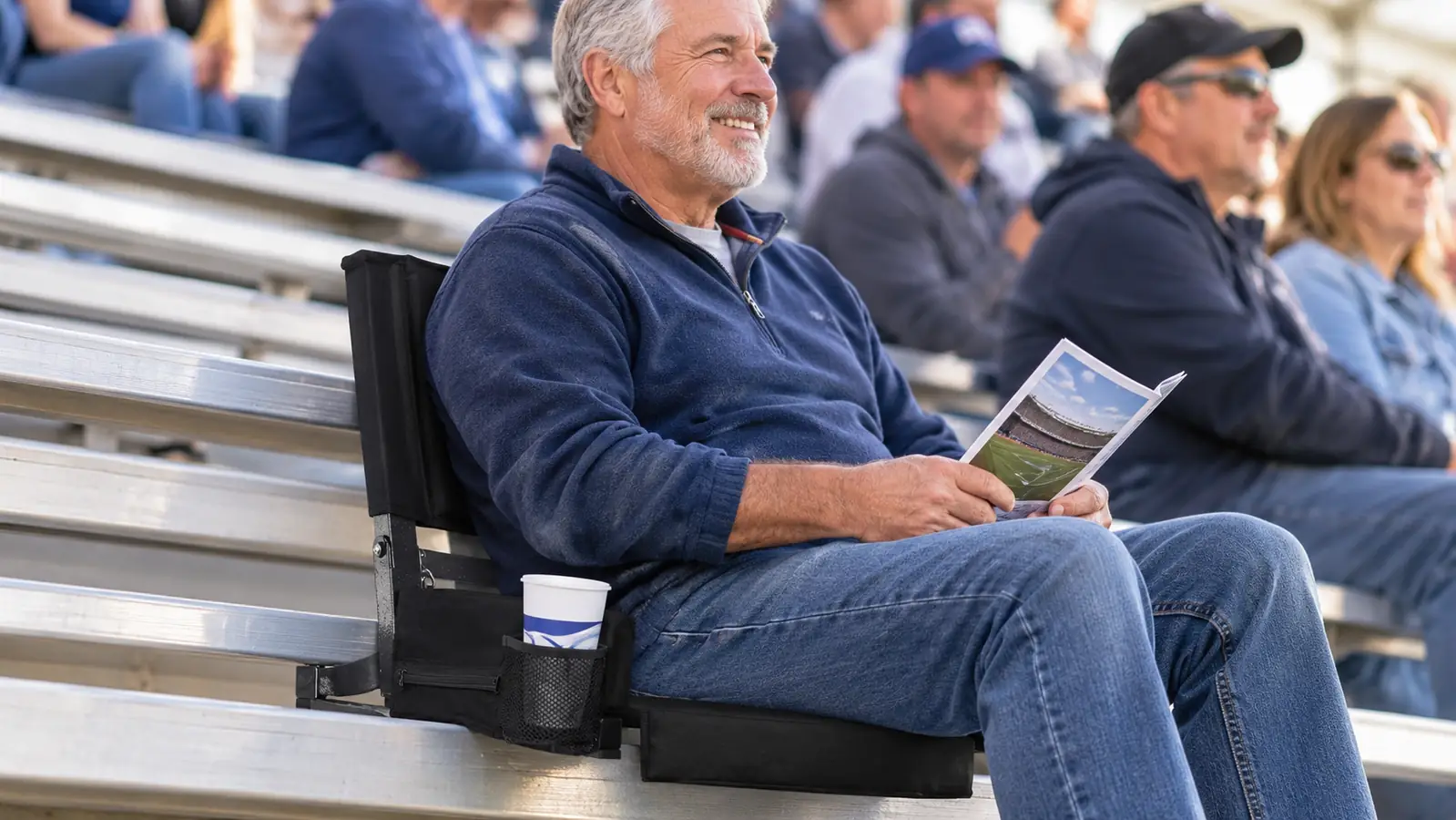
Strip away the adjectives and here is the object. A steel frame rated for up to 250 pounds. A 2.8 inch high density foam cushion. A solid backrest, 16.5 inches tall on the Regular. An adjustable padded shoulder strap, a built-in handle, a cup holder molded into the frame, and a pocket on the side for a phone or a program. It folds flat, and there is a seat lock so it stays folded instead of flopping open on the stairs. That is the whole SPORT BEATS seat, and there is not much else to explain.
The warranty is six months, and I want to be plain about that because six months is not long for something you sit on twenty times a year. It tells you what the maker expects the useful life to be. Practically, it means you should look the frame, the stitching, and the hinge over in the first few weeks rather than discovering a problem in year three.
What is not on it: armrests, a recline, and a carry bag. If those are on your list, you are shopping in a different part of the category. I would rather have this than a heavier seat with arms I would never use at a ballpark where legroom is already tight.
The Cold Bench Test
Aluminum in November pulls heat out of you faster than you expect. You feel it through jeans in about ten minutes. This is the whole argument for the foam, because 2.8 inches of it means you are sitting on foam and not on metal. I did two games last season where it was in the thirties at kickoff and I sat through the fourth quarter both times. On the bare bench I would have been standing and stomping by the third, and my back would have paid for it on Monday.
The wind matters more than the thermometer does. My seats are on the west side and the wind comes over the top of the deck, and on one of those days the temperature never climbed above 36 the whole afternoon. I had long johns and two pairs of socks and a coat I have owned since the nineties, and the only part of me that was genuinely warm by the fourth quarter was the part sitting on foam. That sounds like a small thing to write down. It is not a small thing when you are sixty-one and the alternative is watching the rest of the game from the concourse.
A full season later, the foam has softened where I sit. Not collapsed. Softened, the way a good pair of boots softens. The cover has held, the stitching at the corners is intact, and the frame has not bent. I wipe it down with a damp cloth and leave it in the garage between games, which is not careful treatment, and it has not complained yet.
The backrest is where I have my real note. At 16.5 inches it reaches my mid back, not my shoulders. It stops the slump, which is exactly the problem I bought it for, but if you are picturing yourself leaning back with your whole spine supported, this is not that. It is a folding seat with a back on it, not a chair, and the difference is obvious by the fourth quarter.
The Small Things That Decided It
I did not expect to care about the cup holder and I care about it. On a bleacher your drink goes between your feet, where it gets kicked, or on the bench beside you, where it gets knocked over by the person next to you. A cup holder in the frame means the drink is where you left it. It takes a standard cup or a bottle. A big souvenir cup is a squeeze, so plan for that.
The strap is the part I would miss most if it went away. I sling the seat over one shoulder and both hands stay free for a program and a ticket, and the padding means it does not cut in on the walk from the lot. The side pocket swallows a phone, a folded program, and the bill for a hot dog. Small things, all of them. On a bleacher, small things are the entire experience, because the bench itself is going to give you nothing.
As for keeping it clean, a damp rag does the job. I have not put the cover in a washing machine and I would not, and nothing in the listing asks you to. After a season of spilled soda and a mustard packet that lost an argument with my sleeve, the seat still looks like a seat and not like a rag, which is more than I can say for the cushion I used to carry.
The seat lock matters more than I expected. Folded, it stays folded. I have watched people fight an unfolding seat down a concrete stair with a crowd behind them, and it does not go well for anybody. You set it down, you unfold it, and it sits flat on the aluminum instead of rocking.
A Seat Versus a Cushion
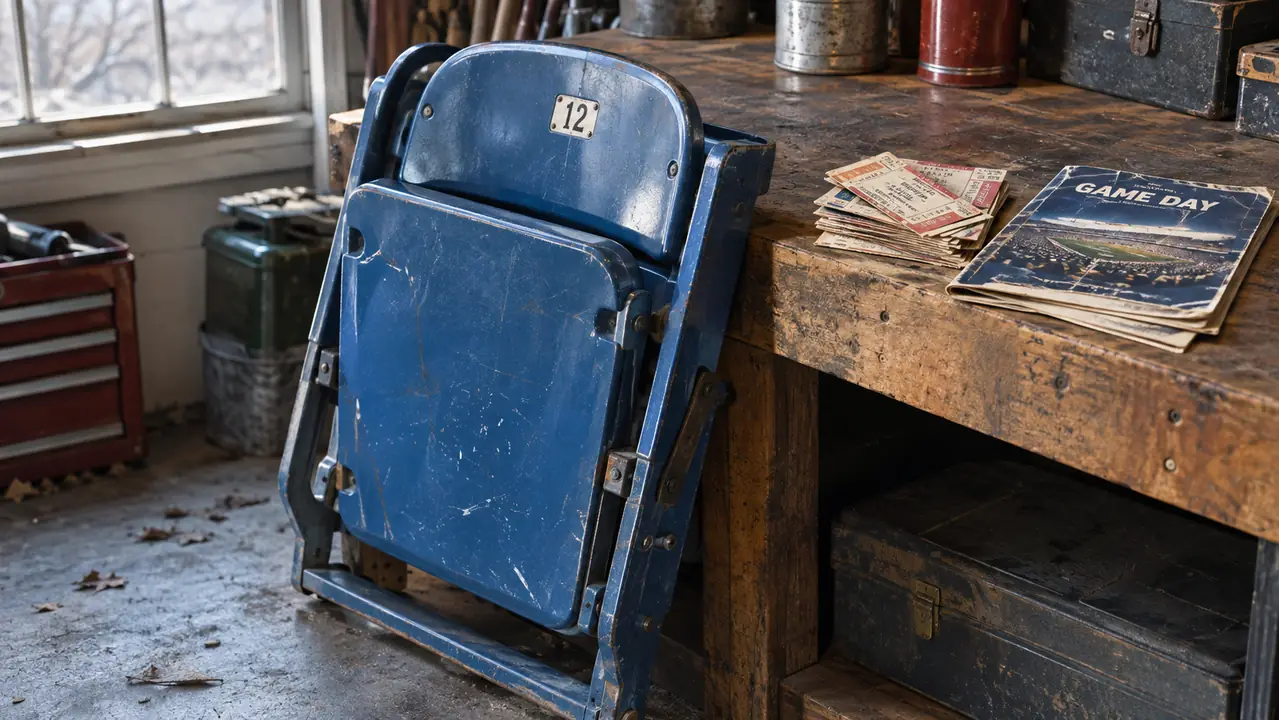
Plenty of people will ask why not just bring a cushion. I did that for years. A cushion is lighter, it fits in a coat pocket, and if all you want is to take the chill off the metal, a cushion is a reasonable answer. What a cushion does not do is hold your back in a sitting position, and after sixty that is the part that decides whether I enjoy a game or endure it.
The seat also does something a cushion cannot, which is stay put. It has a footprint. When you shift your weight, it shifts with you instead of squirting out from under you onto the step. If your choice is genuinely between the two, and you go to a game or two a year, take the cushion. If you have a regular seat and a regular back complaint, take the seat.
Where It Falls Short
No armrests. On a long game I noticed it, because there is nowhere to rest your forearms and the seat gives you about your own lap. A folding stadium seat with arms exists, and if that is what your shoulders need, buy that instead of this. I am not going to pretend the omission is a feature.
The weight rating is 250 pounds and that is a ceiling, not a suggestion. If you are at it or over it, do not buy this and hope. The frame is steel and it will do what steel does, which is fail at the worst possible moment in front of a section full of people.
It also expects a bench. The frame is built to line up with a standard bleacher, and that is where it is stable and level. I took it once to a high school field with wooden planks and it was fine, but I would not drag it to a park concert on a sloped lawn and expect the same result. Buy it for bleachers and you will never think about this.
The foam softens, the warranty is six months, and there is no bag. The cup holder is shallow enough that a tall cup leans. Crumbs get into the hinge and stay there until you turn the SPORT BEATS seat upside down and shake it out. None of these are reasons to skip it. All of them are things I would rather you hear from me than discover in October.
What I Liked
- 2.8 inches of foam takes the cold out of an aluminum bench
- Backrest stops the halftime slump
- Folds flat and carries hands free on a padded shoulder strap
- Cup holder and side pocket are genuinely useful
- Steel frame rated to 250 pounds held up for a full season
- Regular and Large sizes line up with standard bleachers
Where It Falls Short
- Backrest stops at your mid back, not your shoulders
- No armrests
- 250 pound limit with no margin
- Six month warranty
- Foam softens where you sit
- No carry bag, and the cup holder is shallow
Two games in the thirties at kickoff, and I was still sitting in the fourth quarter. On the bare bench I would have been standing and stomping by the third.
Who This Is For
This is for the fan with a regular seat and a regular complaint. Football in cold weather, baseball in July, three hours at a stretch on aluminum. If you are around 200 pounds or under, if what you want is a backrest that keeps you from folding forward, and if 6.6 pounds on your shoulder from the car to the gate does not scare you, it will do its job every week.
It is also a decent gift for a fan who has everything else. I have reached the age where I do not want another signed anything, and a thing that makes Sunday more comfortable is worth more to me than a knickknack for the shelf. If you are buying for someone who sits in the same seats year after year, this lands better than you would expect.
Who Should Skip It
Skip it if you are near or over 250 pounds. Skip it if you need armrests or a back tall enough to reach your shoulders, because this will not get you there. Skip it if you are in a club section with an actual padded seat and a real back, since there is no reason to carry anything. And skip it if a mile walk from remote parking is part of your game day, because a cushion is the smarter carry at that distance.
One last thing. Measure your bench, or look up your section, before you order. A folding seat that is too wide for the space you have is worse than no seat at all, and the whole reason the sizing is listed down to the inch is so that you can check it in your driveway before the season starts.
Twenty Sundays a year is a lot of time on aluminum
The Regular is 17 by 12 with a 16.5 inch back and weighs 6.6 pounds. The Large is wider with a taller back. Measure your bench, then get to the gate early enough to set it up before the crowd arrives.
Amazon Check Today's Price on Amazon →