
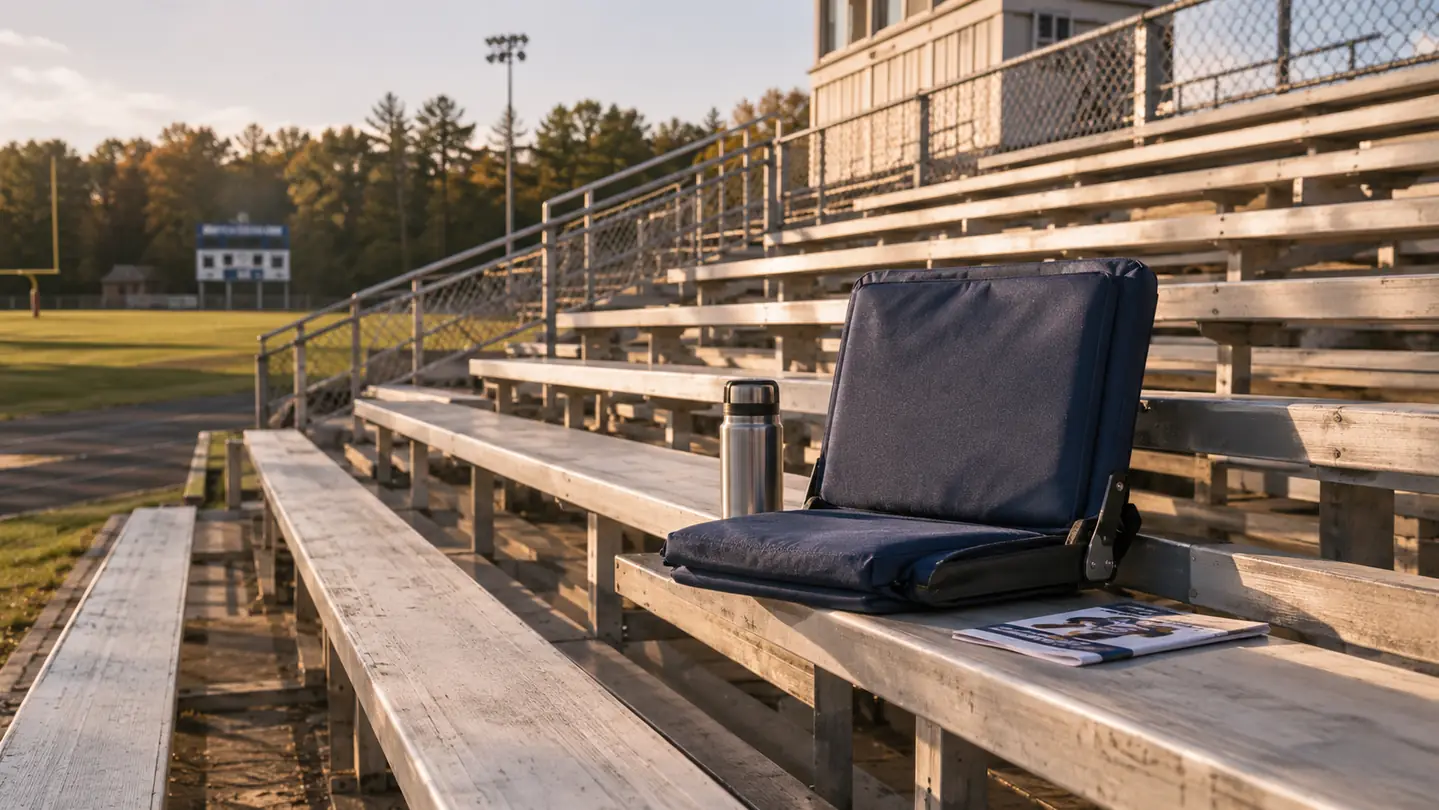
Three hours on an aluminum bench is not a sitting contest. It is a slow argument between your lower back and a piece of metal that was designed for a crowd, not a person. I am 61, I have had football season tickets in the family for decades, and I have spent enough November afternoons in the stands to know that the last quarter is where backs go bad. What changed it for me was a simple SPORT BEATS stadium seat with back support, set up the right way. Not thrown on the bench five minutes before kickoff. Set up the right way.
Most people buy a seat like this, carry it in once, and then sit on it like a cushion. That misses the point. A stadium seat with a back is a small piece of furniture, and small furniture only works when it fits the bench, fits your frame, and gets adjusted before the game starts. These are the five steps I use now, plus a few things that help when the weather turns.
The Seat That Makes the Fourth Quarter Feel Like the First
A 2.8 inch high density foam cushion, a tall backrest, and a steel frame rated to 250 pounds. The SPORT BEATS stadium seat folds flat, carries by the padded shoulder strap, and gives you a place to put a cup and a program.
Amazon Check Today's Price on Amazon →Step 1: Match the Backrest Height to Your Torso, Not the Bench
The first mistake is buying the biggest seat you can find. The SPORT BEATS seat comes in a Regular with a 16.5 inch backrest and a Large with an 18.5 inch backrest. That difference sounds small in a listing. It is not small after two hours. If you are short through the torso, a backrest that runs too high can push your shoulders forward. If you are long through the torso, a short back leaves your upper back hanging off the end.
I am six feet even and long in the back, so the 18.5 inch backrest on the Large is the one that lines up with my shoulder blades. My wife Joan is five foot four and prefers the Regular. Neither of us is making a fashion choice. We are matching the top of the backrest to the part of the back that needs support. We settled it with a kitchen chair and a strip of masking tape the week the first box came. Back straight against the chair, Joan put the tape at the top of my shoulder blades, then we measured down to the seat. The Regular came up about two inches short on me and landed right on Joan. Five minutes of work, and we have not thought about it since. Sit on a hard chair at home before you order. If the top edge lands at your shoulder blades, that is your size.
Width matters too. The Regular is 17 inches wide and the Large is 18.5 inches. Most stadium benches are built for a crowd, and a seat that is too wide will crowd the person next to you or hang off the edge. The SPORT BEATS seat is sized to line up with standard bleachers without a goofy overhang. Measure your bench if you are unsure, and be honest about the space you actually get.
Step 2: Set It Up Before the Anthem, Not After the First Whistle
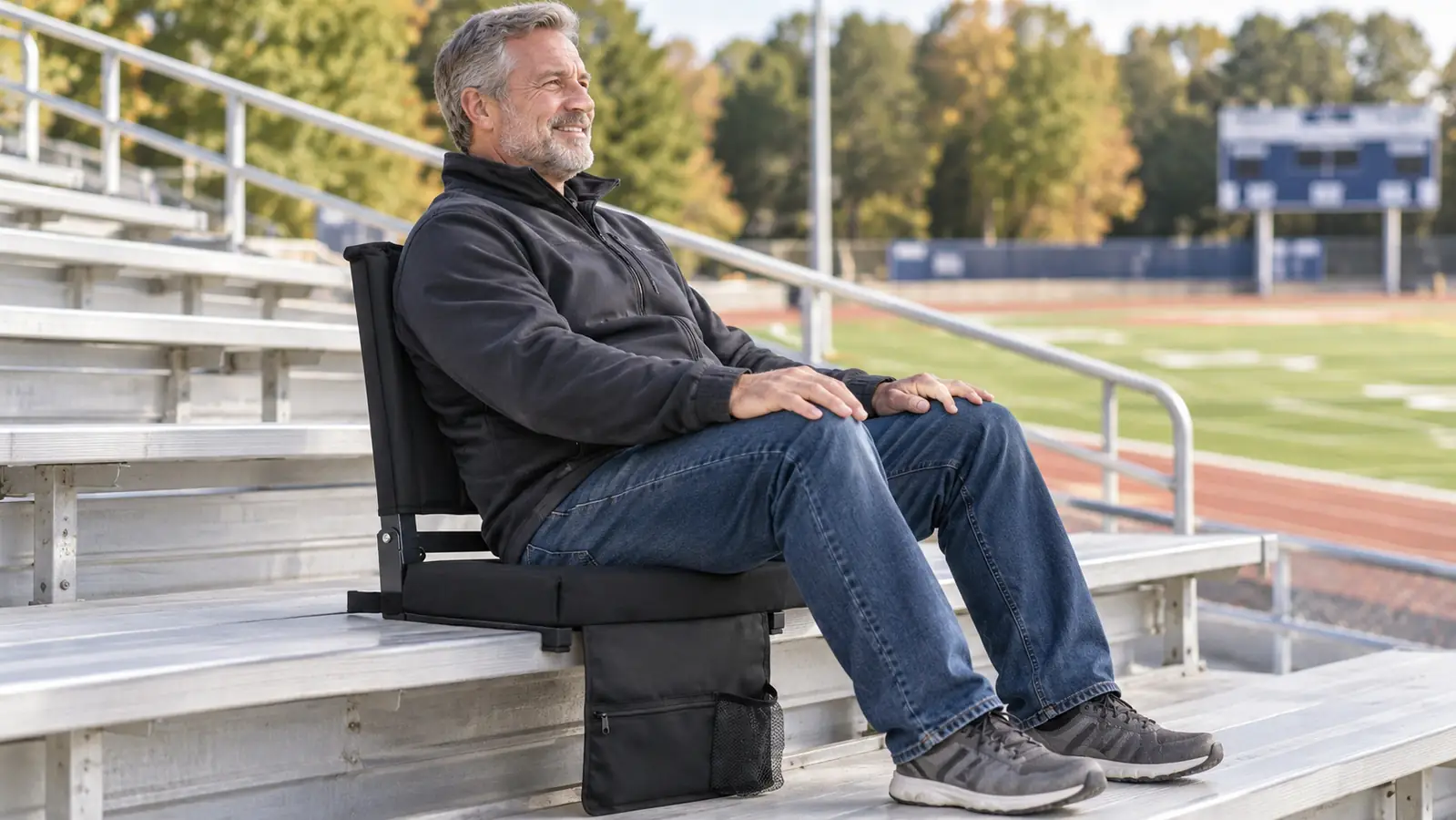
The seat lock is the part people skip. Open the frame, set the seat on the bench, and press down until the lock settles. If you drop it and go, the seat can shift when you lean back. I set mine before the anthem, then I sit down and lean back hard once to test it. If it moves, I get up and reset it. Two seasons back, at a cold late-season game with the wind coming off the north end, I dropped mine on the bench and sat down in a hurry. The first time I leaned back it slid an inch and a half to the right, and I spent two quarters hitching it back into place with my hip. That was my own fault, and I have not done it since. Ten seconds of setup saves an afternoon of squirming.
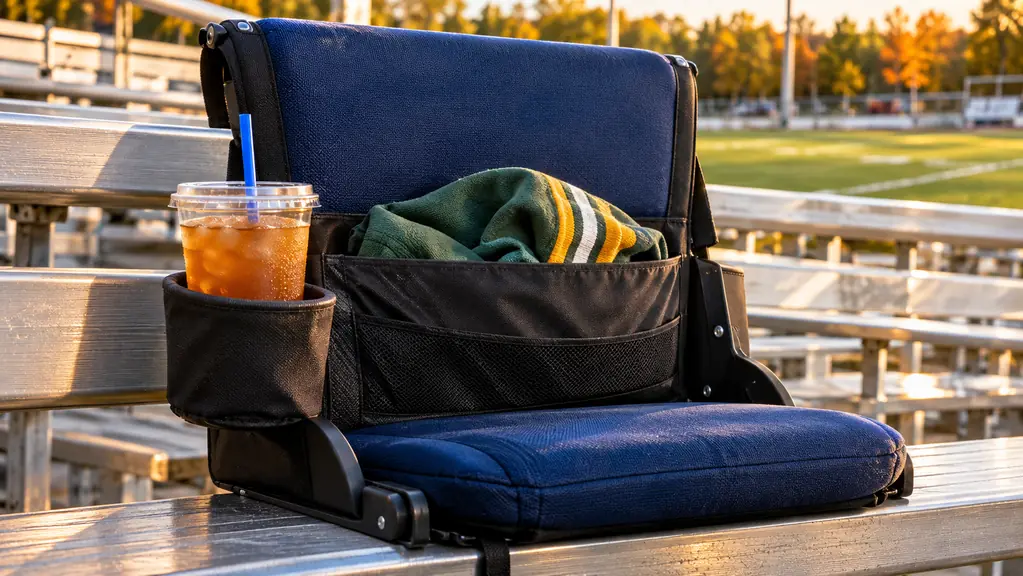
The padded shoulder strap and the built-in handle are for carrying, not for hanging the seat on the bench. I see people leave the strap dangling under the seat and then wonder why it slides. Fold the strap up, tuck it behind the backrest, and keep the bench contact clean. The pocket is for a program, a phone, or a pair of gloves. The cup holder is for a cup with a lid, not a paper cup you are going to knock over in the third quarter.
If the bleacher has a lip or a rail, make sure the frame sits flat and not on the lip. The seat is rated for 250 pounds, and that rating assumes the frame is supported by the bench. A seat perched on a rail is not supported. I would rather move one spot to the left than sit on a seat that is half on and half off the bench.
Step 3: Sit Back Into the Seat, Not Forward on the Edge
The backrest only works if you use it. Most people sit on the front edge of the cushion, lean their elbows on their knees, and then blame the seat for their back. I did that for years. Now I sit all the way back, put both feet on the bleacher below, and let the solid back take the weight. The 2.8 inch high density foam cushion is enough to lift me off the aluminum, but it is not a recliner. It is a surface that lets me sit like a person.
Posture on a bleacher is a simple chain. Feet flat. Hips back. Lower back against the backrest. Shoulders relaxed. If your feet are on the bench instead of the step below, your knees come up and your back rounds. If your hips are forward, the backrest is behind you doing nothing. I check this once at the start of each quarter. It sounds fussy. By the third quarter, the people around me are usually hunched forward with their elbows on their knees, and I know exactly why. Nobody told them the backrest only counts if their hips are behind it. It is the difference between watching the game and thinking about your back.
I also stand up during every timeout. Not because I am restless, but because a back that stays in one position for three hours gets stiff no matter what is under it. The seat buys you a better position. It does not buy you a pass on moving. Stand, sit back down, reset your feet, and you get another quarter out of the same seat.
The backrest is not a decoration. If your hips are forward, you paid for a cushion and left the support behind you.
Step 4: Dress for the Bench, Then Use the Seat as a Barrier
Aluminum pulls heat out of you. That is the part people forget when they check the forecast. A 45 degree afternoon in November feels different after an hour on metal. I wear a base layer, a fleece, and a jacket that blocks wind, and I bring a folded stadium blanket for my legs. The SPORT BEATS seat puts foam between me and the bench, which helps, but it does not heat the bench. Dress as if you will be sitting still, because you will be.
I also keep a stocking cap and gloves in the storage pocket, even when the sun is out at kickoff. If it looks like rain, I put the gloves in a small bag first. I fold the seat flat, carry it by the handle, and put it in the truck. A seat that lives in the weather will not last as long as one that gets put away. That is true of most gear, and it is true of this.
The seat is 6.6 pounds in the Regular and 8 pounds in the Large. That is light enough to carry in one hand, but it is not weightless on a long walk from the parking lot. I use the padded shoulder strap when I have a cooler in the other hand. If I am walking far, I put the strap across my body and keep the seat against my hip. Small thing. It keeps me from arriving at the gate already tired.
Step 5: Build Two Standing Breaks Into the Game
My rule is simple. Stand at halftime, and stand at least once in the fourth quarter, even if the game is close. I started doing it after a Sunday game where I stood up at the final whistle and my lower back had that hot, tight feeling that tells you Monday is going to be a long day. Nothing was wrong with the seat. I had simply sat in one position for three and a half hours. A full game is a long time in one position. The seat makes that position better, but it does not make it permanent. When I stand, I put my hands on my hips, lean back gently, and take a few slow breaths. Then I sit back down and reset my feet.
The cup holder is a good excuse to stand. I empty it, walk to the trash, and come back. The pocket is a good excuse too. I take out the program, check the score around the league, and put it back. These are small movements, but they break up the static load on the lower back. If your back is already cranky, stand at the end of each quarter. Nobody behind you will mind. They are probably stiff too.
At the end of the game, fold the seat flat before you stand in the aisle. The frame folds, the strap goes over your shoulder, and the seat stays out of the way while you wait for the crowd to clear. I have watched people fight a half folded seat in a narrow aisle. It is not worth it. Fold it flat, pick it up by the handle, and walk out.
What Else Helps
A seat is not a cure. It is a tool. The things that help most are the boring ones: sleep, water, and a little walking before the game. I park a little farther out on purpose, not because I am virtuous, but because a 10 minute walk loosens my back before I sit down for three hours. I also do a few standing hamstring stretches in the parking lot. Nobody has ever asked me about it. They are too busy tailgating.
If you have a diagnosed back condition, talk to your doctor before you spend three hours on a bleacher, even with a seat. A stadium seat with a back is not medical equipment. It is a padded seat with a steel frame, a solid back, a seat lock, and a 6 month warranty. That is what it is. What it does is give you a better chance of sitting through the whole game without paying for it on Monday. For me, that has been worth the walk back to the truck.
One more thing. The seat is rated to 250 pounds. If you are close to that number, check the frame and the bench before you sit. I would rather know than guess. And if you are buying for a larger friend or family member, be straight with them about the rating. A seat that is overloaded is not a favor.
Sit Through the Whole Game, Then Walk to the Truck Like a Normal Person
The SPORT BEATS stadium seat folds flat, carries by the padded strap, and gives you a 2.8 inch foam cushion and a solid backrest on a steel frame rated to 250 pounds. Set it up before the anthem. Sit back. Stand at halftime.
Amazon Check Today's Price on Amazon →