
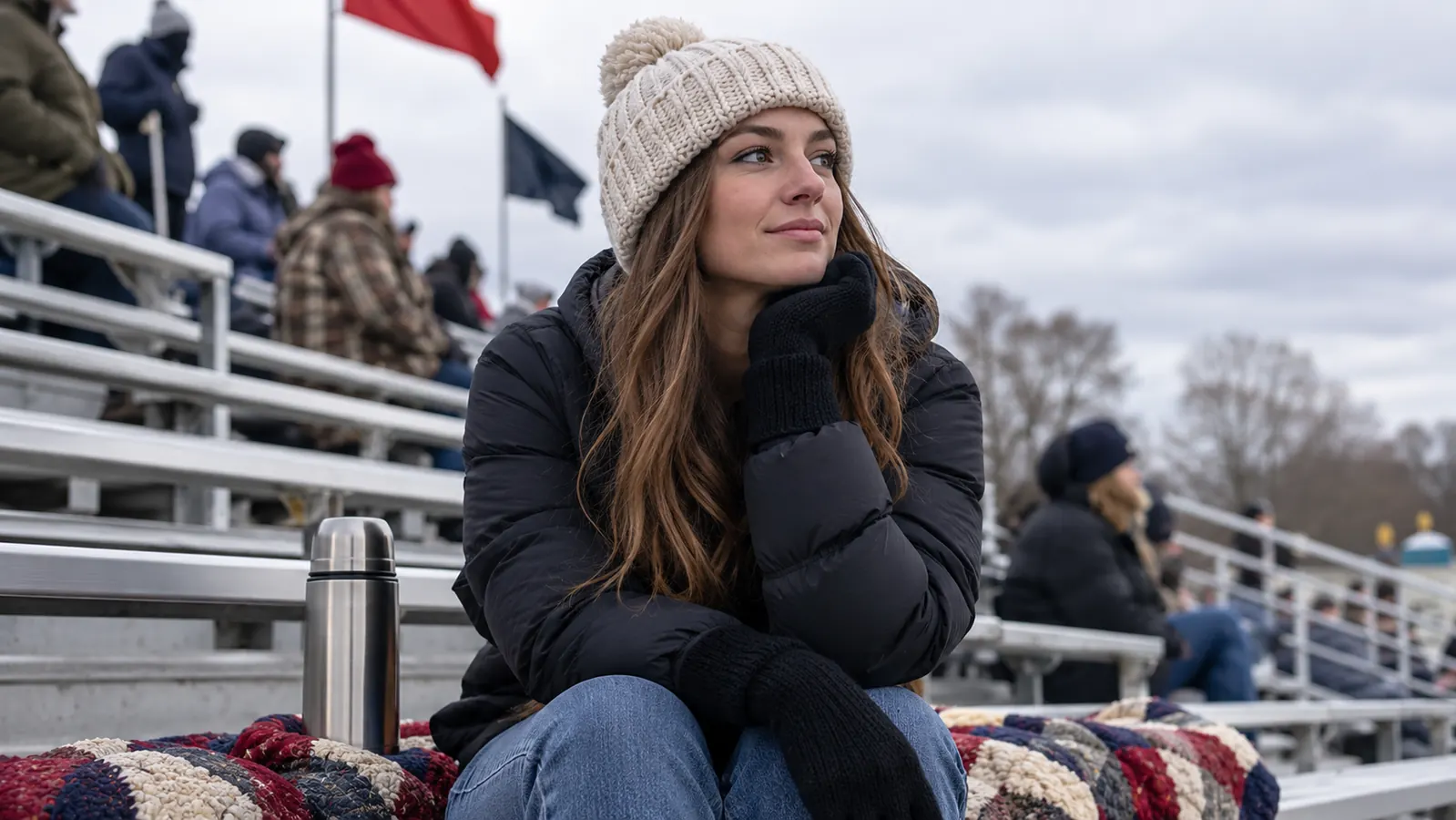
Two blankets live in my house and they do not do the same job. One is a plain fleece throw folded over the back of the couch in the den, the one Joan pulls over her knees when a baseball game runs long. The other is a DOWN UNDER OUTDOORS waterproof stadium blanket that rides in the truck from the first Friday night in September until the last cold Saturday in December. Both are soft. Both are warm inside a house. Only one of them has ever kept me dry on wet aluminum.
The short answer: in a stadium, in wind, on cold metal, take the stadium blanket. On the couch, over Joan's legs during a late inning, the fleece throw is the better blanket and it is not close. Everything after this paragraph is the reasoning, because which one you should own depends on where it will spend most of its life.
The Two Blankets, Side by Side
A regular fleece throw is a single layer of brushed polyester, usually around 50 by 60 inches, made to look good draped over furniture. The DOWN UNDER OUTDOORS blanket is a quilted polyester quilt with a 350 GSM fleece face, a waterproof layer, and a stated weight of 3.1 pounds in an X-Large size. One is furniture. One is equipment. Here is how the two line up on the things that matter once the temperature drops and the wind picks up.
| DOWN UNDER OUTDOORS | A regular fleece throw | |
|---|---|---|
| Wet bleacher seat | Waterproof backing keeps damp aluminum off you and keeps the fleece from wicking it up | Soaks through in a drizzle and passes the wet straight to your trousers |
| Wind | 3.1 pounds of quilted polyester that hangs on to a shoulder | Light enough that a gust peels it off your lap |
| Layers staying put | Ultrasonically quilted, so the two layers cannot slide against each other | Lining bunches into a wad at your feet within twenty minutes |
| Free hands | Toggle and loop let you wear it like a cape | You hold it closed with one hand all afternoon |
| Coverage | X-Large covers two adults shoulder to shoulder | Lap sized, one person, and not a tall one |
| Packing | Stuff sack with a carry handle and a shoulder strap | Rolls into a tote with no strap and no shape |
| Softness on bare skin | Quilted face against the neck, and you feel the seams | Brushed fleece, softer at the neck and wrists than any quilt |
| Weight in the bag | 3.1 pounds plus the sack | Light enough that you forget it is in the tote |
| Drying after a wash | Machine washable, then a day on the porch rail because the backing holds moisture | Machine washable and dry before the next load finishes |
| Around the house | Doubles as a quilt on a cold porch evening | That is what it was built for, and it is good at it |
Where the DOWN UNDER OUTDOORS Blanket Wins
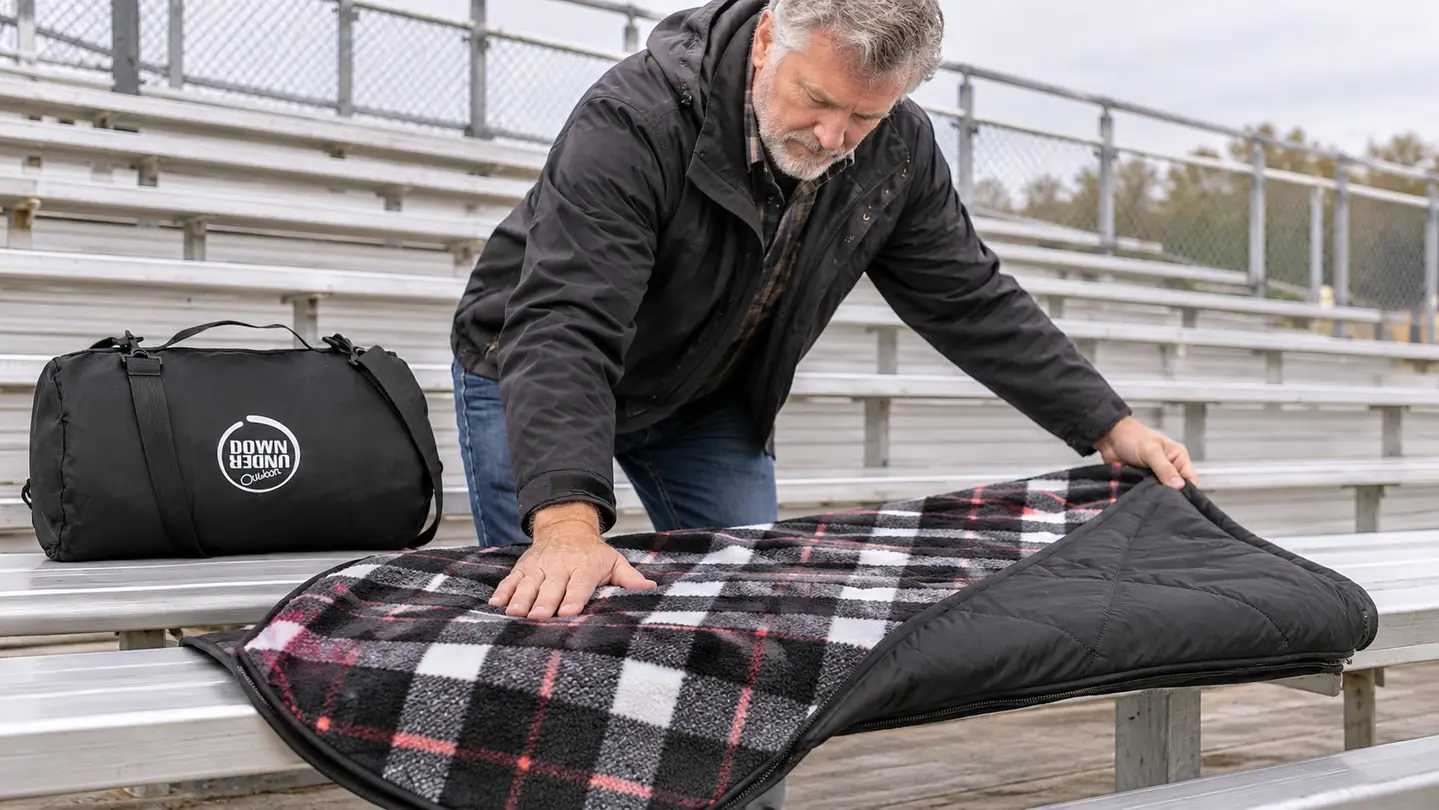
Weather is the whole argument. The game I keep pointing to was the second Saturday in November, kickoff at eleven in the morning, mist since dawn and a wind out of the northwest that never let up. The bench had been rained on since morning and nobody in my row was dry below the waist. The week before I had tried a folded moving blanket, the quilted pad kind that comes off a shelf at a hardware store, and it slid off the aluminum twice before the first quarter ended. So I laid this one over the bench, sat on it for three hours, and stood up with dry trousers. The waterproof backing does that work, and it also stops the damp from wicking up into the fleece while you sit. There is a pocket sewn into the waterproof side for a phone and keys, which matters more than it sounds like it should when your hands are already full of a thermos and a program.
Wind is the second argument. The blanket is ultrasonically quilted, which means the two layers are bonded across the whole surface and cannot slide against each other. With an ordinary throw, the lining bunches into a wad at your feet before the first quarter is over. This one stays flat. At 3.1 pounds it is heavy enough to hang on to a shoulder when the wind comes across an open concourse, and still light enough that Joan carries it in from the truck herself without handing it back to me at the gate. I have walked in from the far lot with it over one shoulder and a thermos in the other hand and never once had to stop and re-fold it on the way.
The toggle and loop are the upgrade I did not know I wanted. The blanket can be worn like a cape, which frees both hands for a thermos, a program, or the railing on the stairs. I used it that way on the sideline more than in the stands, standing there with a clipboard under one arm and both hands free to blow on. It sounds like a small thing until you have spent an afternoon holding a blanket closed with one hand. When the game ends it goes into the stuff sack, which has a carry handle and a shoulder strap, so it is one bag over the shoulder instead of a bundle under one arm. The strap is the part I use most, because it leaves a hand free on the concrete stairs. In X-Large it covers two adults sitting shoulder to shoulder, and I have done exactly that with Kyle home for a weekend.
Ultrasonically quilted so the two layers cannot slide, 3.1 pounds in a stuff sack with a shoulder strap, and a waterproof backing between you and a wet bench. That is the entire case.
Where a Regular Fleece Throw Wins
Comfort, first. A brushed fleece throw is softer at the neck and the wrists than a quilted blanket will ever be, because there is no quilting line and no backing against your skin. Sitting indoors, that softness is the thing you notice every single time you use it. Joan keeps one folded on the left arm of the couch from October to April, and when a game goes fourteen innings she is under it from the seventh. The stadium blanket is comfortable the way a jacket is comfortable, not the way a throw is.
Weight and drying, second. A throw disappears into a tote bag. The stadium blanket is 3.1 pounds plus the sack, and after a wash the quilted body and the waterproof layer take longer to line dry than a single layer of fleece does. It is machine washable and mine has been through the machine more than once, but it is an afternoon on the porch rail, not an hour. A throw is dry before the next load is finished.
And honestly, the throw is better at the job it was built for. It lives on the back of the couch, it comes off without a thought, and if it picks up a grass stain at a backyard cookout nobody cares. Mine has survived a decade of Sunday afternoons and one very unfortunate bowl of chili.
The blanket that stays in my truck from September to December
Waterproof backing, ultrasonic quilting, 3.1 pounds, and a stuff sack with a shoulder strap. If you sit outdoors in cold weather more than a few times a year, this is the one that ends up getting used. Rated 4.7 by nearly 4,000 buyers.
Amazon Check Today's Price on Amazon →The November Test, Three Seasons In
I have used this blanket through three cold late-season games and a handful of Friday nights when I was on the sideline rather than in the stands. The night that settled it was a Friday in late October, forty-one degrees at kickoff and dropping through the thirties by the fourth quarter, with a steady wind out of the north and a light mist that came and went. The pattern I keep coming back to is that the difference between the two blankets shows up around the two-hour mark. For the first hour a fleece throw is perfectly fine. Somewhere in the second hour, once the sun is off the stands and the wind has shifted, the throw stops helping and starts reminding you that it is a couch item. The quilted blanket is still doing its job at hour three.
The other thing I noticed is that I stopped carrying a second blanket. That first season I brought both, spread the fleece over my legs and sat on the stadium blanket. By the second season the throw stayed home, and by the third I had stopped thinking about it entirely. That is not a knock on fleece. It is just what happens when one item covers the seat, the legs and the shoulders, and the other one covers the lap.
For what it is worth, roughly 3,991 buyers have rated it 4.7 out of 5, and the complaints I read through were mostly about drying time and the size of the sack, not about the blanket failing in the cold. That lines up with what I found.
How Each One Washes
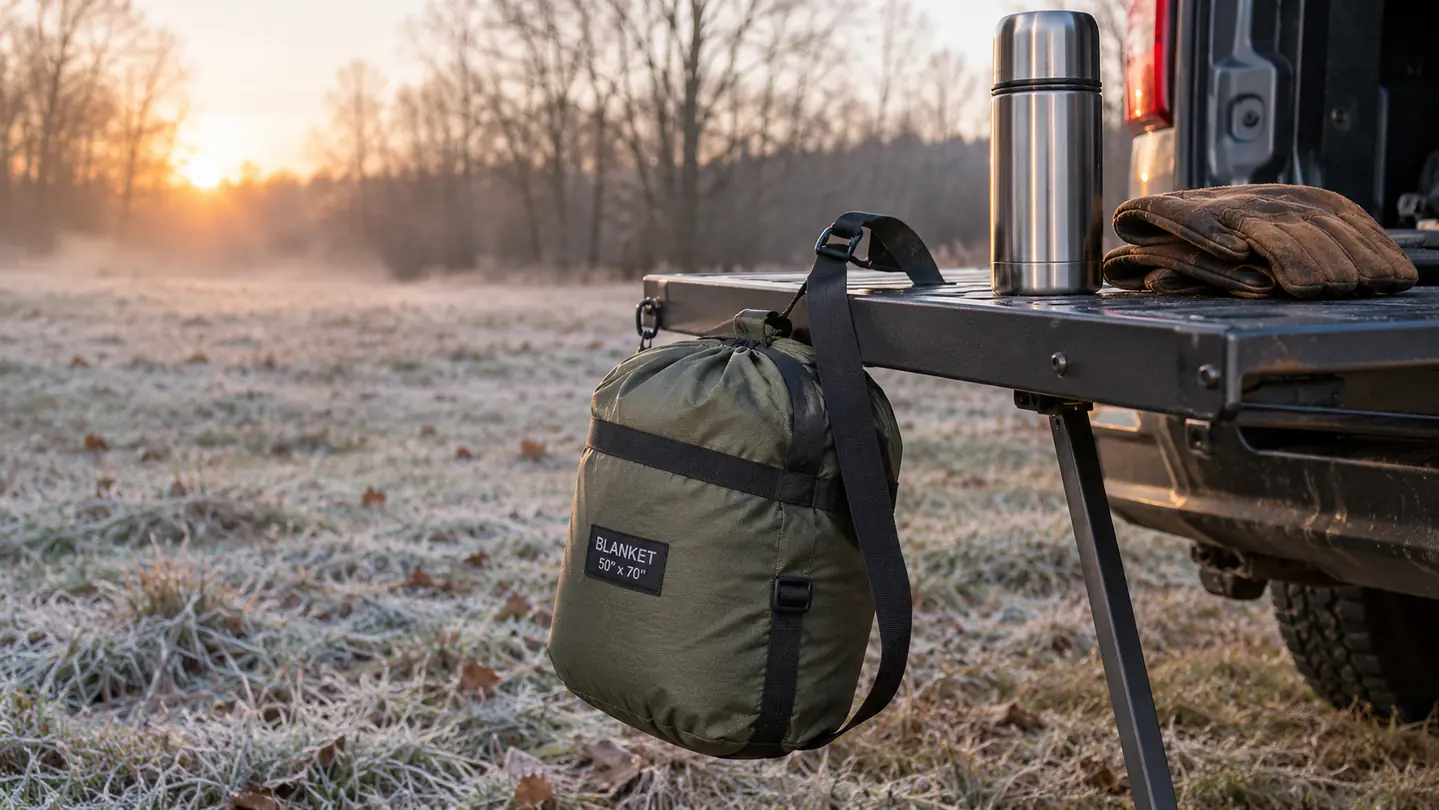
The fleece throw gets tossed in with the towels and comes out the same. The stadium blanket is machine washable as well, and the quilting holds through a cycle, which is the part I was skeptical about. I washed mine on a Saturday morning in October, hung it over the porch rail at nine with the waterproof side out, and brought it in around four. What takes time is drying. The waterproof layer and the quilted body hold moisture longer than one layer of fleece, so give it the day rather than the hour. Do that and it comes back flat and square with no bunching at the edges.
One caution from experience: do not leave either one compressed in a bag while it is damp. The fleece throw will smell like a gym bag. The stadium blanket will do the same, and because the waterproof side keeps air off the fabric it is a little worse. Pull it out, hang it, and pack it the night before the next game.
What About the Other Options
I have tried the mylar emergency blanket that folds into a pocket. It reflects heat, it weighs nothing, and it crinkles like a chip bag, traps no moisture, and tears the first time it catches a bleacher bolt. That is a thing to keep in a glove box for an emergency, not a thing to sit on for three hours.
A sleeping bag is warmer than either one and useless as a seat. You cannot sit on a bag and wear it at the same time without looking like you are in a cocoon, and getting an arm out to reach a thermos is a project. The quilted stadium blanket sits between those extremes, which is why it ends up being the one that gets used in my house.
Where People Get This Wrong
The mistake I see most is buying a stadium blanket for the couch and then deciding stadium blankets are overbuilt. If it never leaves the house, of course it feels like too much blanket. The second mistake is the reverse, hauling a decorative throw to a November game and concluding that nothing works. Neither product failed. Both were used in the wrong room.
The third mistake is buying one blanket for a family. In X-Large this one covers two adults comfortably. Three is a negotiation. If the whole family goes, you want one per two people, and the cape toggle settles most of the arguing about who has the corner.
Who Should Buy Which
Buy the DOWN UNDER OUTDOORS stadium blanket if you sit outdoors in cold weather more than a few times a year. Season ticket holders, parents on the sideline at a Saturday morning youth game, anyone whose team plays into November, and anyone who has ever stood up after a game with a wet backside and a damp coat. It is also the better pick for a cold, wet baseball night in early April, which in Kansas is a real thing and not a figure of speech. It handles wind, wet seats and three hours without needing to be adjusted.
Buy a regular fleece throw if the blanket is going to live indoors. Movie nights in the den, a game on the porch radio on a cool evening, a lap blanket for Joan while the innings run long. It is softer, lighter, dries fast, and costs a fraction of what a stadium blanket does. There is no shame in that purchase. It is a good blanket for a house.
One blanket for the seat, the legs and the shoulders
The fleece throw still lives on the couch, and it should. The one that goes to the truck every Friday night is this one. Waterproof, quilted, machine washable, with a pocket for your phone and a sack with a shoulder strap.
Amazon See It on Amazon →