
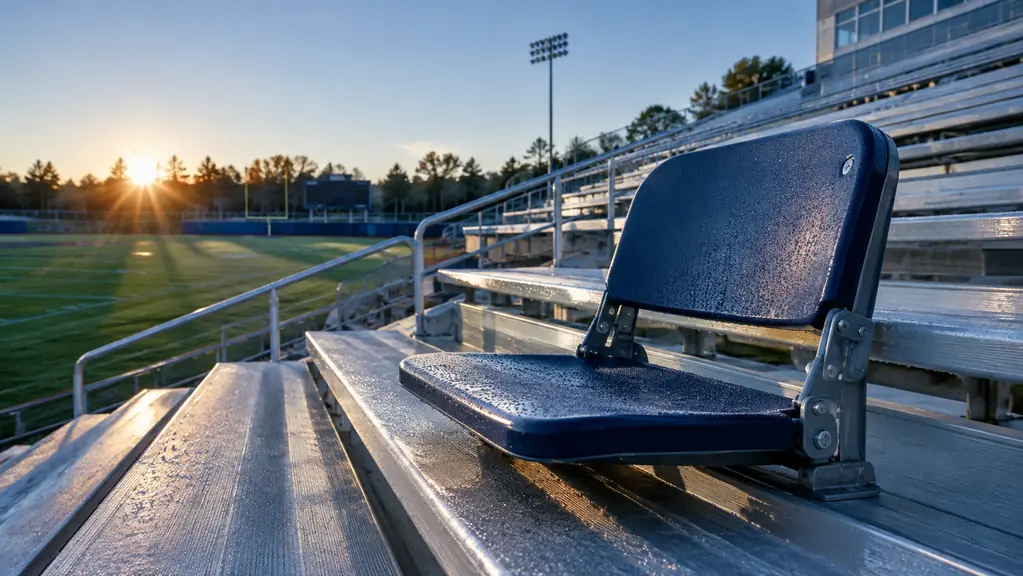
Three folding stadium seats are stacked in my garage right now, and two of them are junk. The third is the SPORT BEATS stadium seat with back support, and I have spent two seasons and a lot of cold afternoons in it, which is the only reason I feel qualified to say anything useful about it. I am 61, I taught history for thirty years and coached on the sideline for a good chunk of that, and my back has met a great deal of aluminum.
This is not the version of the review that lists every feature in the order the box does. You can read the listing for that. This is the version I wish somebody had handed me before I bought the wrong seat twice: what this thing actually fixes, what it quietly does not fix, and the handful of details I would want to know before I bought a second one for Joan.
Because here is what nobody puts in the product photos. The cushion is the easy part. Any decent foam pad keeps cold aluminum off you for three hours. The backrest is the hard part, and the backrest is where every one of these seats makes a different compromise, because a tall supportive back and a seat that folds flat enough to carry under one arm are pulling in opposite directions.
The Quick Verdict
A sturdy, genuinely supportive bleacher seat that folds flat and carries easy. The backrest is real support and not a recliner, and tall fans should check the sizing numbers before they order.
Amazon Check Today's Price →The seat that ended a two season search
Folds flat, carries on one shoulder, and puts a solid back between you and the bench. Sizing and today's price are on the listing.
Amazon Check Today's Price on Amazon →What Nobody Tells You Before You Buy One
The first thing is that these seats are sized to the bleacher and not to you, and the two sizes are not cosmetic. The Regular is 17 inches wide, 12 inches deep and carries a 16.5 inch backrest. The Large is 18.5 inches wide with an 18.5 inch backrest. If you are a broad shouldered adult and you order the Regular to save a little weight, you will feel the difference by the second quarter, and you will spend the rest of the game noticing it.
I found that out the hard way. Before I ordered the Regular I took a tape measure out to the garage and put it across the bench of the old wooden bleachers behind the middle school, the ones I coached from for years. Seventeen inches sat inside the bench line with a little room to spare, and the 12 inch depth left my heels on the row below instead of hanging. That measurement is the one I would give anybody: measure the bench, not your sofa. If your bench is narrow or has a lip on the front rail, set the seat down before the row fills up and see how it sits. It took me one game to learn that a seat which does not sit flat is worse than no seat at all, because you spend three hours bracing with your legs instead of watching the game.
The second thing is the weight rating. The steel frame is rated to 250 pounds, which sounds generous until you remember that a folding frame with a solid back takes a load differently than a flat pad does. Mine has not creaked once, and I am not a small man. But if you are close to that number, treat it as a ceiling and not a suggestion, because that is exactly what the manufacturer is telling you.
The third thing is the cold, and this is the one that separates a seat you use from a seat you leave in the truck. Foam firms up in November. A 2.8 inch high density cushion will feel different at 30 degrees than it does in September, and no folding seat on the market fully solves that. What this one does is keep the metal away from you and give you real thickness to sit on, which is most of the fight.
How I've Actually Used It
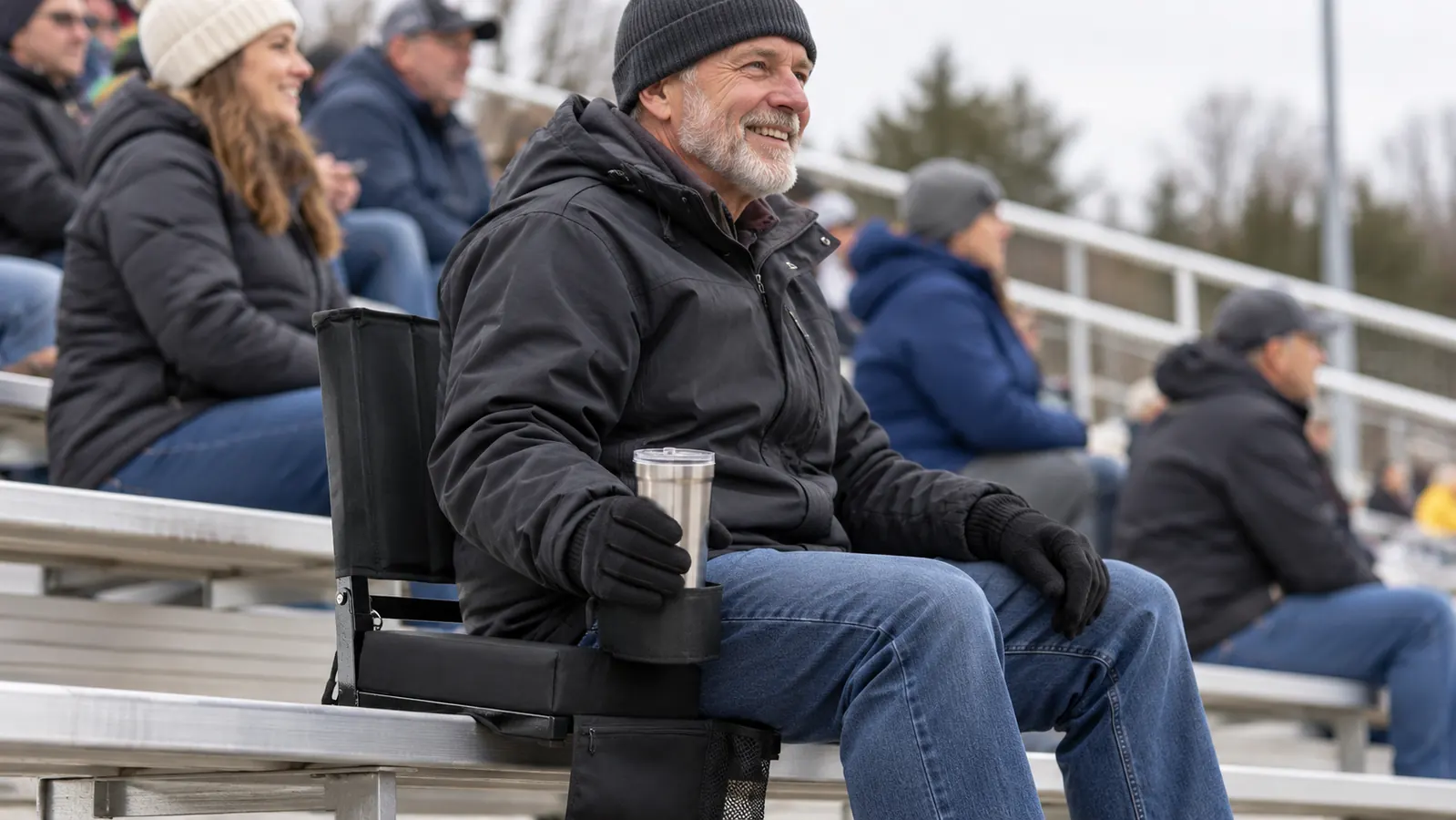
I have used it for home football games in the cold, for a pair of summer baseball games where the only seating was a set of bleachers, and once on a hard gymnasium floor at a school function, because the listing says hard floor and I wanted to know whether that was marketing or fact. It was fact.
One of the baseball games is worth describing because it was not a stadium at all. It was a summer evening doubleheader at a small ballpark where the seating is a set of uncovered aluminum planks, the kind that has been there since the 1970s, and the first pitch was a little after six and the last out came close to ten. Four hours on a plank that has no give in it. About the sixth inning of the second game I noticed I was still sitting up straight, and the man next to me, who had brought a towel folded under himself, was already standing in the aisle. Between games I carried the seat over to the concession stand with the strap on my shoulder and did not think about it once. That is the whole test of a portable seat, honestly. It should disappear between uses and only exist when you sit down.
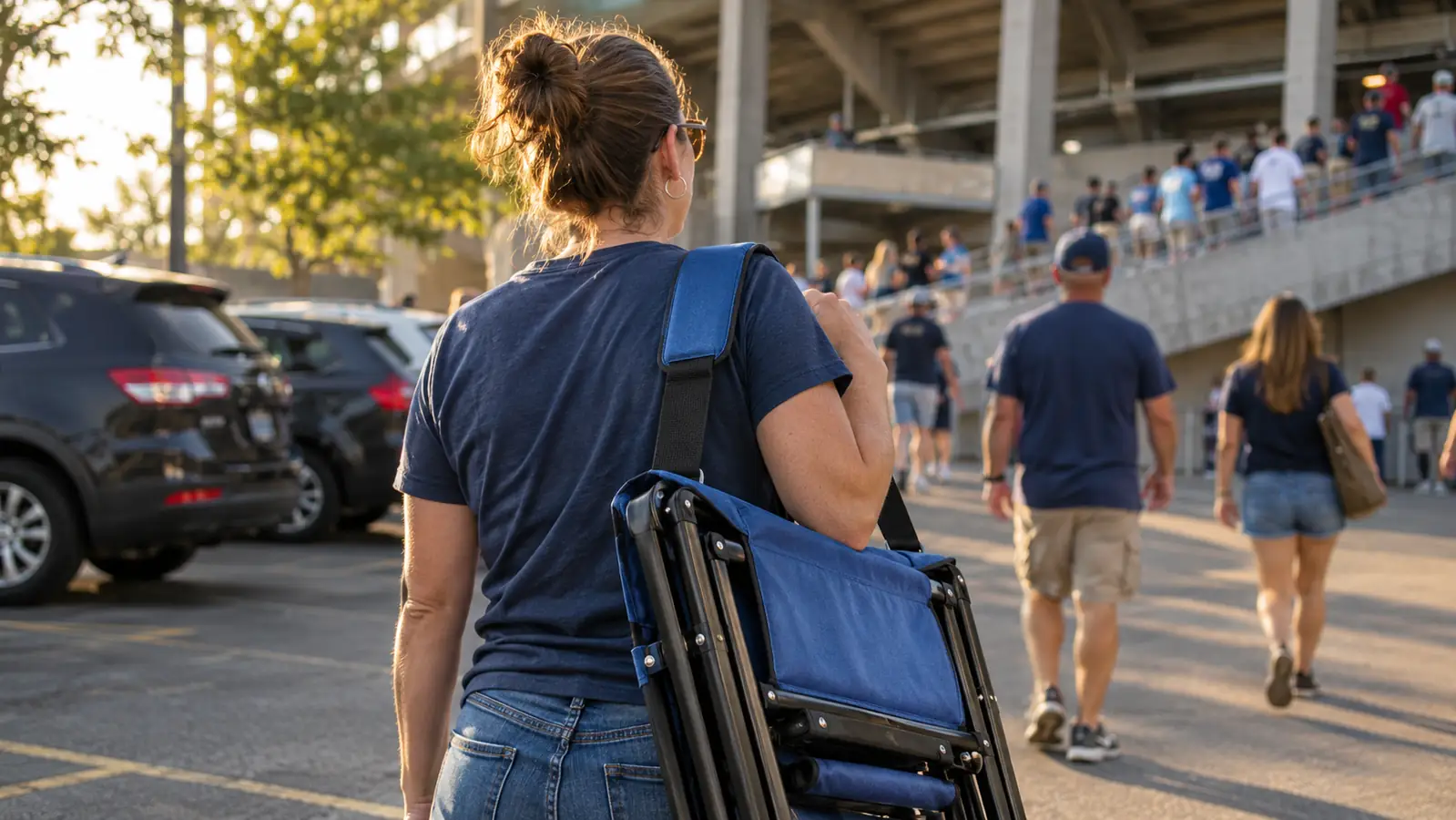
The SPORT BEATS seat folds flat, and I mean flat enough that it slides behind the truck seat and I forget about it until I need it. The padded strap is adjustable and the seat carries hands free on one shoulder, which matters when you are also hauling a jacket and a thermos. At 6.6 pounds for the Regular it is not weightless, but it has never once made me wish I had left it home.
The cup holder is the feature I assumed would be useless and I use it every single game. It holds a normal cup and it does not tip when the row in front of you stands up. There is also a pocket under the seat for a phone, keys and a program, plus a built in handle for the short carries. That pocket gets more use than I expected, because bleacher rows are not built for a man with a phone, a wallet and a paper program.
The Backrest Is the Whole Point
Let me be plain about what the back support is. This is not a chair. It is a folding seat with a solid back, and on the Regular the back rises to roughly the middle of my shoulder blades. That is enough to stop the slouch that used to put my lower back in knots by halftime. It is not enough to lean back into and relax. If you buy it expecting a recliner, you will be disappointed, and it is better to know that now.
For me the height is exactly right. The ache I used to get was never really from sitting. It was from sitting badly, hunched forward with nothing behind me for three hours. A solid back at shoulder blade height fixes the hunch, and fixing the hunch fixed the ache. That is a narrow, specific benefit and it is the entire reason I keep carrying this thing to games.
The seat also locks open, which sounds minor until you have had a folding seat collapse under you on a bleacher. That happened to me once with a cheaper seat, and it is why that seat lives in the garage now. The lock on this one has not slipped in two seasons, including on a bench that was not perfectly level.
A Cold November Game, in Detail
The game I keep measuring this seat against was a late season football game, temperature in the twenties with a wind coming across the open end of the stadium. I got there early, set the seat down, locked it open and sat through pregame, four quarters and a delay. Three hours and change. My back was fine at the end. My hands were not, but that is a glove problem and not a seat problem.
The delay was a weather one, twenty minutes with the teams off the field and the PA telling everybody to stay put, and this is where a seat with a back earns something a pad cannot. People around me got up and walked the concourse to keep warm. I stayed, because sitting still with my back supported in cold weather is a lot more tolerable than standing around in it. I ate a sandwich I had in my coat pocket, drank the coffee I had in the cup holder, and watched the ground crew work. When play resumed I was not stiff, which at 61 is not a small thing. The only part of me that complained by the end was my feet, and that is because I wore the wrong boots and not because of the seat.
What I noticed most is that I stopped shifting. With a flat pad I move around constantly, trying to find an angle that does not hurt, and by the fourth quarter I am standing for no good reason. With a back behind me I sat still. Sitting still for three hours in the cold is worth more than any cushion feature on a spec sheet, and it is not something the listing can tell you.
The one thing I would change for a game like that is a second layer under me, which is not a knock on the foam. It is just physics. Cold travels through anything you put on aluminum. If you go to games in real winter weather, plan on dressing for the bench and let the seat handle the support, and it will do that job all afternoon without complaint.
What I Liked
- A solid back that actually stops the halftime slouch
- Folds flat and carries hands free on a padded, adjustable strap
- Cup holder and under seat pocket that get used every game
- Seat locks open and has not slipped in two seasons
- Steel frame feels solid at 6.6 pounds for the Regular
Where It Falls Short
- Backrest is shorter than tall fans will want
- Foam firms up in genuine cold weather
- Folded width still takes some room in a packed row
- Six month warranty is short for gear that lives in a vehicle
The ache I used to get was never really from sitting. It was from sitting badly, hunched forward with nothing behind me for three hours.
The Details That Held Up, and the Two That Did Not
Two seasons in, the stitching has held everywhere it matters. The foam has not flattened into a board. The strap has not frayed at the anchors, which is where cheap seats go first. I wipe it down with a damp cloth after a muddy game and it comes clean without any fuss, and I have never had to do more than that. The SPORT BEATS frame still folds and unfolds without catching on itself.
The fabric has picked up two marks I cannot get out, both from a bench I set it on in a parking lot and not from a game. Neither one is a hole, and neither one has gotten any bigger in a year. What I have learned is to keep it out of the direct sun when it lives in the truck, because the foam and the fabric both take heat badly over a whole summer. I now bring it inside after the season ends and leave it on a shelf with my old ticket stubs and the signed balls, which sounds sentimental and is really just me wanting the thing to last. Wiped down, folded, stored indoors, it has come through two seasons looking close to the way it did in the first month.
The one thing that has stretched is the fabric around the cup holder rim, because I kept forcing a travel mug into it that was a little too wide. That is on me and not on the seat. The other small annoyance is the folded footprint. It folds flat but it is still 17 inches across, so in a packed row it takes some maneuvering to slide under the bench when the game ends.
The warranty is six months, and I will say plainly that this is the number I like least. Nothing has gone wrong with mine, but six months is a short window for a piece of gear that lives in a vehicle and gets sat on by adults. Treat the first month as your real test, use it hard at home before you trust it at a game, and you will know exactly what you have.
One more honest note on fit. This is built for standard bleachers and hard floors, and that is where it shines. On a bench with a raised rail along the front edge, or a bench that is unusually narrow, the 12 inch depth means you should set it down and check before the crowd fills in. It has fit every bench I have tried it on, but I check anyway.
Why a Cushion Alone Was Not Enough
I started with a plain foam cushion, the kind that folds into quarters and lives in the trunk. It solved the cold and did nothing for my back, because a cushion by definition has no back. I spent two seasons making that trade before I admitted it was a bad one. The difference between a pad and a seat with a solid back is the difference between not being cold and not being sore.
The middle option is a seat with a soft or frameless back, and I tried one of those too. It was better than the pad and it still let me slouch, because a back that bends with you does not hold you up. The solid back on this one is the part that does the work. That is the whole argument, and it took me two purchases to believe it.
Who This Is For
This is for the fan who goes to a handful of games a year and comes home with a back that hurts for two days. It is for the parent who spends a Saturday on aluminum at a youth game. It is for the coach or the former coach who still shows up early and stays late. If your problem is the bench and not the weather, this is a direct answer to it.
Who Should Skip It
Skip it if you are tall enough that a 16.5 inch backrest lands in the middle of your back instead of at your shoulder blades. Order the Large, or look for a genuinely tall back. Skip it if you want to lean back and doze between innings. Skip it if you stand all game, because you will be carrying six and a half pounds around for no reason at all.
And skip it if you want one seat that does everything. This handles bleachers and hard floors well. It is not a camp chair, it is not a replacement for the rental seats at a ballpark, and it is not trying to be. It is a good answer to one specific problem, and it is honest about that.
Two seasons in, it is still the seat that lives in my truck
If your back is the reason you stopped enjoying the bleachers, this is where I landed after buying the wrong thing twice. Check the size chart before you order, especially if you are tall.
Amazon Check Today's Price on Amazon →