
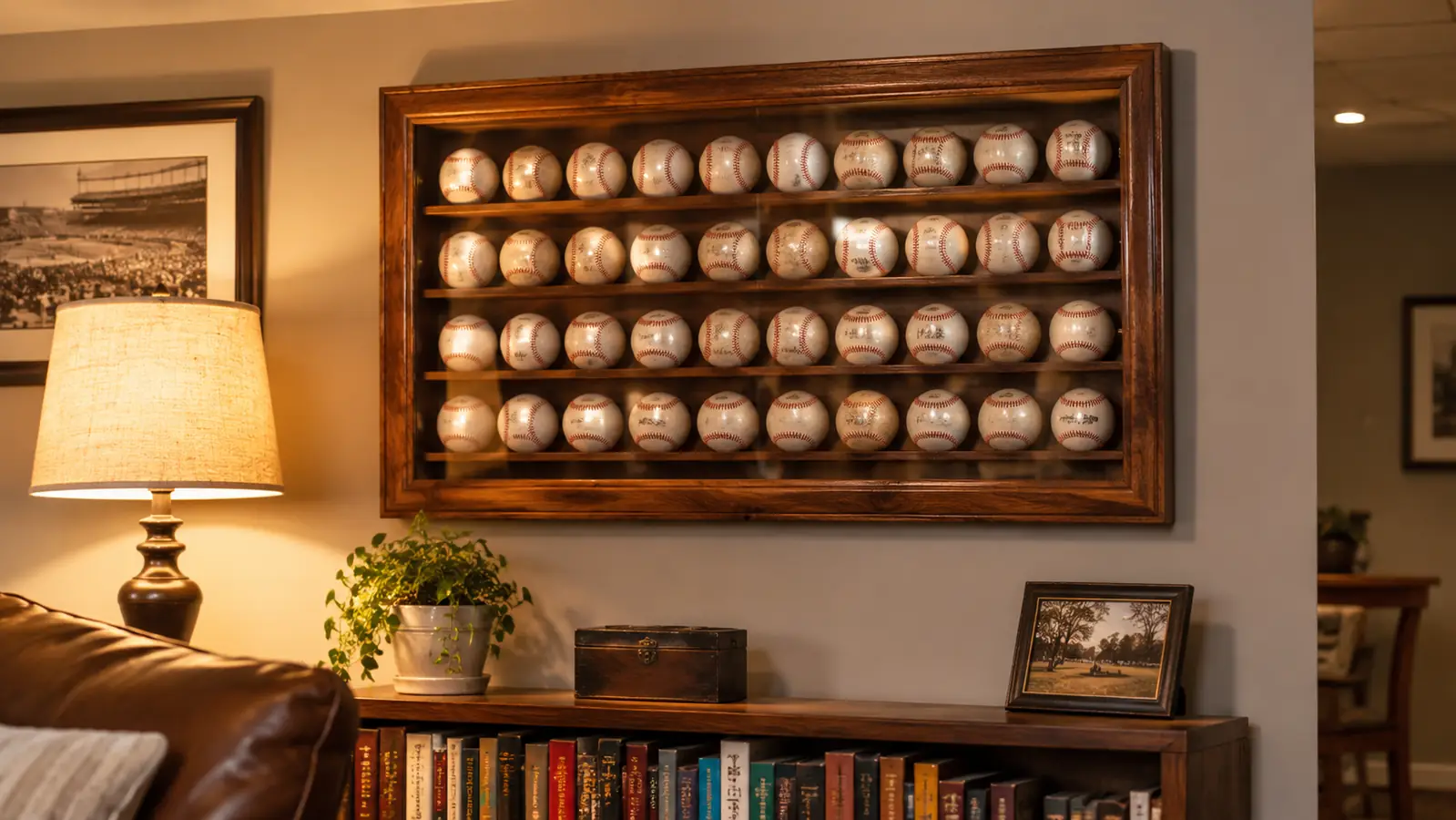
I had thirty-one signed baseballs in a cardboard box under the basement stairs for eleven years. Not because I stopped caring about them. Because every display option I looked at asked me to make a decision I was not ready to make, which was to rank my own collection. Put the good ones on the wall, leave the rest in the box, and quietly admit the box was the real home for most of them.
The DisplayGifts 21-slot wall case took that decision away. Twenty-one spots in one rectangular frame, 19.25 inches long and 17.75 inches tall, and the question stopped being which balls deserved the wall. It became whether I had enough wall. Six months after I hung it, I have a firmer opinion than I had the morning I measured the studs.
The Quick Verdict
The first wall case I have owned that behaves like furniture instead of a souvenir. Real capacity, a deep interior that keeps the door off the leather, and a locked acrylic front that solves a problem I did not know I had until my brother-in-law started coming down for games.
Amazon Check Today's Price →Get Twenty-One Balls Off the Shelf and Onto the Wall
Same case, same 21 slots, 19.25 by 17.75 inches of finished hardwood and a 98% UV rated acrylic door. Check the current price and the finish options before you measure your wall.
Amazon Check Today's Price on Amazon →How I've Used It
I hung it myself on a Saturday morning, on the den wall between the television and the doorway, at about eye level when I am standing. The mounting hardware came in the box. The frame is hand selected hardwood and the whole unit weighs 7.5 pounds, so it is not a two-person job and it is not going to pull a wall apart. I measured twice because the case is 19.25 inches long and 17.75 inches tall and I wanted it centered over the low bookshelf, and then I was done before the coffee went cold.
What I did not expect was how much the size changed the room. A single-ball cube on a shelf is decoration. A case that is a foot and a half wide and holds twenty-one balls is furniture. Before this I tried three individual acrylic cubes lined up on the bookshelf, and between them they never held more than three balls. They also looked like something off a gift shop counter, and the spacing was never right no matter how many times I nudged them back into line. The wall case reads as a collection instead of a souvenir, and it gave the den a wall that finally looked intentional instead of like a place where things got set down.
Filling it took longer than hanging it, and that was the good part. I laid all thirty-one balls out on the pool table, wiped each one down, and spent an hour deciding which ten went back in the box and which twenty-one went up. Home run balls. A couple from games I went to with Kyle before he moved out of state. A few signatures I cannot read and would not trade. Joan came downstairs, looked at the layout, moved four of them, and she was right about all four. The one I had put dead center, a scuffed ball from a cold November game, ended up in the bottom row, which is exactly where it belonged.
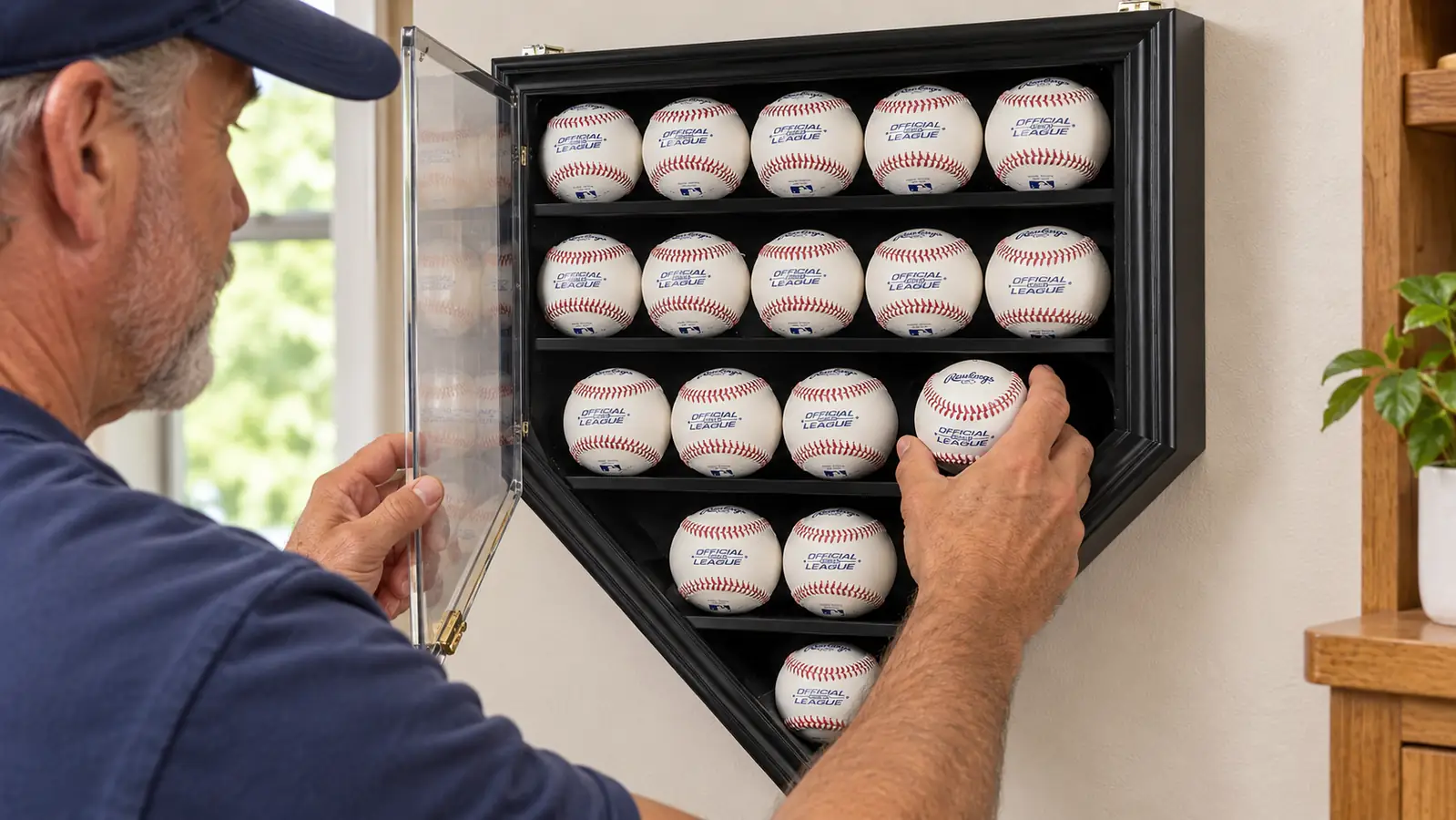
What 21 Slots Actually Holds
I own baseballs of different ages and conditions, and the practical question with any wall case is whether the slots are sized for real balls or for perfect ones. Twenty-one compartments on a 19.25 by 17.75 frame means each ball sits in its own slot, and the ones with a scuffed cover or a slightly yellowed panel fit the same as the clean ones. The ball with the cover worn smooth on one panel slides in and sits straight like the rest. Nothing rolls. Nothing leans on the ball beside it.
Depth is the other thing, and nobody talks about it. The DisplayGifts case is 3.7 inches deep, which is more than a baseball needs, so there is real clearance between the ball and the door. I put a tape on it in March out of curiosity and the front of a ball sits well back from the panel. That matters more than it sounds. A shallow case presses the acrylic against the leather and after a few summers you get a flat spot or a mark right on the sweet spot of a signed ball. I have none of that, and I check.
Twenty-one is also a number that fits a real collection instead of a curated one. Most wall cases sold to fans hold six or twelve balls, which forces you to rotate. I rotated for a decade, and what that actually meant was that I looked at the same six balls while the other twenty-five sat in the dark under the stairs. Now the whole thing is out at once. Even the balls I care less about are visible enough that a visitor can point at one and start a conversation, which is the entire reason to have them out. A neighbor who has never watched a full inning spent ten minutes in front of it in February asking about the scuffed one on the bottom row.
The UV Door and the Anti-Fade Question
Autograph fading is the slow tragedy of this hobby. I have one ball that proves it. It sat on a windowsill in the front room of our old house for six years before we moved, and the signature went from a strong blue to a pale gray you have to tilt toward the light to read. I keep it in the box now as a reminder of what a west-facing window and a few summers will do.
DisplayGifts rates the door at 98% UV protection with high transparency, and the frame carries an anti-fade lacquer finish. I cannot verify a percentage in my own basement with my own eyes and I am not going to pretend I did. What I can tell you is how the door behaves. It is a shatter proof acrylic panel, not glass. It is clear enough that I can read a signature from across the room, and it does not have that faint green edge you see on cheap panels when the lamp hits it from an angle.
Acrylic over glass was the right call for a basement in Kansas. Glass in a wall frame over a concrete slab is one bad bump away from a very bad afternoon. I have a nephew who proved that with a framed jersey and a broom handle. Acrylic takes a knock, and if it ever does fail it does not rain shards onto twenty-one signed baseballs, which is the whole point of putting them in a case in the first place.
The honest caveat is that acrylic scratches and it attracts dust like a magnet. You clean it with a soft cloth and nothing aggressive. I have one faint mark near the lower corner where I got careless with a paper towel in month two. It is only visible when the lamp is on and I am looking for it, but it happened, and it will happen to you if you treat the door like a window.
Hardwood, Locks, and Living on a Basement Wall
The frame is hand selected hardwood with a lacquer finish, and after six months on a basement wall it has not swelled, split, or done anything dramatic with the humidity. Kansas is humid in July and dry in January, and I have watched enough furniture react to both that I pay attention to this now. The hygrometer down there read 68 percent in late July and 31 percent the first week of January, and the frame did nothing at either end. The miters at the corners are still tight, and the finish has not gone cloudy the way a cheap clear coat does.
The locks matter more than I expected. The case has locks on the door, and I first assumed that was theater for a display piece in a private room. Then Kyle came home for a weekend with two friends, and then my brother-in-law started coming down during games to look at the wall. A locked case turns a room full of people into a room where nobody is holding a signed ball by the cover with barbecue on their fingers. It is not a security system. It is a polite boundary, and it works.
Wall mounting is the other thing worth stating plainly, because it is where these purchases go wrong. The hardware is included, the unit is 7.5 pounds, and mine went into studs. If you have plaster or a wall you are unsure about, treat that as your project's problem and not the case's problem. A 7.5 pound case that is 19.25 inches wide has some leverage at the edges, and you want it anchored properly rather than hanging on drywall anchors and hope.
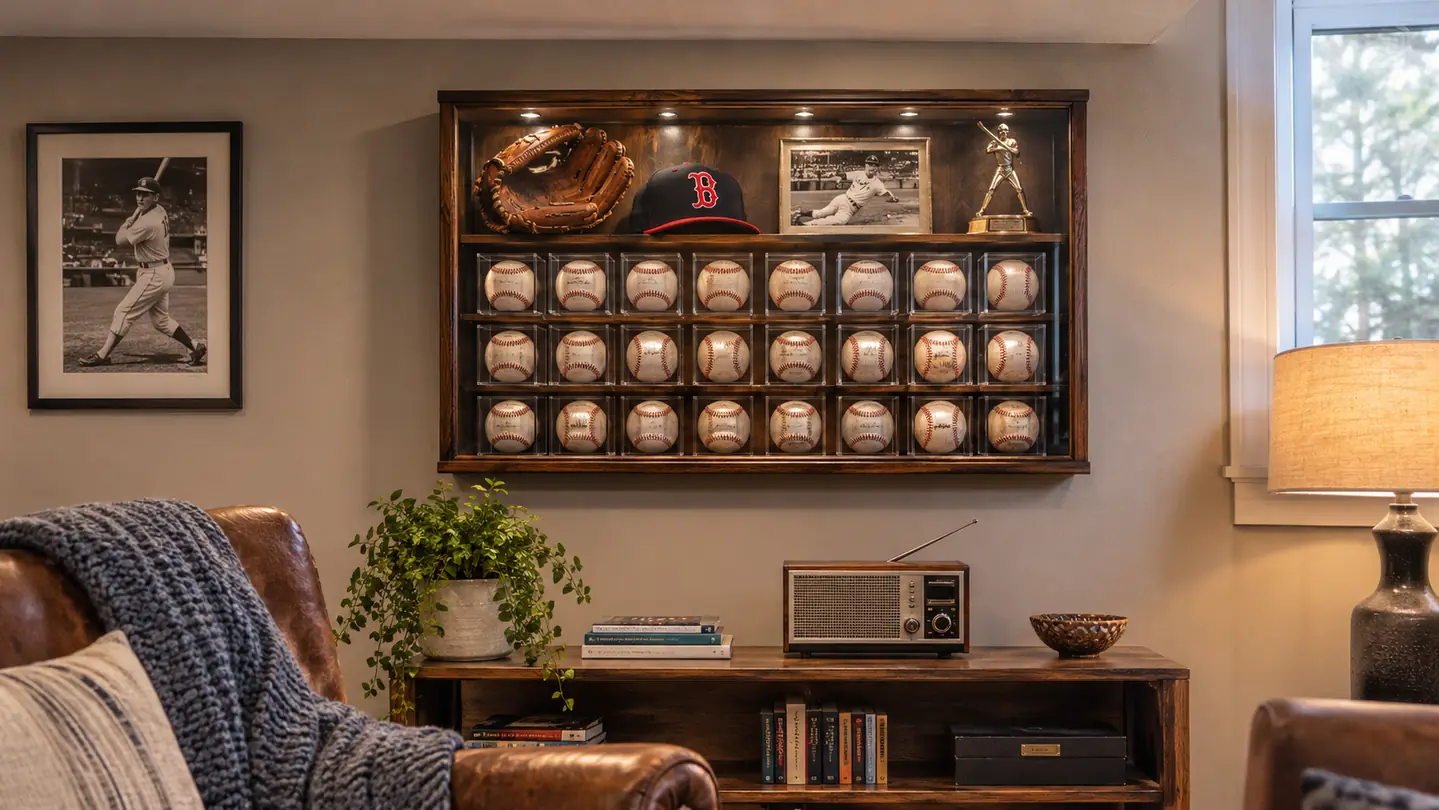
The Tradeoffs After Six Months
No case is perfect, and I would rather hand you the friction than sell you a fantasy.
First, filling twenty-one slots is a commitment. If you own eight balls, this case will look half empty, and the empty slots are visible because the interior is open behind the door. I would not buy this as a first display case. I would buy it when the box under the stairs has become embarrassing and you are ready to deal with all of it at once.
Second, the door. Every time you add or rearrange a ball, you are swinging a full-width acrylic panel open and you have to put it somewhere safe while you work. It is a two-hand operation. You should not do it in a hurry and you should not do it over a hard floor. I added two balls in April and I cleared the coffee table first, which tells you how I feel about it.
Third, dust finds the inside eventually, mostly working through the gap around the door. Twice a year I take the panel down and wipe the interior and the balls. Fifteen minutes with a soft cloth. Not a dealbreaker, and not zero either. I do it in April and again in October, the same weekend I change the furnace filter, so I do not have to remember it.
And the small one that is really about you and not the case: twenty-one is not thirty. If your collection keeps growing, you will eventually be right back to deciding which balls get the wall. That is the nature of a fixed case. The answer is a second case on the other wall, which is a problem I would be glad to have.
What I Liked
- Twenty-one slots in a single frame, so the whole collection goes up at once instead of six at a time
- 3.7 inch interior depth keeps the acrylic door off the leather and off the signature
- Door rated at 98% UV protection with high transparency and an anti-fade lacquer on the hardwood frame
- Locks on the door make it easy to keep visitors from handling signed balls
- Shatter proof acrylic panel instead of glass, which matters over a basement slab
- Wall mounting hardware included, and the unit weighs 7.5 pounds
Where It Falls Short
- Empty slots are plainly visible, so it looks wrong until you have a real collection
- The full-width door is a two-hand operation when you add or rearrange a ball
- Acrylic scratches if you wipe it carelessly
- Twenty-one is fixed, and collections tend to grow
I rotated for a decade, and what that actually meant was that I looked at the same six balls while the other twenty-five sat in the dark under the stairs.
Who This Is For
This is for the fan whose collection has outgrown the box. If you are somewhere north of fifteen balls, the math works and the wall starts earning its keep on day one. It is for the person setting up a den or a basement room who wants one piece that does the work of six small cubes, and who would rather hang a single 19.25 inch case than arrange a gallery wall of little boxes and get the spacing wrong three times. It is for the MLB fan with two decades of home run balls and the NFL fan with a handful of signed balls from cold November games that mean more than anything on a shelf.
It is also for anyone who has ever watched a signature go pale. If you have one ball already fading, the UV rated door and the anti-fade finish are the reason to stop waiting. And if you have people in your house who like to pick things up, the locks turn an awkward conversation into a non-event.
Who Should Skip It
If you own four baseballs, skip it and buy something smaller. You will be looking at seventeen empty slots for years, and empty slots do not flatter a wall. If you add one signed ball a year and you like the ritual of finding it a home, a case this size is a commitment you do not need yet.
Skip it if you want a display that disappears into the room. This one is a foot and a half wide, it is solid hardwood, and it is meant to be looked at. If your den is a shared space and the collection is supposed to be a quiet detail, this will be louder than you want. And if you are not willing to put it into studs or have somebody do that for you, do not buy any wall case yet. Solve the wall first.
If Your Balls Are Still in a Box Under the Stairs, This Is the Fix
Twenty-one slots, 19.25 by 17.75 inches of hardwood, shatter proof acrylic with a 98% UV rating, locks on the door, mounting hardware included. Mine has been up six months and the box is finally empty.
Amazon See the DisplayGifts 21-Ball Case on Amazon →