
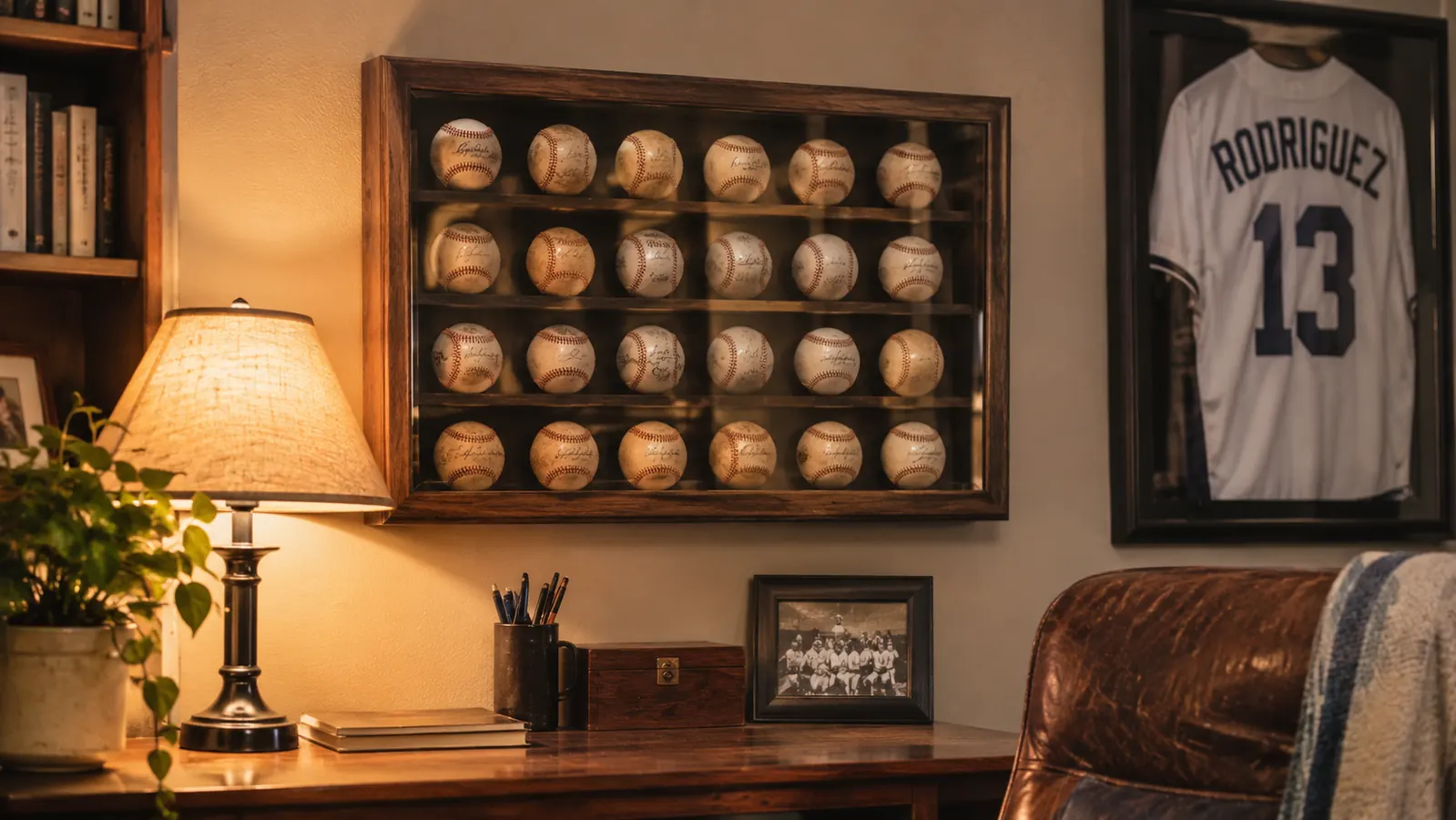
Nine signed baseballs sat in a cardboard box in my basement for three years. Not because I stopped caring about them. Because every time I walked past that shelf I could not decide how to show them, so they stayed in the box, which is the same as not owning them. I went two directions before I settled. First I bought individual acrylic cubes, two at a time, whenever I came home with a ball worth keeping. Later I swapped to a DisplayGifts wall case, the one with 21 slots, and hung it above the desk in the den. The box went out with the recycling that week. Both approaches are legitimate. They are just built for two different stages of a collection, and most people pick the one that fits the collection they have today instead of the one they will have in five years.
Short answer: if you already own more than a dozen balls, or you know you will, the wall case is the better buy and it is not close. If you own two balls and one of them came from a game your kid played in, cubes are fine and you should not talk yourself into a 21-slot frame. The rest of this is the reasoning, including the parts where the cubes win.
| DisplayGifts Wall Case | Individual Cubes | |
|---|---|---|
| Capacity | 21 baseballs in one frame | One ball per cube, added whenever you find one |
| Wall footprint | 19.25 inches wide by 17.75 inches tall for all 21 | Each cube needs its own spot, shelf edge or strip of wall |
| UV protection | Door rated at 98% UV protection, anti-fade lacquer on the frame | Most cube listings say nothing about UV one way or the other |
| Dusting | One door, one surface to wipe | Twenty one small interiors and twenty one dust catchers |
| Locking | The door has locks | The cubes I have owned have no lock at all |
| Looks as one piece | One hardwood frame, one finish, one thing on the wall | Cubes bought from different sellers do not match each other |
| Mounting hardware | Wall mount hardware included in the package | Each cube needs its own screw, strip or shelf space |
| Starting small | You commit to a 21-slot frame whether you own 21 or not | Buy two cubes for two balls and stop there |
| Empty slots | Unfilled slots are visible until the collection catches up | No holes, because you only own what you need |
| Carrying one ball to the porch | The case stays on the wall | A single cube goes wherever you go |
| Replacing damage | If the door takes a bad hit, you are dealing with the whole unit | A cracked cube is one cube |
| Best for | A collection already past a dozen and still growing | One or two balls with sentimental value |
What 21 Slots Actually Takes Up on a Wall
Numbers first, because this is where people guess wrong. The DisplayGifts case lists at 19.25 inches wide, 17.75 inches tall, with about 3.7 inches of depth off the wall and a frame size of 17.75 inches. It weighs 7.5 pounds before you put anything in it. That is roughly the footprint of a large framed poster, on a wall that probably has room for one more large framed poster.
Twenty one cubes do not stack into that same rectangle. Each cube is its own object with its own footprint, and unless you build shelves for the express purpose of holding them, they end up in a line across a wall or scattered on a bookcase. That is exactly what happened to mine. I had cubes on the shelf, cubes on the desk, one on the windowsill between the radio and a coffee mug. It did not read as a display. It read as a collection of small boxes that happened to be near each other.
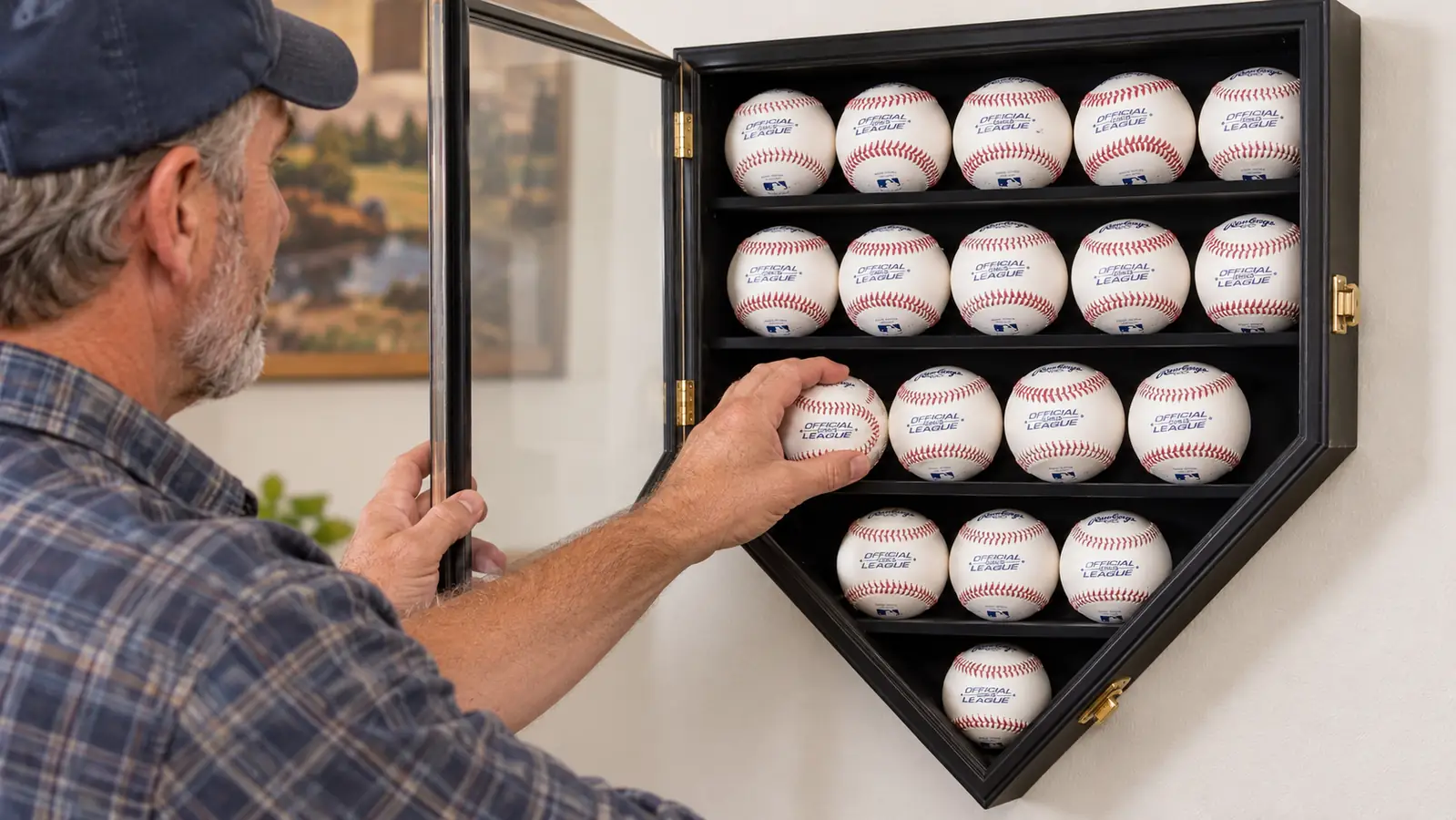
Hanging is the other half of this. The wall case ships with wall mounting hardware in the package, so it is one measuring job, one level, and two fasteners into studs above the desk. Twenty one individual holders means twenty one decisions about height and spacing, and twenty one chances to get one slightly crooked, and twenty one holes to patch when you decide to move the whole thing. I hung mine in a single afternoon and have not touched it in three seasons.
That 3.7 inches of depth is worth thinking about too. Mine sits above a desk that is 24 inches deep, so the front of the case ends up roughly over the back edge of the keyboard tray and nobody bumps their head leaning back in the chair. On a narrow hallway wall it would have been a different story. A case that stands almost four inches off the drywall at eye level is something people walk around, not past. I paced it out with a tape measure against the doorway trim before I committed, and the gap came to about five inches on either side, which is tight but workable. Two inches less and I would have picked a different wall.
The Light Question Nobody Thinks About Until It Fades
Autographs fade. Not dramatically, not all in one week, but a signed ball that sits in daylight for a few years goes from sharp to soft, and once it does there is no fixing it. The door on this case carries a 98% UV protection rating and the frame has an anti-fade lacquer finish. Those two things are doing quiet work every afternoon the sun comes through the den window and lands on that wall.
The cubes I bought gave me no such information. They were clear acrylic, they looked good on a shelf, and the listings said nothing about UV either way. Maybe some of them block it. I could not tell you, and neither could the listing. When I am deciding where to park something a player signed with a marker, maybe is not a good answer. That single unknown is what pushed me to consolidate.
The den faces east, which means the morning sun comes in low and hard from about seven until ten, straight across that wall. My first arrangement put three cubes on the sill of that window, because the light made them look good. Two summers of that and the signature on the oldest ball in the bunch had gone from dark blue to a faded gray, still readable but noticeably softer than the day I got it. Nobody warned me. I moved everything to a shelf on the opposite wall and the fading stopped, but it did not reverse. That ball is in the case today, and I can pick it out from across the room without reading it, because it is the pale one.
Where the DisplayGifts Wall Case Wins
The obvious win is capacity and coherence arriving at the same time. Twenty one balls behind one door, in one hand selected hardwood frame, under one finish. There is a reason card shops and memorabilia counters display this way: a single large piece reads as a collection, while a scatter of small holders reads as clutter no matter how good each holder is individually. When my son Kyle visits from out of state, he walks down the stairs and takes the whole thing in at once. With the cubes, he had to ask which ones were the good ones, which is not a sentence you want to hear about your own shelf.
The door is shatter proof acrylic glass rather than the thin plastic you find on cheaper holders, and that matters in a room where a guest's elbow or a grandkid's forehead is eventually going to connect with it. Mine has taken one solid knock from a folding chair and did not mark.
It also locks. I did not think I cared about that until I had a house full of people after a game and watched somebody pick a ball up off the shelf to read the signature while holding a plate. Now the door closes, the balls are behind it, and the question does not come up. Dust is the unglamorous version of the same win. One door means one surface to wipe once a month. Twenty one open cubes meant twenty one little interiors, and I will not pretend I kept up with them.
The dusting is worth a number, since I claimed a win here. I used to pull all the cubes down once a month, wipe the inside of each one with a microfiber cloth, and set them back. That is twenty minutes if nothing goes wrong, and something always goes wrong, a lid that does not seat right, a ball that rolls off the desk while you are holding it. With the door it is a swipe across one panel of acrylic and I am done in under a minute. I do it on the first Sunday of the month now, same as the furnace filter, and I have not missed one since.
The box in my basement held nine balls for three years. The case on the wall held all of them in one afternoon.
Where Individual Cubes Win
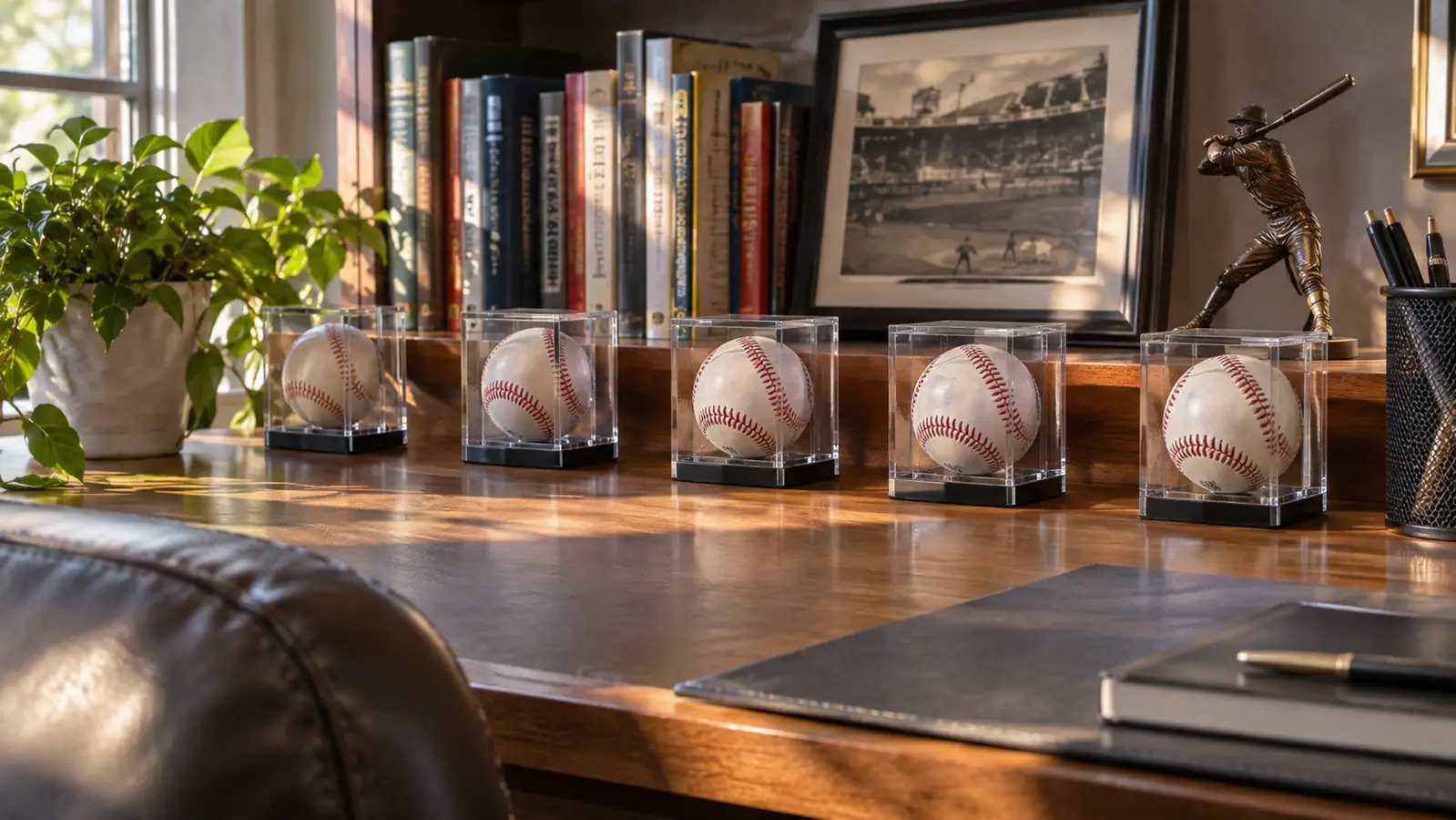
I will defend the cubes, because there is a stage where they are simply the right call. If your collection is small, a 21-slot frame is a standing reminder of how empty it is. Twenty one slots with nine balls in it looks like a project you have not finished, and it looks that way for years. Cubes never show a hole. You own three balls, you own three cubes, and the display is complete at three.
Cubes also let you buy as you go. You are not committing to a large frame before you know whether you are the kind of person who keeps collecting. That matters more than display people like to admit. Plenty of folks buy one signed ball at a charity auction, enjoy it, and that is the end of the story. Asking that person to hang a 21-slot case on the wall is asking them to buy furniture for a hobby they do not have.
A cube also travels. I used to carry one out to the porch on summer evenings while Joan and I listened to the radio, and set it on the table between us. You cannot do that with a wall case, and you should not try. And when a cube gets scratched or cracked, you replace one cube. With the wall case, the door is the door. If it takes a bad hit, you are dealing with the whole unit rather than a single small object. That is a real tradeoff and I am not going to talk it away.
Here is the space argument in reverse, since I spent a section complaining about scattering. A cube fits on a windowsill, a nightstand, the corner of a desk, the top of a bookcase. It asks nothing but a flat surface. My first three lived on the desk beside the radio, and one of them stayed there two full years because I liked glancing at it while I worked. That is a real thing a wall case cannot do, and it is why I still keep three cubes around even now.
If you are past a dozen balls, stop buying cubes two at a time
The DisplayGifts case holds 21 behind one locking, 98% UV door, with the mounting hardware in the box. One afternoon with a level and the wall is finished.
Amazon Check Today's Price on Amazon →What I Would Do Differently If I Started Over
I would have bought the wall case a year earlier and kept three cubes for the overflow. That is the arrangement I have now and it is the one I would recommend to anybody standing where I stood. The case handles the collection as a body of work. The three cubes handle the ball I am currently attached to, the one that goes out to the porch, the one that sits on the desk while I am working. The mistake was treating it as an either-or for as long as I did. It cost me three years of a cardboard box.
The one thing I would not change: measure before you order. Nineteen and a quarter wide by seventeen and three quarter tall is not enormous, but it is not a shoebox either, and it looks different on a wall with a light switch and a doorframe crowding it. I used a strip of painter's tape to lay out the rectangle first. Took four minutes. Saved me from hanging it six inches too low and having to move it.
Who Should Buy Which
Buy the DisplayGifts wall case if you are past ten or twelve balls and still adding, if your collection sits in a room with any daylight at all, and if you have people in your house who will pick things up. It is also the right answer if you are tired of the shelf looking like an estate sale. The honest case for it is not that it is fancier. It is that it settles the question. Once it is on the wall, you stop thinking about display and go back to watching baseball.
Stay with individual cubes if you own a handful of balls, if you are not sure you will keep collecting, or if the sentimental value is concentrated in one object you want within arm's reach. There is nothing wrong with a shelf of cubes. It is a perfectly good display for a small collection, and it costs you the freedom to change your mind later, which is worth something.
Measure the wall first, then go look at the 21-slot case
Nineteen and a quarter by seventeen and three quarter inches, 7.5 pounds, mounting hardware included, and a door rated at 98% UV protection. If it fits the space you have, it ends the display question for good.
Amazon See It on Amazon →