
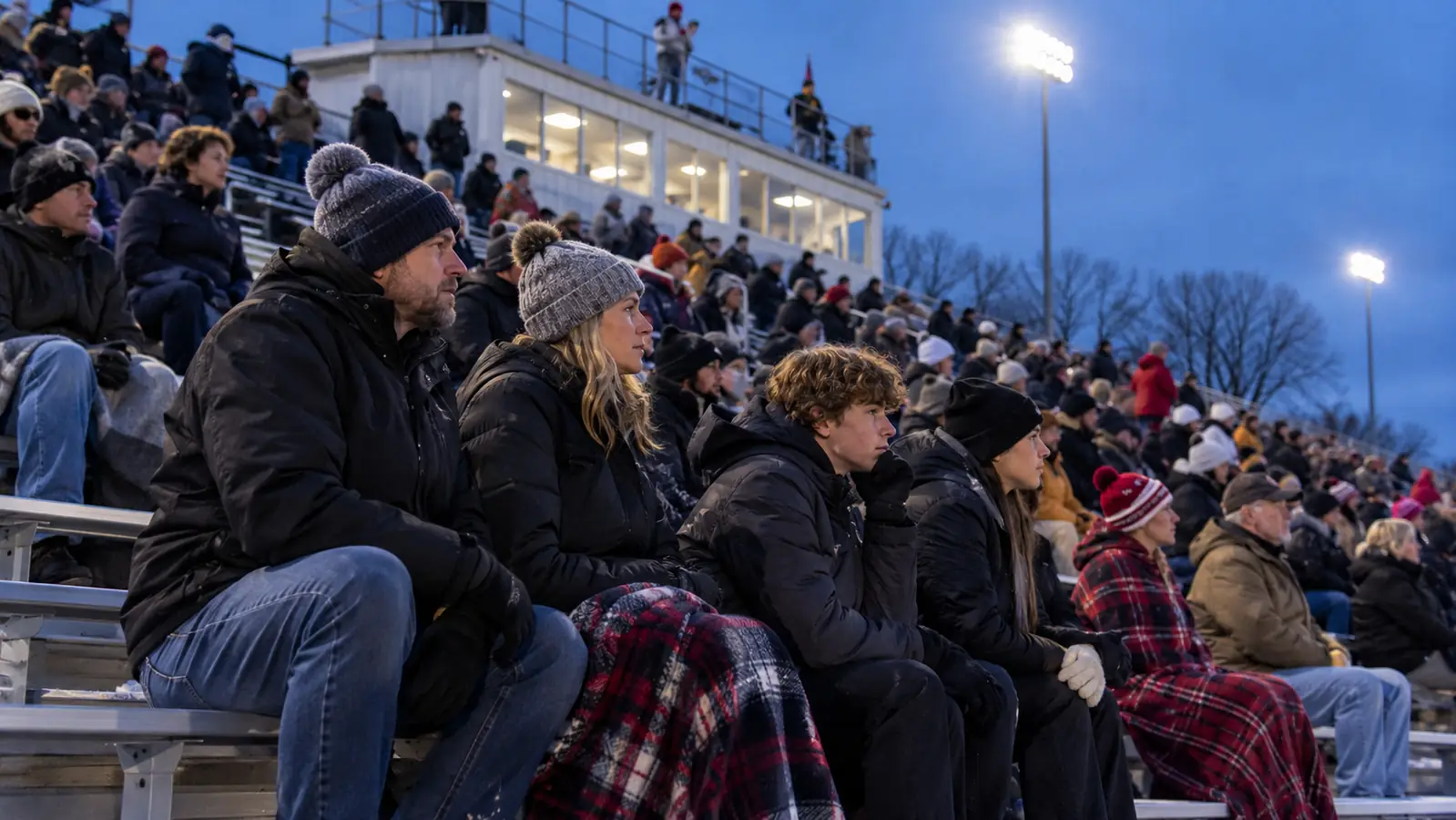
November football is its own kind of endurance test. The first quarter is fine. You have your coat, you have your coffee, you are comfortable. By the fourth quarter your feet have gone numb against the aluminum, the wind has found the inch of bare skin between your collar and your hat, and you are standing on the bench because sitting still is worse than standing in the wind. I spent years on the sideline as an assistant coach and a lot more years in the stands after that, and the difference between a game I enjoyed and a game I survived usually came down to one piece of gear: a DOWN UNDER OUTDOORS stadium blanket that lives behind the seat of my truck from September through December.
That fabric matters more than the coat. A couch throw will not do it. A plain fleece soaks up moisture off a damp bench and holds it, and by halftime you are wrapped in something cold and heavy. What you want is a blanket with a waterproof layer and enough weight to stay put when the wind comes over the top of the grandstand. The one I use is 350 GSM fleece, 3.1 pounds, X-Large, and it travels in a stuff sack with a shoulder strap. Here is how I use it, step by step, after a good many cold Friday nights figuring it out the hard way.
The Bleachers Are Cold. The Blanket Should Not Be.
Waterproof layer, 350 GSM fleece, 3.1 pounds, and a toggle and loop so you can wear it like a cape with both hands free. It rides in a stuff sack with a shoulder strap until you need it.
Amazon Check Today's Price on Amazon →Step 1: Layer Up So You Can Shed, Not Just Add
The mistake I see most in November is one enormous coat pulled over a t-shirt. You are warm walking in from the lot, then you climb to row 22, take your seat in what amounts to a wind tunnel, and you have nothing left to add. Layers let you adjust as the sun drops behind the scoreboard. Start with a base layer, add flannel or a light fleece, then a wind resistant shell. Hat and gloves go in the coat pocket before you leave the house, not in the truck.
The blanket is the top layer, not the only layer. Wrapped right, it traps a pocket of warm air against your chest and legs, and that pocket is what keeps you sitting through a defensive series that will not end. Overdress underneath and you sweat on the walk in, and damp clothes at forty degrees feel colder than dry clothes at forty degrees. I learned that one coaching, standing on a sideline in a parka I could barely move in.
One more thing about arrival. Get there early enough to see which way the wind is running through the grandstand, because the section you bought and the section you want can be two different places. On a north wind night the top rows catch everything and the lower rows behind the press box are calm. That is not a gear problem. It is a seating problem, and it is free to fix.
Second Friday of November a few years back, the forecast said forty two and clear, so I wore a heavy wool coat over a cotton shirt and figured I was set. By the middle of the second quarter the temperature had dropped to thirty one with a north wind coming straight down the grandstand. A base layer, a flannel and a wind shell would have let me add and subtract all night. Instead I spent three quarters with my shoulders up around my ears and my hands in my armpits. I have not worn one heavy coat to a game since.
Step 2: Sit on Insulation Before You Wrap in It
Aluminum is a heat sink. It pulls warmth out of your legs faster than the air does, and it does it straight through a pair of jeans. The fix costs nothing: fold part of the blanket under you before you take your seat and bring the rest up over your lap. Now you have a barrier between yourself and the metal, and you have blocked the wind that comes up between the risers.
If it is going below freezing, add a closed cell foam pad about a half inch thick. I keep two in the truck bed, cut to the width of a bench seat. Tuck one corner under your leg and it will not blow away when the section empties out at halftime. Cut yours to about thirty six inches, hip width plus a hand on each side. My first one was forty eight, the full width of a bench, and the extra foot hung over the front edge like a sail every time somebody walked past our row.
Feet next, because they go cold first. Boots beat sneakers, wool socks beat cotton, and a knit hat pulled over the ears does more than any hood, since a hood that will not stay up is not a hat. If you are on concrete or bare aluminum, a flattened cardboard box under your soles interrupts the same heat transfer the foam pad handles. I have handed out more than one to a shivering stranger in the row behind me.
Weight matters here too. A 3.1 pound quilt with two layers bonded across the whole surface stays where you put it. Something thin and light slides off your knees the moment you stand up to yell at a fourth down call, and then you are bent over in the dark hunting for it while the play happens without you.
Step 3: Use the Cape Toggle and Get Your Hands Back
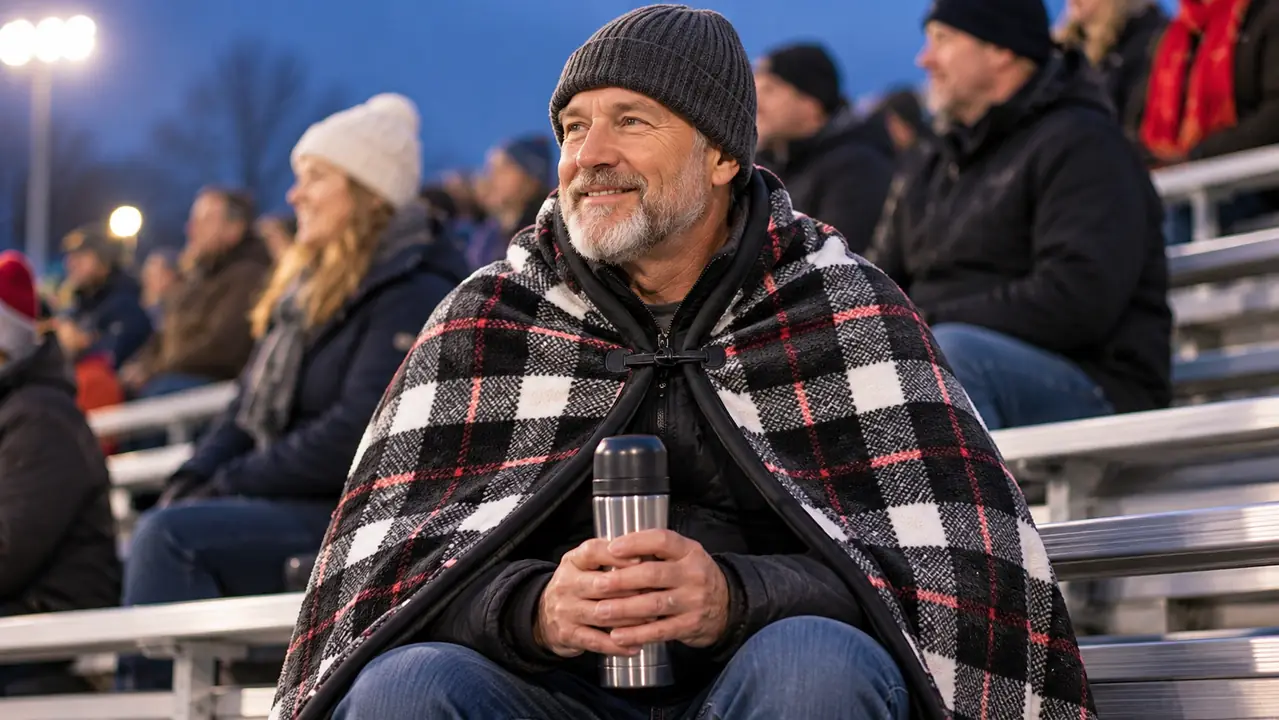
Cold hands are what ends a game early for most people. You cannot hold a phone, a thermos, or a program when you are gripping a blanket closed at the collar. The DOWN UNDER OUTDOORS blanket has a toggle and a loop so you can wear it over the shoulders like a cape, with both arms free. It is a small feature that changes the whole second half.
Cape style also solves the standing problem. When the whole section gets up for a third down, you get up with them and the blanket stays on your shoulders instead of falling into the row behind you and landing on somebody else's food. I have been on both ends of that exchange, and only one of them is a good time.
There is a trick to fastening it. Sit down first, drape the blanket over both shoulders so the back panel hangs behind the bench, then reach back and find the toggle and loop at chest height. Fasten it standing in the aisle and the back panel bunches under your arms and you end up sitting on the whole arrangement. The first time I tried it I spent a quarter fighting the thing like a man in a straitjacket.
If you have a kid or a grandkid with you, this is the difference between watching the game and wrestling fabric for three hours. Wrap them, fasten the toggle, hand them something warm to hold. They sit still, which is its own kind of warmth for everybody around them.
A 3.1 pound quilt with two layers bonded across the whole surface stays where you put it. A thin throw slides off your knees the moment you stand up.
Step 4: Deal With Wet, Because November Is Not Always Dry
November is not always dry. Rain, snow, a spilled thermos, a bench that has been wet since the morning drizzle. A blanket without any waterproofing becomes a sponge, and a wet blanket is worse than no blanket because it pulls heat out of you instead of holding heat in. The DOWN UNDER OUTDOORS blanket has a waterproof layer and a waterproof pocket, so a wet bench stays a wet bench and does not become a wet lap.
The two layers are ultrasonically quilted rather than stitched only at the edges, so they are bonded across the whole surface. Nothing slides. You do not end up with a wadded lump of fleece in one corner and bare backing in the other after twenty minutes of shifting around.
I tested that by accident one October, the year the drizzle started an hour before kickoff and never stopped. My old throw soaked through in about twenty minutes and weighed twice what it should have. The quilted blanket sat on the same wet bench for three hours and my legs were dry when I stood up. The pocket mattered more than I expected: phone, keys and a folded program went in and stayed dry. Now the phone goes in there out of habit, wet or not, because a cold battery dies fast.
When it gets dirty, and it will, it goes in the washing machine. That is the whole instruction. No dry cleaning, no hand washing in the bathtub. A blanket you are afraid to wash is a blanket that stays in the garage, and a blanket in the garage keeps nobody warm.
Step 5: Pack It So It Comes Back Next Week
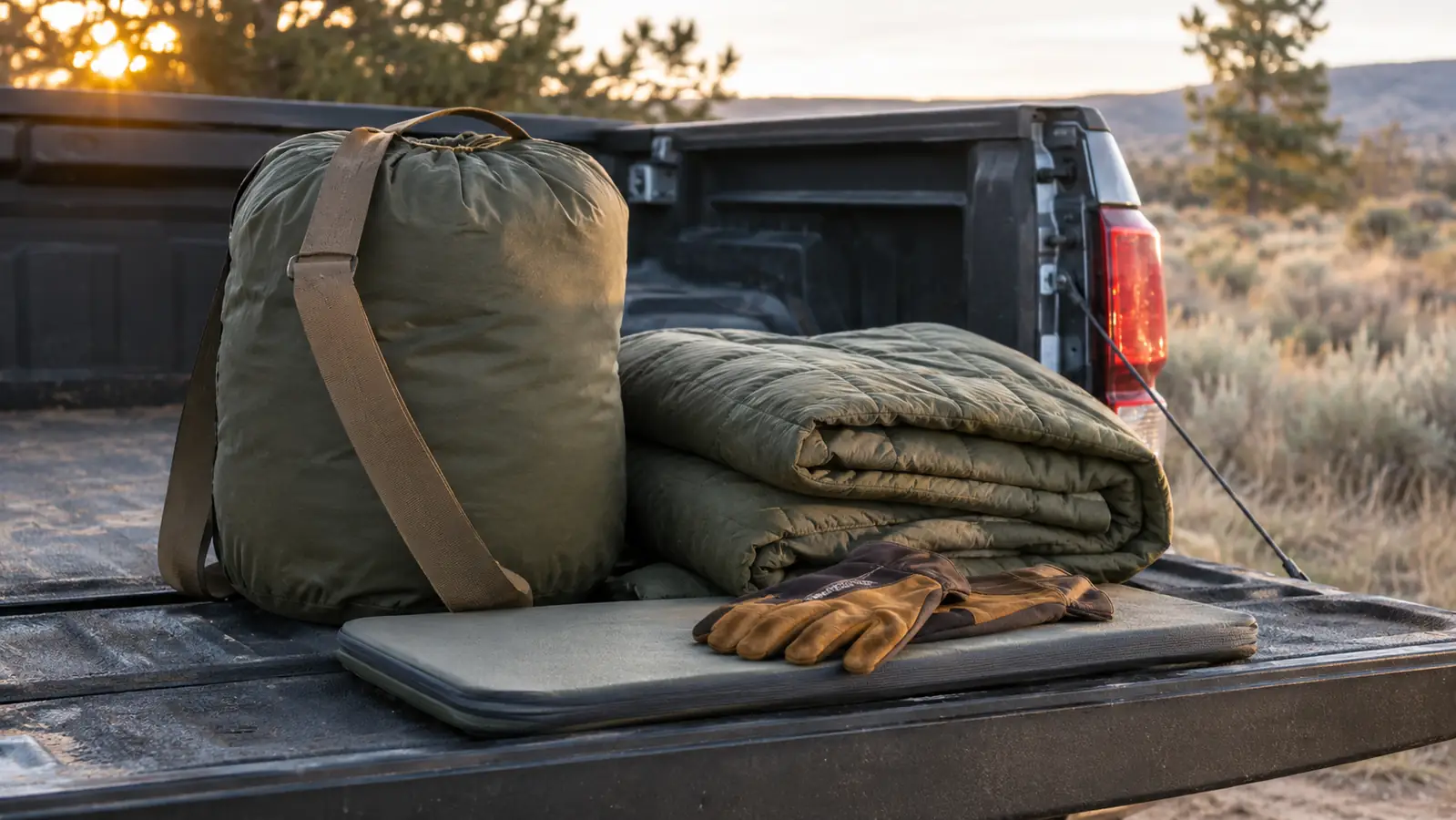
The most common way a stadium blanket dies is that it gets left in the garage under a cooler and never makes it to another game. The DOWN UNDER OUTDOORS blanket comes with a stuff sack that has a carry handle and a shoulder strap. I keep the blanket in the sack, and the sack goes behind the driver's seat with the foam pads, a pair of work gloves and a scraper, from the first cold Friday in September until the season ends.
Three pounds on a shoulder strap is nothing on the walk from the far lot. It is easier to carry than a folding chair or an overstuffed tote, and because it lives in the truck it is not a thing I have to remember. The gear you remember is the gear that stays packed.
Fold it flat: lay it out, fold the long sides in to the middle, then fold in thirds from the foot end, and it goes into the sack in about thirty seconds. Roll it instead and it takes twice as long and never sits right in the bottom of the sack. One habit worth building: unpack it and hang it over the porch rail when you get home, even if it seems dry, then back in the sack on Monday. Twenty seconds of work and it is ready for the next one instead of sitting in a damp lump all week.
What Else Helps
A wide mouth thermos with a screw cap beats a paper cup you have to set on the bench and then knock over. Hand warmers in the coat pockets, one for each hand, run about six hours and fit in a pocket. A hat that covers your ears, always. A sheet of cardboard under your feet if you are on concrete, which is the same heat sink idea as the foam pad, just free.
Two things I would skip: the foil emergency blanket that crinkles every time you breathe, and the battery powered heated seat cushion that quits in the third quarter with no spare battery. Both sound better in the store than they are in the stands.
If you want the longer version of how a stadium blanket holds up across a whole season rather than one cold night, that is a separate write-up. The short version is that the edges and the waterproof layer are what fail first on cheap blankets, not the fleece.
Get It Behind the Seat Before the Next Cold One
350 GSM fleece or sherpa, 3.1 pounds, X-Large, machine washable. Waterproof pocket, cape toggle and loop, stuff sack with a carry handle and shoulder strap.
Amazon Check Today's Price on Amazon →