
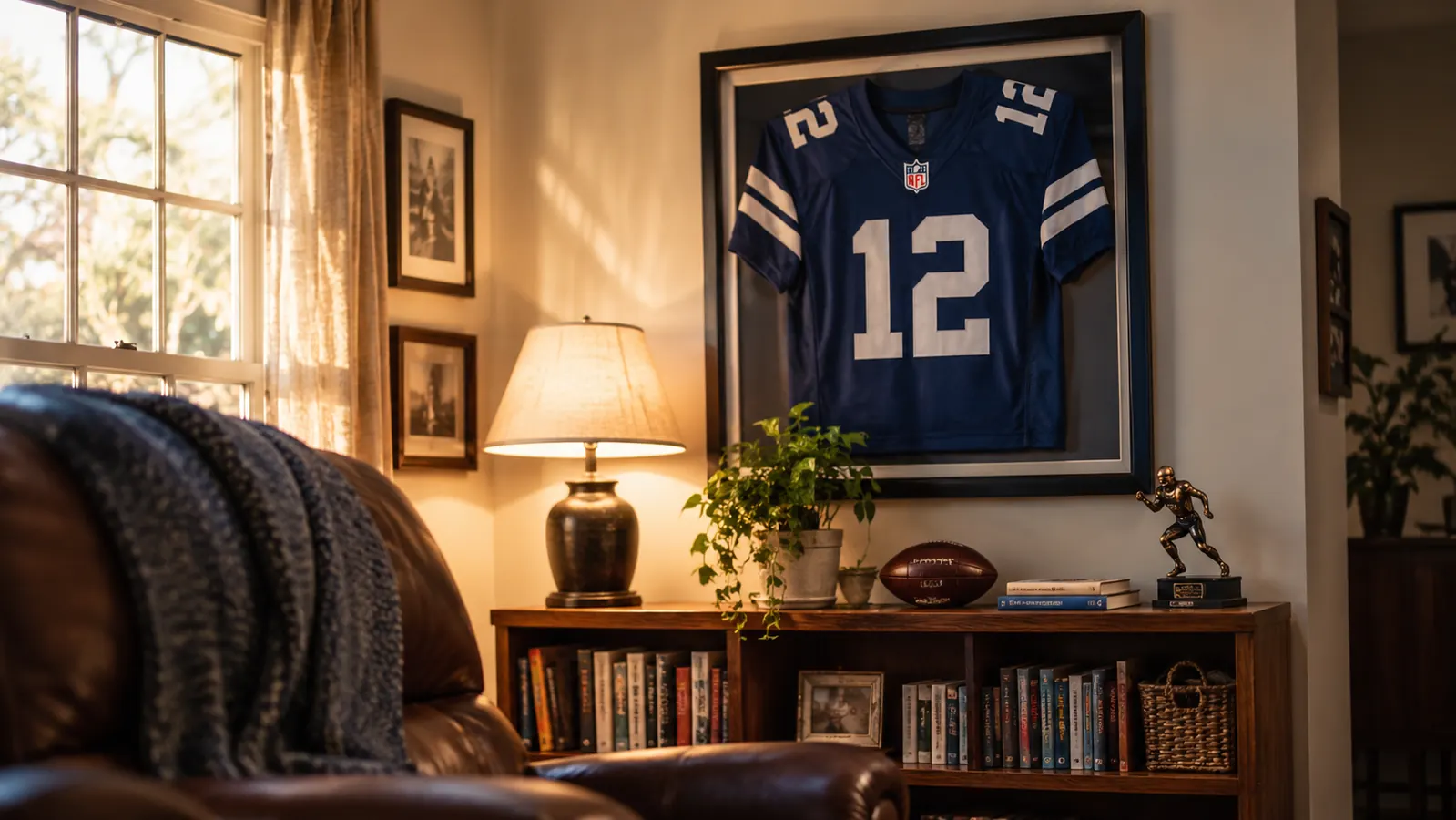
The jersey spent eleven years folded on the top shelf of my den closet. It was a home jersey I came by at the end of a season, and every time I opened that closet door I told myself I would do something with it. What I actually did was move it twice and then stack a box of old ticket stubs on top of it. Last September I finally bought a frame. It is the IHEIPYE jersey display frame case, and it has been hanging on the den wall across from my recliner for seven months now, through a full football season, a Kansas winter, and a spring dry enough to crack the caulk around my windows.
I am not a collector in any formal sense. I have a few signed baseballs, a shoebox of ticket stubs, and two jerseys that matter to me for reasons that would bore a stranger. What I wanted was modest. Get the thing out of the closet, keep it off a wire hanger that was already leaving shoulder bumps, and not spend a Saturday building a shadow box out of cedar and hope. What I did not want was something that looked like it came from a trophy shop in 1994.
The Quick Verdict
A wood wall case that holds a grown man's football jersey without folding it, with three ways to hang it and the hardware already in the box. The pin method takes patience and the size leaves little room for a bulkier jersey, but seven months in, mine is straight and the jersey is clean.
Amazon Check Today's Price →Get it off the closet shelf and onto the wall
The case ships with the frame, two hangers, a pin board, mounting hardware, a thimble and pins, and a visual guide. Today's price and current availability are on the listing.
Amazon Check Today's Price on Amazon →How I've Used It
It hangs in the den, on the wall between the bookcase and the window, mounted with the hardware that came in the box. The case weighs 10.6 pounds empty and a jersey does not add much, but I still drove the mounting into a stud rather than trusting a drywall anchor. That took about twenty minutes, most of it spent finding the stud finder and then finding the stud finder's battery.
In the box: the frame itself, two hangers (one wood, one metal), a pin board, the hanging hardware, a thimble and pins, and a visual guide. That last part matters more than it sounds. I have bought display hardware before that assumed I already owned a level, a stud finder, and a second set of hands. This one at least gave me a picture of the order to do things in.
I read the guide once, hung the case, decided the jersey was sitting a half inch low, took it down, and did it again. The second attempt was better. If you are the kind of person who measures twice, the guide will get you there on the first try. If you are the kind of person who is me, budget an extra fifteen minutes and be fine with it.
It has been up since late September. I have taken it down twice since. Once to check the hanger after the first month, because I did not believe a jersey hanging inside a case would hold its shape over a season. Once in January, when my son Kyle was home for a weekend and wanted a closer look, so we lifted it off the wall and set it on the pool table.
The den is where I watch football on Sundays, so the jersey is in my line of sight about four hours a week from September through January. That is a strange thing to weigh when you are buying a frame, but it is the real test. A frame you notice once a month is fine. A frame you notice every time you sit down has to be right.
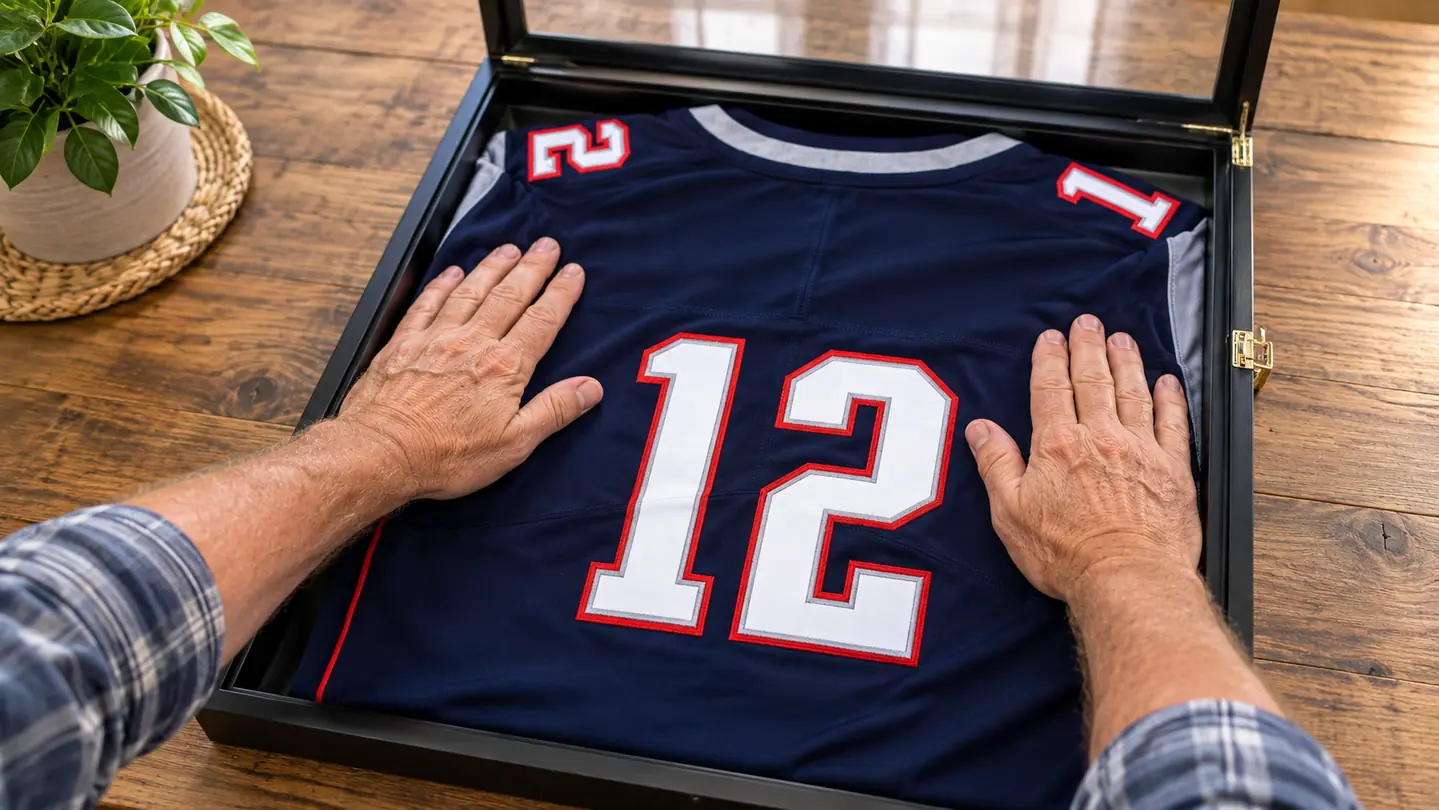
Three Ways to Hang a Jersey, and Which One I Picked
The case gives you three ways to hold the jersey, and the difference between them is not cosmetic. The wood hanger is the one I used. It holds the jersey from the shoulders the way it would sit on a person, so the front reads the way it does in a photograph: sleeves out, number centered, a little natural drape along the bottom. If what you want is for the jersey to look like somebody invisible is wearing it, this is the method.
The metal hanger is the lighter of the two. It does the same job with less bulk behind the fabric, which matters if your jersey runs snug or if you want it sitting a little higher in the case. I tried it for a week. It worked fine. I went back to the wood one because the shoulders looked a touch sharper with it, and because by then I had gotten used to the look.
The pin board is the third method, and it is the one that gives you the flattest, most symmetrical result. You lay the jersey against the board and pin it out until the shoulders and sleeves sit where you want them. It is also the method that took me two tries and a certain amount of muttering. The pins are small, they want to go in at an angle, and the thimble in the box is there for a reason. Do not skip the thimble.
Whichever you pick, do a dry run first. Lay the jersey in the case on a table before anything goes on a wall. It takes five minutes and it saves you from discovering at eye level that you wanted a different method.
My advice: decide on the method before you mount anything, and do the pin board on a table with good light if you go that route. Pinning a jersey while it is already hanging is a two person job and an argument waiting to happen.
What 23.25 by 31.25 Inches Actually Fits
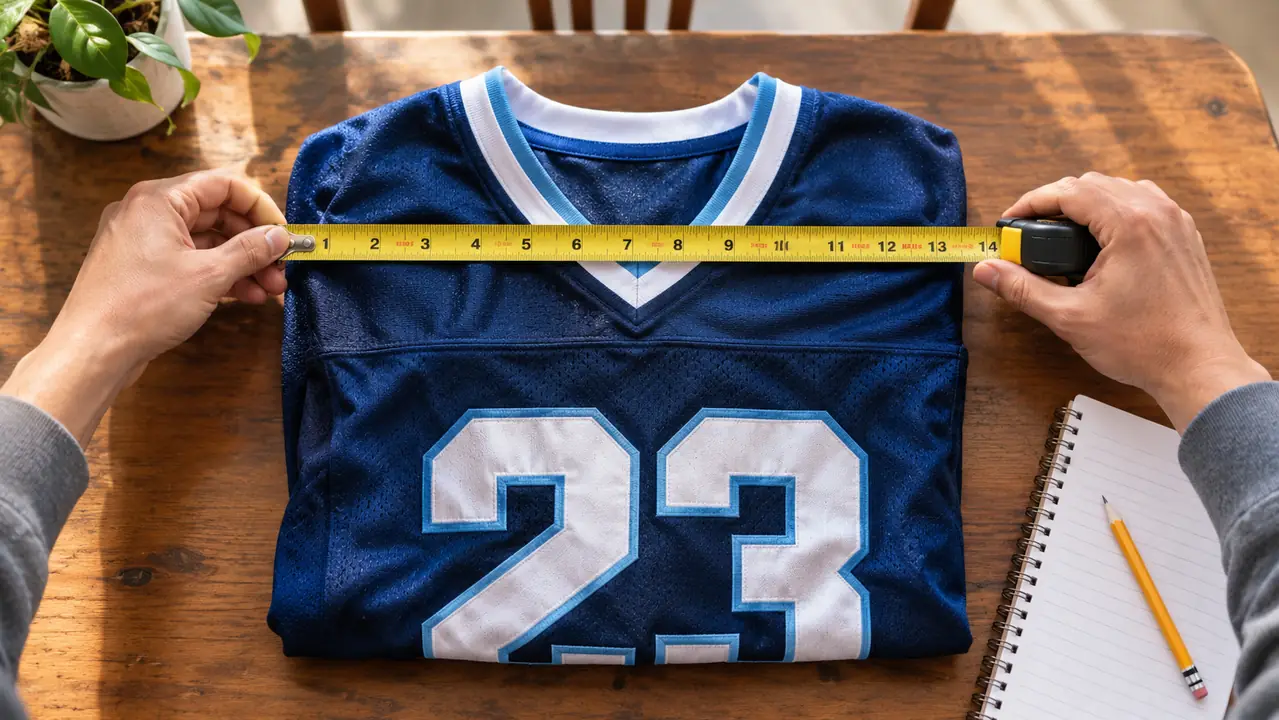
The IHEIPYE case measures 31.25 inches tall, 23.25 inches wide, and 1.5 inches deep. That is the number that decides whether this works for you, so measure your jersey before you order. Lay it flat, sleeves out, and measure from the top of the collar to the bottom hem, then shoulder seam to shoulder seam.
My football jerseys went in without folding anything. Sleeves inside the frame, hem clear of the bottom, a little air above the collar. The listing says it fits most sports jerseys and names baseball among them, and after seeing how a football jersey sits in it, I believe the claim. A baseball jersey is going to have room to spare.
Where it gets tight is at the top of the size range. This is a standard size case, not a custom one, and a heavier jersey with a lot of fabric in the shoulders is going to want a small tuck at the sleeves or a slightly higher hang. That is not a defect. It is what happens when one frame is asked to cover every jersey ever made. Just know it going in, and if your jersey sits at the far end of the sizing, measure first and measure twice.
The 1.5 inch depth is worth a sentence of its own. It sits close to the wall, closer than I expected from the product photos, which I liked. On a narrow strip of wall between a bookcase and a window, a deep box would have read as a piece of furniture. This reads as a frame.
Months on the Wall: What Held Up and What Didn't
Seven months is not a lifetime, but it is long enough to catch the things that go wrong. The frame has not warped. The corners are still tight. The wood has not picked up any bowing from the dry winter air, which is more than I can say for a cheap shelf I bought the same month. Whatever the frame is finished with, it has held up to a room that gets a lot of afternoon light.
The cold stretch is the part I expected to be hard on it. Kansas goes from humid summer to bone dry winter, and the house does too. Wood moves when that happens. I checked the corners in February expecting a gap and found none. Whether that is the frame or luck, I cannot tell you, but I will take it.
The hanger has not sagged. That was my main worry, that the shoulders would slowly pull down into points over a winter the way they do on a wire hanger in a closet. They have not. When I took the case down in January the jersey was sitting exactly where I left it in September, and it went back the same way.
What did happen is dust. Not inside the case, on the outside of it, same as any frame in a room with a furnace and a door that gets opened all day. A dry microfiber cloth once a month handles it. I have not noticed any fading, though the wall it is on gets indirect light rather than a direct beam, and I would not hang any jersey in direct sun regardless of what the frame is made of.
The one honest wear item is the pin holes, if you go the pin board route. They are small and they are on the inside of the jersey where nobody sees them, but they are permanent. If the jersey is one you might wear again, use a hanger instead. If it is going on the wall for good, pin it and get the cleaner look.
The Small Annoyances Worth Knowing
The pins are fiddly. That is the whole complaint, and it is a small one. Small pins, fabric with some give to it, and a board that wants you to work at an angle. Take your time and use the thimble.
Hanging it is a two hand job at minimum. At 31.25 inches tall and 10.6 pounds it is not heavy, but it is big, and getting it onto the wall hardware while keeping it level is easier with somebody holding one side. My wife Joan held the level. That is the entire extent of the help I needed.
The visual guide is one page and assumes you have done this before. It shows you the parts and the order. It does not walk you through what to do if you hit a stud off center or how much room to leave above the frame for lifting it on and off. I figured it out. You will too. Just do not expect a step by step that holds your hand through a wall you have never drilled into.
And it is bigger on the wall than it looks in the product photos. Measure the space you have picked out before you commit to it. I had a spot in mind that turned out to be about four inches too narrow, which is how it ended up between the bookcase and the window instead.
What I Liked
- Fits a grown man's football jersey without folding it, sleeves inside the frame
- Three display methods in one box: wood hanger, metal hanger, and pin board
- Mounting hardware, thimble and pins are included, so no second trip to the hardware store
- Wood frame, wall mount, 10.6 pounds, hung on a stud in about twenty minutes
- Stayed square through a dry Kansas winter with no warping at the corners
Where It Falls Short
- The pins take real patience and my first pin board attempt came out crooked
- 23.25 by 31.25 inches leaves little margin for a jersey at the top of the size range
- Larger on the wall than the product photos suggest, so measure your space
- The visual guide is thin and skips the parts you have to work out yourself
Seven months, one dry Kansas winter, and the shoulders have not sagged a quarter inch.
Who This Is For
The IHEIPYE case is for the fan who has a jersey folded on a closet shelf and no plan for it. If you have a den, a basement, an office wall, or a spare room where the rest of your memorabilia already lives, this gets a jersey out of a box and onto a wall for the cost of an afternoon. It is also for the person who wants a finished look without commissioning a custom frame. Three hanging methods means you can change your mind later without buying anything new, and the hardware being in the box means you are not making a second trip out.
And it is for the household where the jersey matters to more than one person. Joan is not a jersey person. She does, however, have firm opinions about what goes on the den walls, and she has not raised one about this.
Who Should Skip It
Skip it if your jersey sits at the very top of the size range and you want a loose, uncrowded look with air on all four sides. Skip it if you want conservation grade glazing and an archival backing, because this is a display case at a sensible price, not a museum piece. Skip it if you rent and cannot put holes in the wall, since the mounting is a wall mount and there is no version of this that sits on a shelf. And skip it if you plan to rotate jerseys every couple of weeks, because the pin board leaves holes and the hanger is the only method that is quick to change.
The jersey has been on the wall since September and it is staying there
Frame, two hangers, pin board, mounting hardware, thimble, pins and a visual guide, all in one box. Measure your jersey first, then check today's price on the listing.
Amazon Check Today's Price on Amazon →