
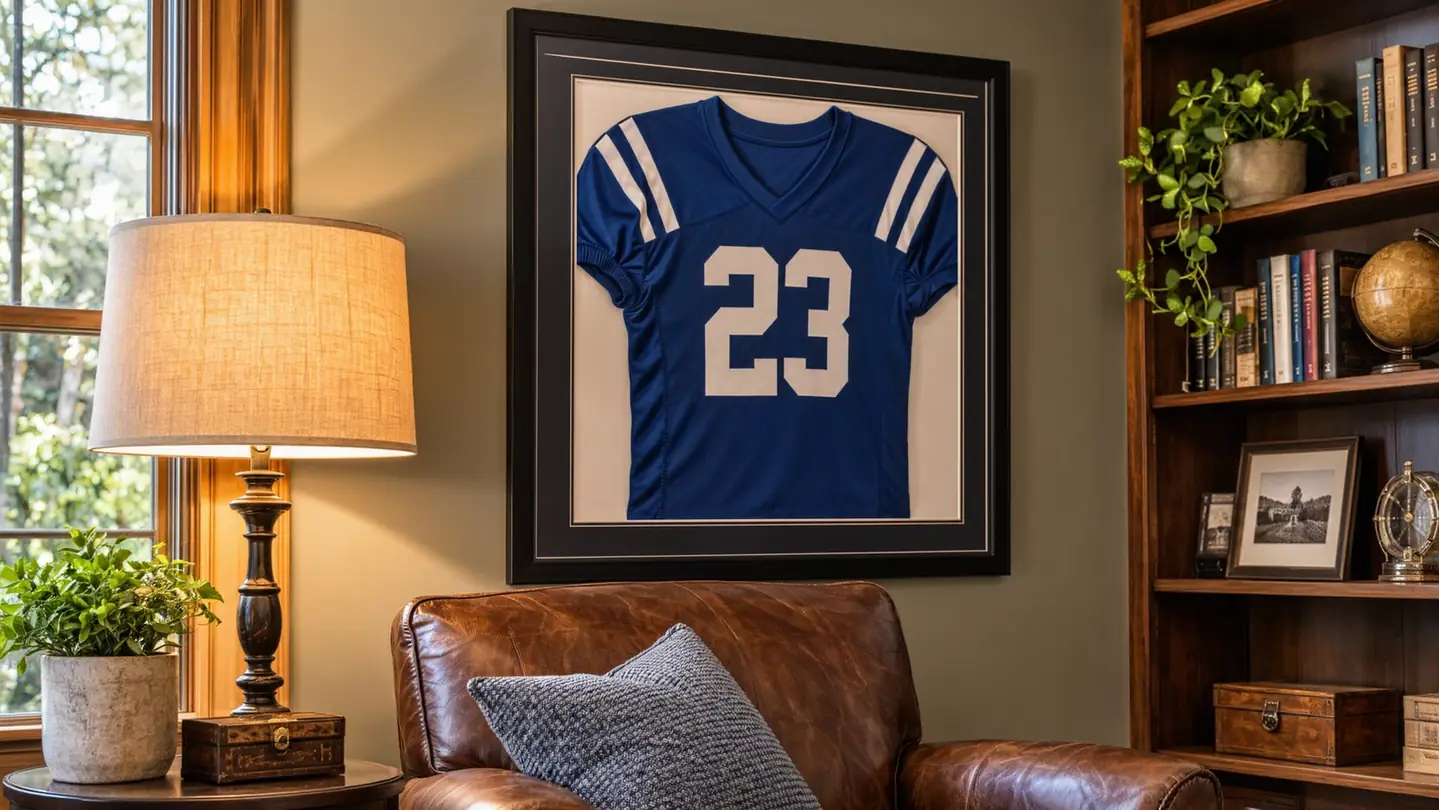
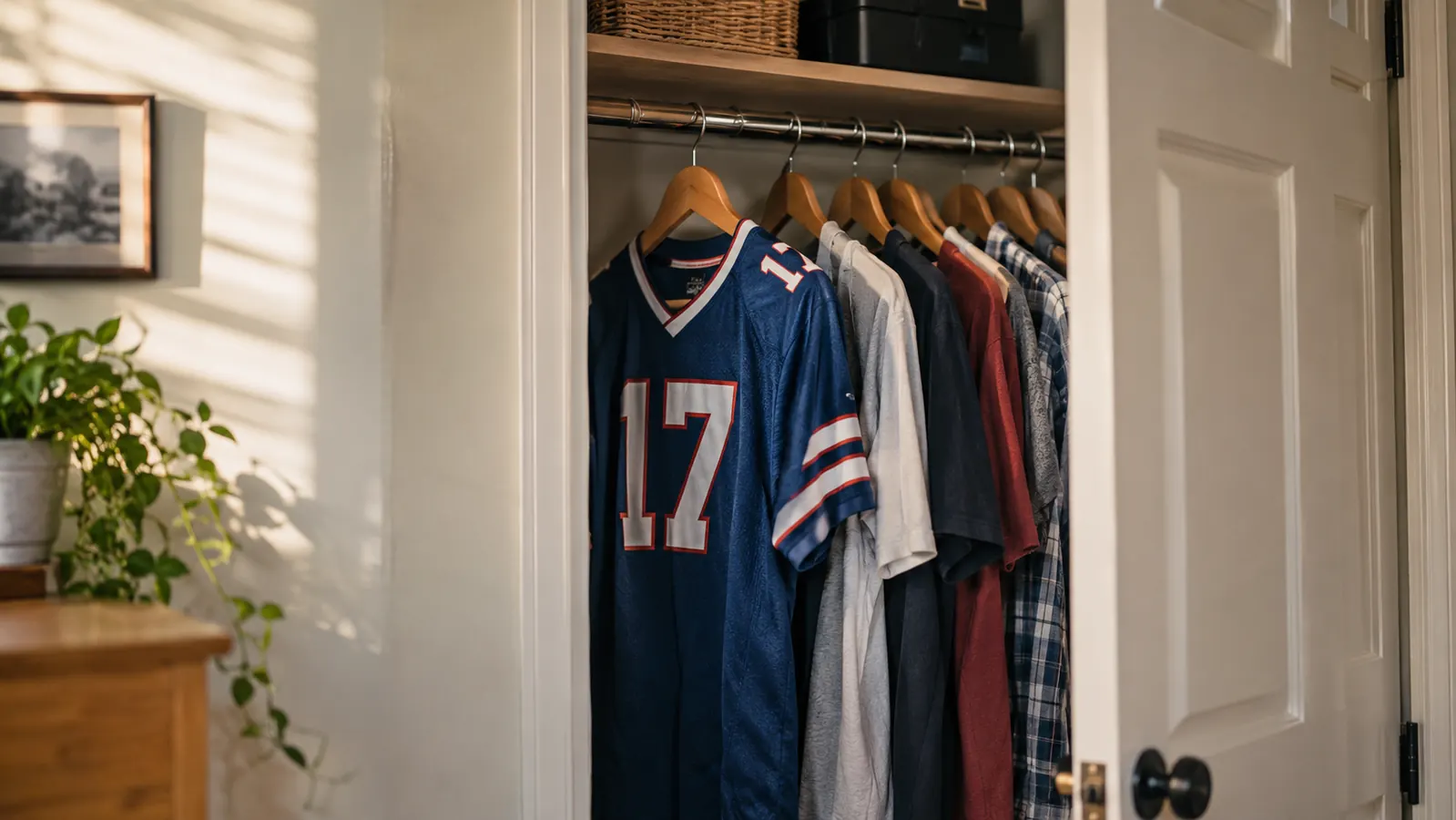
For years the jersey I cared about most lived on a wire hanger in the back of my closet, wedged between a winter coat and a shirt I never wear. I would pull it out for a game, then shove it back. The shoulders had two little peaks from the hanger, and the fabric had that closed-up closet smell. Then I mounted the IHEIPYE Jersey Display Frame on the den wall, and the whole question changed. This is not a close call for every jersey. It is a close call for yours, depending on whether you wear the thing or display it.
A closet hanger is not a dumb idea. You already own hangers, the jersey stays within reach, and you do not have to find a stud in a basement wall. But hanging a jersey in a closet treats a piece of sports history like a Tuesday shirt. The frame treats it like something you want to look at. The right answer depends on which job you are hiring the hanger to do, and most of us are asking one hanger to do two jobs that do not fit together.
| IHEIPYE Jersey Display Frame | Closet Hanger | |
|---|---|---|
| Dust and fingerprints | The display case covers the fabric, so dust and handprints stay off | Open to closet dust and whatever touches it on the rod |
| Shoulder shape | The pin board or hanger holds the jersey without a wire peak | A thin hanger can leave two peaks at the shoulders |
| Game day wear | Built to hang on a wall, not to be grabbed on the way out | Already on a hanger, ready to pull on |
| Setup | Needs wall mounting, hanging hardware, and a choice of wood hanger, metal hanger, or pin board | One hanger on the rod |
| Wall space | Uses a 31.25 by 23.25 inch patch of wall | Uses closet rod space you already have |
| Viewing | Visible from the chair every Sunday | Hidden behind coats and a closed door |
| Long-term storage | Keeps the jersey flat and out of daily traffic | Can slide off the hanger or get crushed by coats |
| Rotating jerseys | Changing the display is a small project | Swap jerseys as fast as you can move a hanger |
Where the IHEIPYE Frame Wins
The frame wins on the thing a closet cannot give you: a jersey that looks like it matters. The IHEIPYE case measures 31.25 by 23.25 by 1.5 inches and weighs 10.6 pounds, so it is a real piece of wall furniture, not a sleeve you tuck behind a door. It mounts to the wall and comes with two hangers, a pin board, hanging hardware, a silver thimble and pins, and a visual guide. That hardware matters because it lets you pick the method instead of fighting a jersey that wants to slump in the middle.
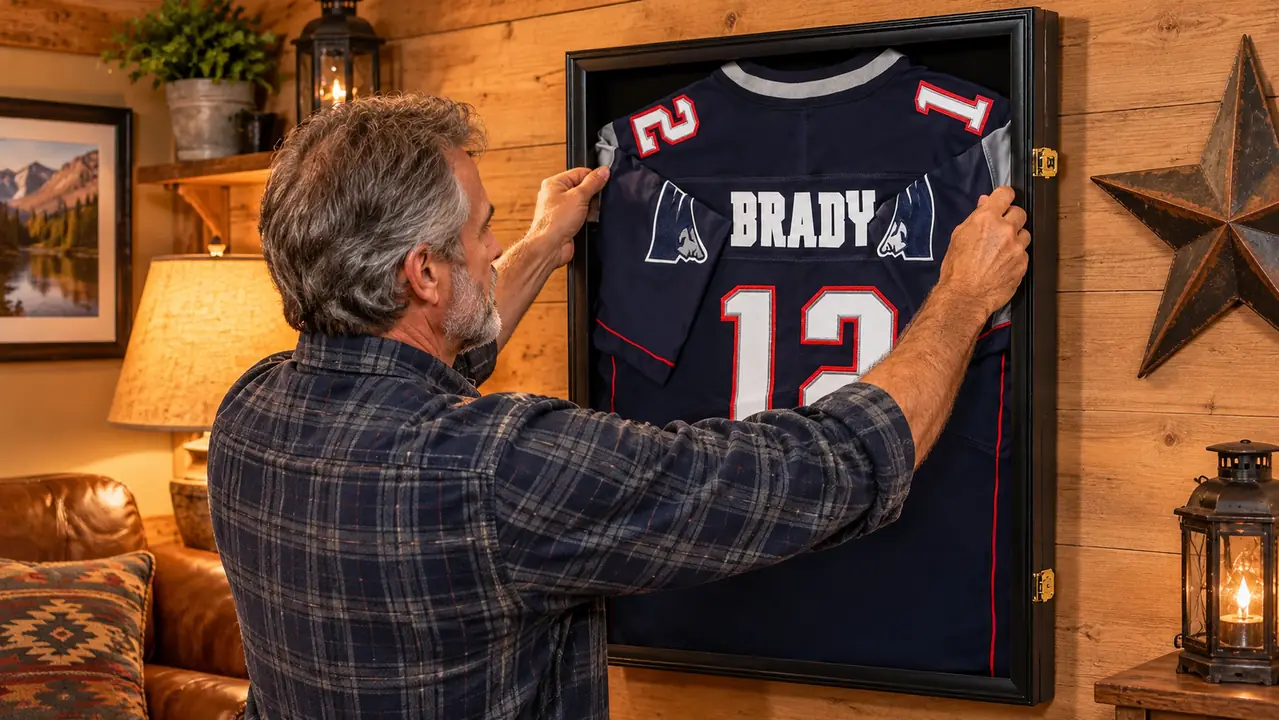
The second win is handling. A jersey on a closet rod gets touched every time someone digs for a coat. The sleeve catches a zipper. The shoulder gets knocked off the hanger. In the frame, the jersey sits behind the front of the case and stays put. I used the pin board for my football jersey because I wanted the shoulders square and the numbers flat. For a baseball jersey with lighter fabric, I used one of the hangers. The point is not that one method is right for every jersey. The point is that the frame gives you three ways to solve the problem, and the closet gives you one. I learned that on a January morning when I reached past the jersey for a coat and a zipper caught the shoulder seam and pulled the thing half off the hanger. Nothing tore, but the shoulder sat crooked for a week before I noticed it, and that was the morning I stopped calling the closet storage and started calling it a pile with a rod through it.
Where the Closet Hanger Wins
The closet wins on wearability, and I will not pretend otherwise. If you put that jersey on six times a season, a hanger is the correct tool. You open the door, grab it, and go. A wall frame is not built for that rhythm. You are not going to unmount a display case every Saturday morning. The closet also wins on setup. One hanger, one rod, no measuring, no anchors, no level. If you rent, or if the den wall is already spoken for, the closet asks nothing of you.
It also wins on space in a small house. The frame needs a 31.25 by 23.25 inch patch of wall, and that is not a small patch when Joan wants a family photo in the same room. A closet hanger uses rod space that already exists. And if you like to rotate jerseys during the season, the closet is faster. You can move a hanger in two seconds. Changing a display is a small project with a step stool. That is a real tradeoff, not a knock on the frame.
Give the Jersey a Wall, Not a Rod
The IHEIPYE frame holds a jersey with a wood hanger, a metal hanger, or a pin board. It comes with the hanging hardware and a visual guide, so the display is a weekend job, not a carpentry project. If the jersey is meant to be seen, stop hiding it behind the winter coats.
Amazon Check Today's Price on Amazon →How the Frame Actually Holds a Jersey
The listing calls it three selectable display methods, and that is the part worth understanding before you buy. You can use the wood hanger, the metal hanger, or the pin board. I tried all three on different jerseys. The wood hanger is the simplest if you want the jersey to hang like a shirt. The metal hanger is the other hanger option. The pin board is the one I use for a jersey I care about most, because it lets me spread the fabric and keep the shoulders from folding inward. That is not a feature I invented. It is the reason the pin board is in the box.
The size is listed as 31.25 by 23.25 by 1.5 inches, and it is meant to fit most sports jerseys. Measure your jersey before you order, especially a youth size or a long basketball cut. A football jersey with big shoulders needs room. A baseball jersey is lighter and hangs easier. I like that the frame is wall mounted, because it gets the jersey out of the closet traffic and onto a wall where I can see it from my chair. That is the whole job. It is not a safe, and it is not a piece of furniture. It is a display case, and it does that one job well.
Before You Mount It
The frame is wall mounted, and the hardware is in the box. That does not mean every wall is ready. I have a basement wall with paneling over drywall, and I took my time finding the studs. The frame weighs 10.6 pounds, and I did not want a jersey swinging on a loose anchor. If you are not handy, this is a two-person job for ten minutes, not a solo job on a ladder. Measure the wall space first. The frame needs 31.25 inches of height and 23.25 inches of width, plus a little breathing room so the corners do not crowd a door frame. I used a stud finder and a pencil, marked both holes, and drilled pilot holes before a screw went anywhere near the wall. My first spot turned out to be a furring strip over concrete, and the screw bit into nothing but dust. I moved two feet right, found solid wood, and the frame has not shifted since. On a finished basement, expect one wrong guess before you find a solid spot.
The visual guide in the box is useful, but it will not make your jersey fit. The frame is made for most sports jerseys, not every jersey ever made. A long basketball jersey or a youth small may not fill the case the way you expect. Lay the jersey flat on a table and measure it before you order. If the shoulders are wider than the frame, the frame will pinch them. If the jersey is much smaller, it will float. The pin board helps with a smaller jersey because you can spread it, but the frame is still a fixed size. That is not a flaw. It is a measurement you need to take.
The frame is 31.25 by 23.25 by 1.5 inches and mounts to the wall. One is storage. One is display.
What the Closet Hanger Does to a Jersey Over Time
Nothing dramatic happens to a jersey in a closet. That is the problem. It does not get ruined in one day. It gets a shoulder peak from the hanger. It gets a crease where it folds against a coat. It picks up dust. It gets that closed-up smell that does not come out with a quick shake. If the jersey is a signed one or a piece from a game you remember, those small marks add up. You do not notice them until you pull it out for a photo and see that it looks tired.
I pulled one out last October for a picture with Kyle while he was home for a weekend, and the first thing I saw in the shot was a crease running across the front number where the jersey had been folded against a coat for two seasons. I had never noticed it in person, because I never looked at it in good light. Under the den lamp it was plain as day. That is the other issue with a closet: it hides the thing you care about in the first place. I am not a museum curator. I do not need a climate-controlled room. But I do want the jersey I care about to be visible when I am sitting in the den on a Sunday. A closet hanger does not fail because it damages the jersey. It fails because it makes the jersey easy to forget. The frame is not for every jersey. It is for the one you want to look at.
The Jersey You Actually Have
There are two kinds of jerseys in a fan's house. The first is the one you wear. It has a mustard stain from a tailgate and a loose thread on the sleeve. The second is the one you keep. It might be signed. It might be from a game you went to with your son. It might just be the one you bought when you were younger and thinner. The first jersey belongs on a hanger. The second belongs in a frame. Most arguments about storage go wrong because people try to use one system for both.
I have both. The wearing jersey stays on a hanger by the door. The one I care about is in the IHEIPYE frame on the den wall. That split solved the problem for me. I do not have to choose between a closet rod and a wall display for every piece of clothing I own. I just have to be honest about which jersey is which. If you are honest about that, the frame versus hanger question stops being a debate and becomes a sorting job.
Who Should Buy Which
Buy the IHEIPYE frame if the jersey is signed, sentimental, or part of the room. If you have a jersey from a game you took your son to, or a piece you want to hand down, the frame is the better home. It keeps the fabric out of closet traffic, gives you three ways to hold it, and puts it on the wall where guests can see it. It also makes a better gift than another shirt, because the person gets a display, not a thing to store. If you have a den wall and a jersey you keep moving from pile to pile, this solves that.
Stay with the closet hanger if you wear the jersey. If it goes on your back for games, tailgates, or a cold November afternoon, keep it on a hanger and save the wall space. A frame is for the jersey that has retired from active duty. The closet is for the one still in the rotation. The mistake is buying a frame for a jersey you wear every week, or leaving a signed jersey on a wire hanger because you never got around to mounting anything. Decide which jersey you have, and the choice gets easy. One more note if this is a gift: measure the jersey and check the wall at the house where it will hang, not your own. A frame that does not fit the wall becomes a box in the garage no matter how good the jersey is.
Put the Jersey Where You Can See It
If the jersey has stopped being something you wear and started being something you keep, the IHEIPYE frame is the cleaner home. It mounts on the wall, gives you a wood hanger, a metal hanger, or a pin board, and comes with the hardware and a visual guide. Take the jersey off the rod and give it a place of its own.
Amazon See the IHEIPYE Frame on Amazon →