
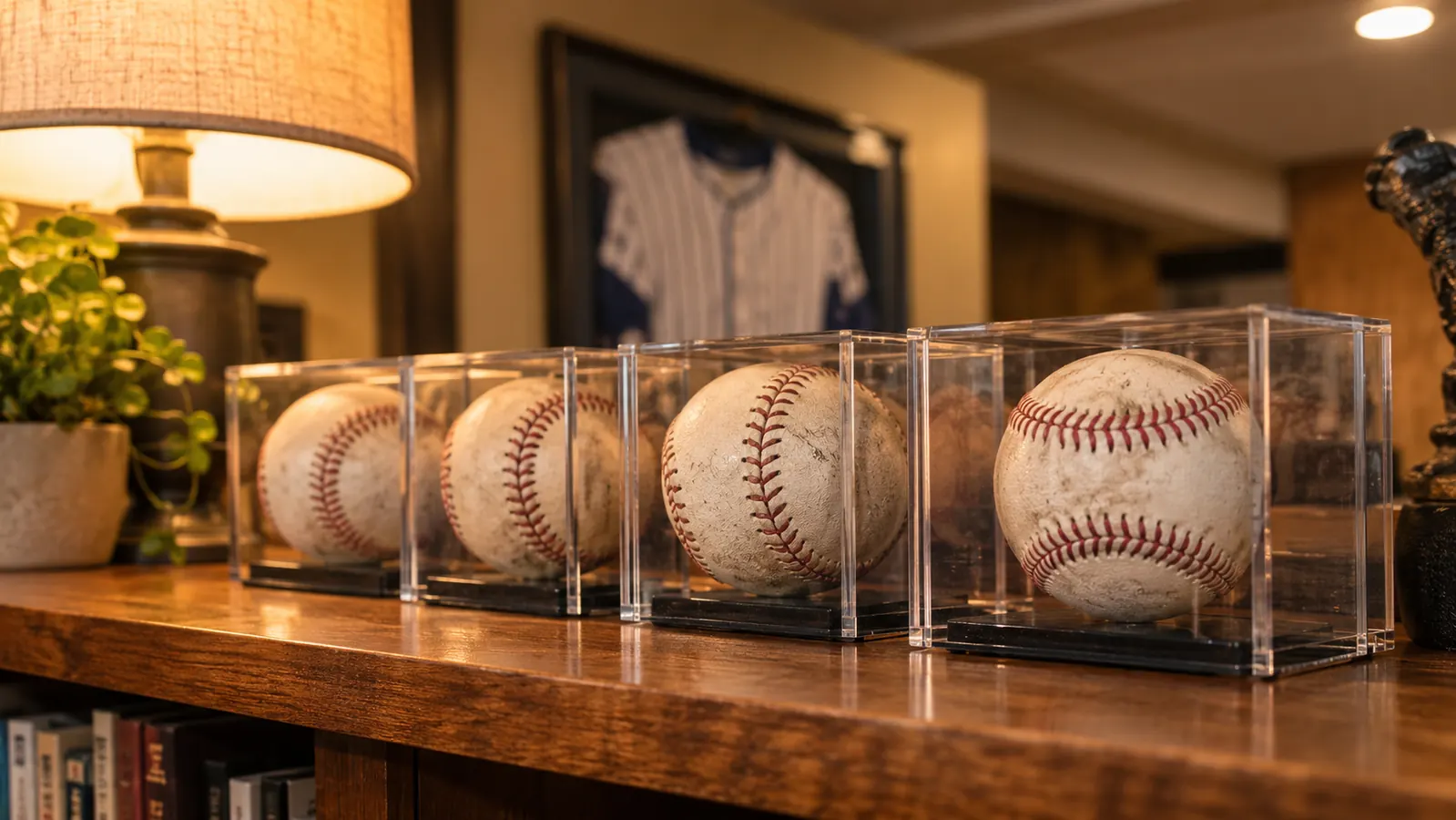
The damage does not announce itself. A baseball I had signed at a charity dinner years ago sat on a shelf in my den for most of a decade, and I would have told anyone it looked exactly the same as the day I brought it home. Then I set it next to a newer ball and the difference was not subtle. The ink had gone from dark to a flat grey-brown, like a photocopy left on a hot dashboard. Nobody dropped it. Nobody smudged it with a thumb. Light did that, slowly, while I was downstairs watching football.
So I went looking for something to put between my collection and the window. What I settled on was the Ultra Pro Baseball Clear Square UV Holder, a small polystyrene box that holds one ball, cuts down the light that does the fading, and stacks. I have had a row of them on the shelf for a while now and I have opinions. This is the honest version, including the parts I do not love and the parts that made me say a few words I will not repeat in front of my wife.
The Quick Verdict
It does the one job that matters, holding a ball steady and cutting the light that fades ink, with less fuss than anything else I tried. It is a plastic box, not a display case, and the packaging is a coin flip.
Amazon Check Today's Price →Your shelf is fading that signature while you read this
One ball per holder, a molded cradle that keeps the ball off the plastic, and a UV barrier between your ink and the room. Tabletop mount, stacks flat, no bracket needed.
Amazon Check Today's Price on Amazon →How I've Used These
I want to be clear about the scale of this. I am not a museum. My den has one shelf along the east wall, a couple of framed jerseys, and a shoebox of ticket stubs that Joan has threatened to throw out twice. The balls that matter to me live in a row on that shelf, and before the Ultra Pro holders they lived there in the open, which is exactly how the fading got a head start. Nothing dramatic happened. They just sat in a room with a window, and the window won.
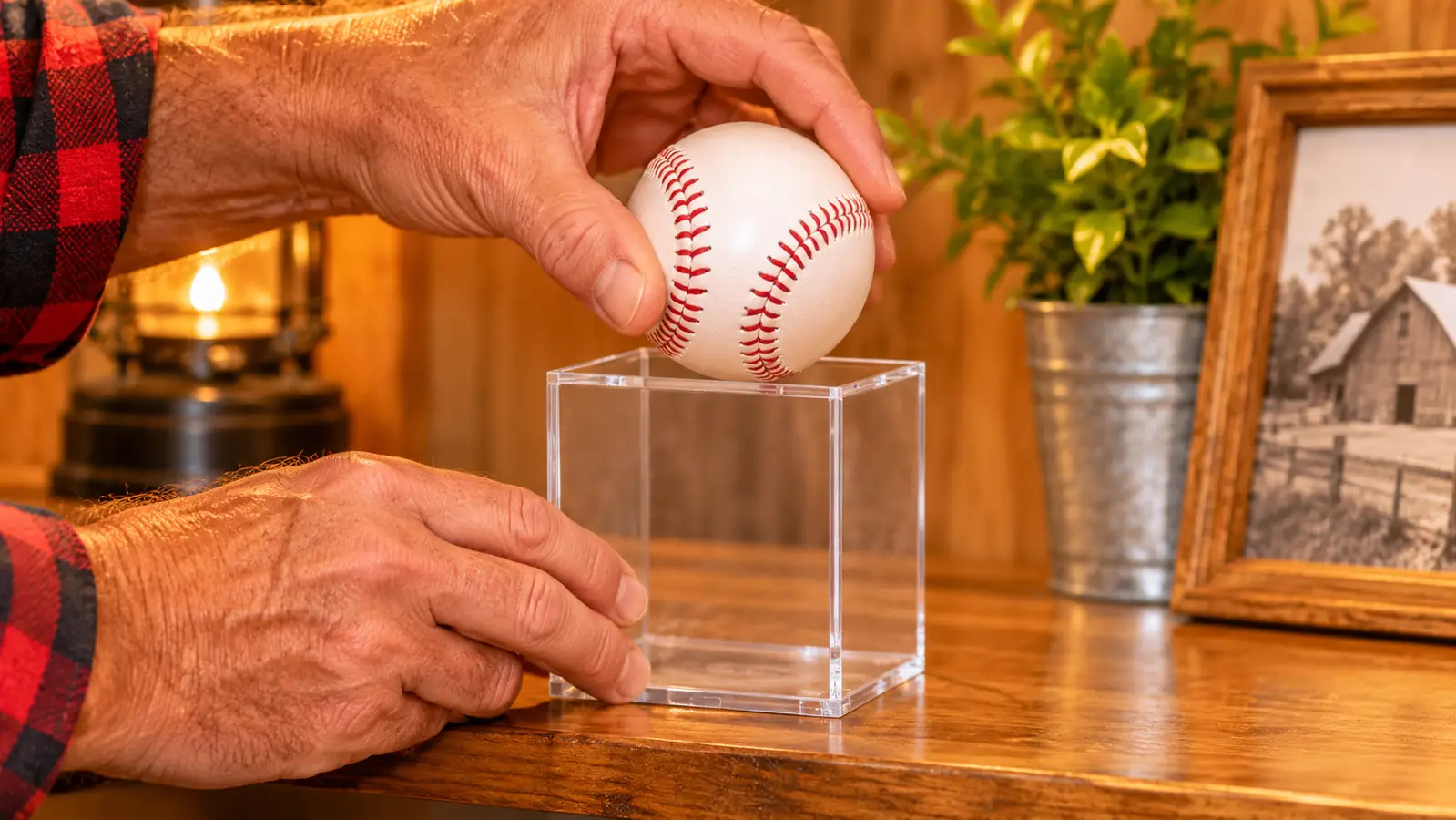
The first one I bought held a ball signed at a high school reunion fundraiser. I put it in, set it on the shelf, and then did the thing everybody does, which is pick it up and turn it over to see whether the ball rattles. It does not rattle. There is a molded cradle inside that cups the ball and holds it off the floor of the box, so the leather with the signature on it is not resting against plastic. That cradle is the reason I kept buying them. A box that lets the ball roll around is worse than no box at all, because now you have paid for something and you still have a loose ball.
Since then I have added one at a time, whenever a ball comes into the house. They stack, which matters more than I expected. Two rows sit flat on top of each other and the whole thing reads as a shelf of balls rather than a shelf of clutter. The last time Kyle came home from out of state he actually stopped and looked at it, which is more attention than that shelf got in the previous five years combined.
The way I use them is simple and I would guess it is how most people use them. A ball comes in, it goes into a holder, the holder goes on the shelf with the others. No labeling system, no rotation schedule, nothing clever. The one habit that actually helped was getting the balls out of the direct line of the window, which meant rearranging the shelf once and then never thinking about it again.
One note on how they arrive. Mine came in a simple sleeve, and the title on the listing says plainly that packaging may vary, so do not plan on a gift box. If you are buying one for a grandson or a friend at the office, plan on wrapping it yourself. That is not a complaint exactly. It is the kind of thing nobody puts in a review and everybody notices on the morning they hand it over.
What the UV Barrier Actually Does
Here is the plain version, and I taught history long enough to know when to simplify. Sunlight carries ultraviolet light. Ultraviolet light breaks down the dyes in ink, and a signature on a baseball is dye that has soaked into leather. The Ultra Pro holder is built with special UV barriers that reduce how much of that light reaches the ball. It does not eliminate it. Nothing at this size and this weight eliminates it. Reducing exposure is the whole game, because fading is cumulative. A ball that gets a fraction of the light lasts a good deal longer than one that gets all of it, and it costs you nothing but shelf space you were already using.
The second half of the problem is the room itself. My den has a window at the far end and a lamp on the desk, and the east shelf sits roughly square to the window. I moved the balls into the holders and left them there through a full summer with the blinds open most days, because Joan likes the light and I am not going to argue about blinds. In the fall I pulled one out and set it next to a duplicate I had kept in a drawer. The ink on the shelf ball was still dark. I do not own a light meter and I am not going to pretend I ran a lab test. That comparison is the one I have, and it pointed in one direction.
Archival safe is the phrase on the listing and it deserves a sentence of translation. It means the material the ball touches is not going to give off something that stains leather or eats ink over the years. I am not a chemist and I cannot verify that with a test tube. What I can say is that none of my balls have come out with a mark where the cradle contacts them, and I have one that has sat in the same spot long enough that a problem would have shown by now.
What it will not do is save a ball that sits in direct sun for hours a day. This is a barrier, not a vault. If your display is a windowsill, move the display. That advice costs nothing, and it is worth more than the box.
Nine years in the open took the ink from dark to grey-brown. One summer behind the UV barrier and the same ink was still dark.
The Cradle, the Stacking, and the Fit
The inside is the part you cannot see in the listing photos, so here it is. The ball sits down into a molded cradle, and the signature faces whichever way you rotate it, which means you can set a ball so the sweet spot reads from the front of the shelf instead of pointing at the back wall. The frame opening on mine measured about 3.2 inches square, and a regulation baseball drops in with a little room to spare. Square shape, tabletop mount, sits flat. Nothing about the fit is fussy, and I have never had to force a ball into one.
The whole unit weighs 4.64 ounces, light enough that I have caught one with my elbow and watched it fall to carpet and survive. It is polystyrene, so it is not going to survive a concrete floor or a move without care, and it will scuff if you stack it on top of something gritty. Tabletop mounting is the honest description. No bracket, no screw, no wall hanging, no way to get these up above eye level without building something yourself.
Because they stack and because the footprint is identical unit to unit, a row of them looks deliberate. I have six now. Somewhere past ten, a row stops reading as a display and starts reading as inventory, and that is worth thinking about before you buy the twelfth. The alternative most people weigh is a single open ball stand, which lifts the ball and shows it off and does nothing whatsoever about light. That is a different job entirely. A stand is for a ball you are not worried about.
What I Liked
- The UV barrier is the actual point, and it does the work over a full summer
- Molded cradle holds the ball off the floor and stops it rolling
- Stacks flat, so a row reads as a display instead of clutter
- Light enough at 4.64 ounces to pick up and rearrange without ceremony
- Archival safe materials, which matters for anything you plan to keep for decades
Where It Falls Short
- Polystyrene scratches and will not survive a hard drop onto concrete
- Packaging varies and it is not presentable as a gift without work
- One ball per holder, so a real collection eats shelf space fast
- Tabletop only, no wall mounting of any kind
- It reduces light exposure, it does not block it completely
What Nobody Tells You Before You Buy
The first thing is that this is not a display case. It is a box. There is no glass, no hinge, no latch, no felt lining, no brass plate. If you are picturing the case a pocket watch lived in at your grandfather's house, adjust your expectations now. What you get is a square polystyrene shell with a UV barrier, a cradle, and a fit that is good enough. It looks right on a shelf in a den with a rug and a recliner. It would look out of place in a formal living room, and I would not want it sold to me as though it belonged there.
The second thing is the packaging, which I have already grumbled about and will grumble about once more, because the title says it and the title is not kidding. There is no presentation. What arrives is the holder in a sleeve. If the ball is a gift, the presentation is on you and your roll of tape.
The third thing is the count. One ball. Not a set, not a rack, not a shelf kit. Every photograph of a shelf full of these is somebody who bought six. The listing is honest about it, but a product page full of balls can make a person think otherwise, and I would rather say it out loud than have you find out at the mailbox.
The fourth thing is the one I would most want to know if I were starting over. This protects against light. It does not protect against humidity. A basement in Kansas gets sticky in July whether you like it or not, and a UV box does not solve that and neither does a nicer box. If your den runs damp, deal with the moisture on its own. A ball that has gone soft from damp is not coming back, and no holder on the market is going to fix it after the fact.
The fifth thing is small but it has annoyed me twice. There is no place to write anything. No label, no slot, no card holder. If you have more than a handful of balls and you cannot remember which fundraiser each one came from, you will end up keeping a list on your phone. Joan suggested a strip of masking tape on the underside and she was right, which I have told her.
How They've Held Up
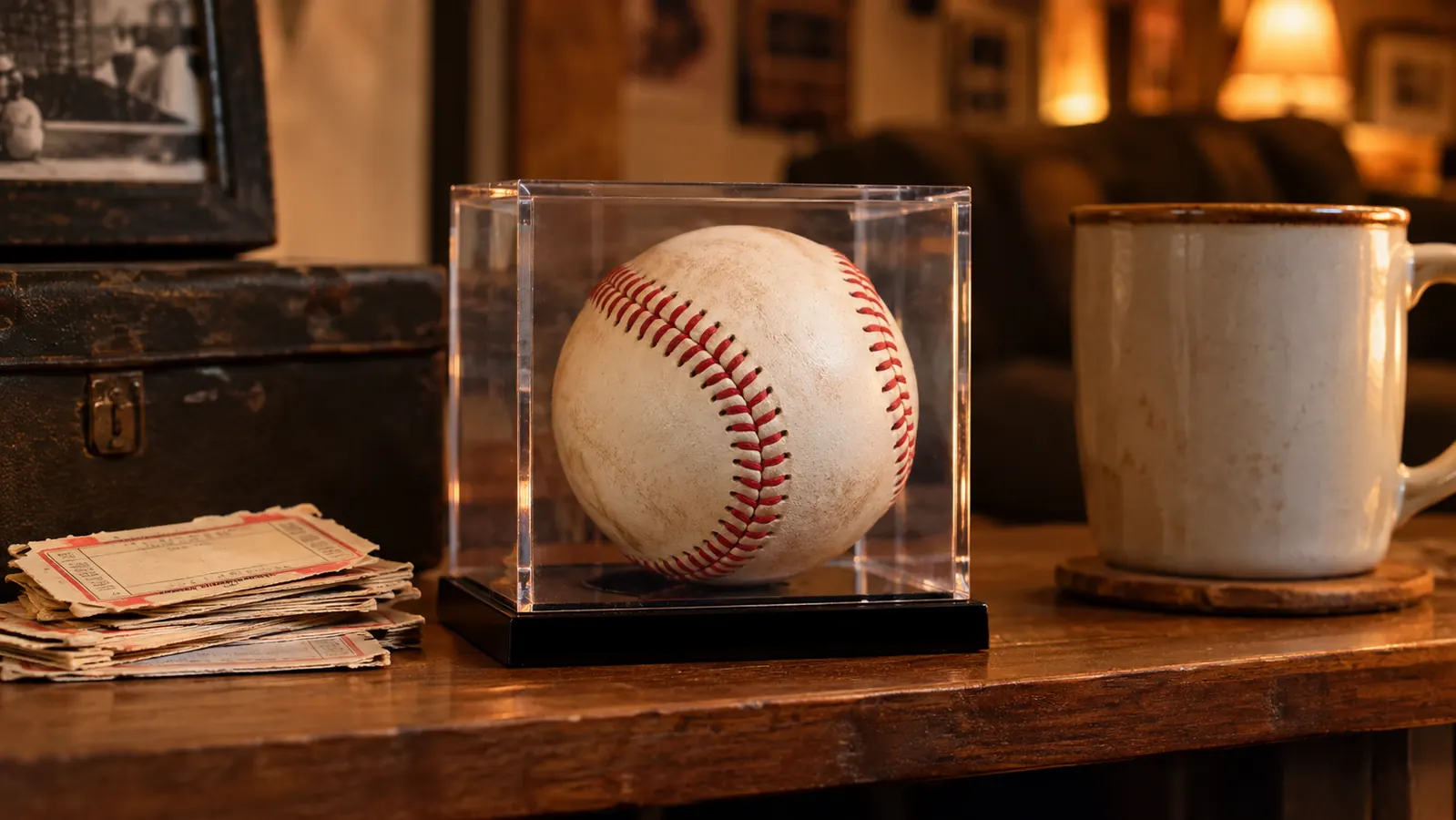
I have had the oldest of mine long enough to move it three times and knock it off a shelf once. The polystyrene has a couple of scuff marks on the outside from stacking and a small nick at one corner from the drop. The cradle inside is unchanged and the ball still sits tight. Nothing has cracked and I have not seen any yellowing. For a four and a half ounce plastic box, that is about all you can ask of it.
The ball inside has held its ink, which is the whole point. I am not going to tell you it looks like the day it was signed, because I did not photograph it then and I would be guessing. What I can tell you is that it looks better than the one that sat out in the open. That is not a scientific finding. It is the only comparison I have, and it is the reason every ball in the den is now in one of these.
The one maintenance item I would flag is dust. The outside of the box collects it the way anything flat collects it, and because you are looking through the front, a dusty box is a duller ball. A dry cloth every few months handles it. Do not go at polystyrene with any cleaner that has solvent in it, because that is how you turn a display box into a fogged-up display box.
Who This Is For
If you have a signed ball on an open shelf in a room with a window, this is for you, and the sooner the better, because fading does not pause while you think about it. If you have three or four balls and no plan, buy three or four holders and be done with it. If you are the type who keeps a ball in a shoebox in a closet because you have nowhere to put it, this gives you somewhere to put it, and the next one will stack right on top.
It is also for the person who wants the collection visible. Half the point of a signed ball is looking at it. A holder you can see through, sitting on a shelf at eye level, does that. A drawer does not.
And I would say this to anyone who inherited a ball and does not quite know what to do with it. Put it in one of these and put it on a shelf where you will walk past it. An inherited ball in a shoebox is a thing you feel guilty about. An inherited ball on a shelf is a thing you enjoy, and that is a real difference for the money.
Who Should Skip It
Skip it if you are expecting furniture. This is not a case with a glass door and a lock, and if that is what you want, go buy that instead. Skip it if the ball lives where direct afternoon sun hits the shelf, because you need to move the ball first and buy the box second. Skip it if you are protecting something that needs climate control, because this does nothing for humidity. And skip it if you want one purchase to cover a whole collection, because one holder covers one ball.
One more honest note. There are cheaper ways to get a ball off a shelf and out of the light. A shoebox in a closet works. A drawer works. What the Ultra Pro holder gives you over a shoebox is that you can see the ball, the ball stays put, and the row looks like something you meant to do. If none of that matters to you, use the shoebox. I mean that.
Put something between the window and the signature
One ball per holder, a molded cradle that keeps the leather off the plastic, a UV barrier, and a stack that stays put on a shelf. If you have been meaning to get the balls off the open shelf, this is the plainest way to do it.
Amazon Check Today's Price on Amazon →