
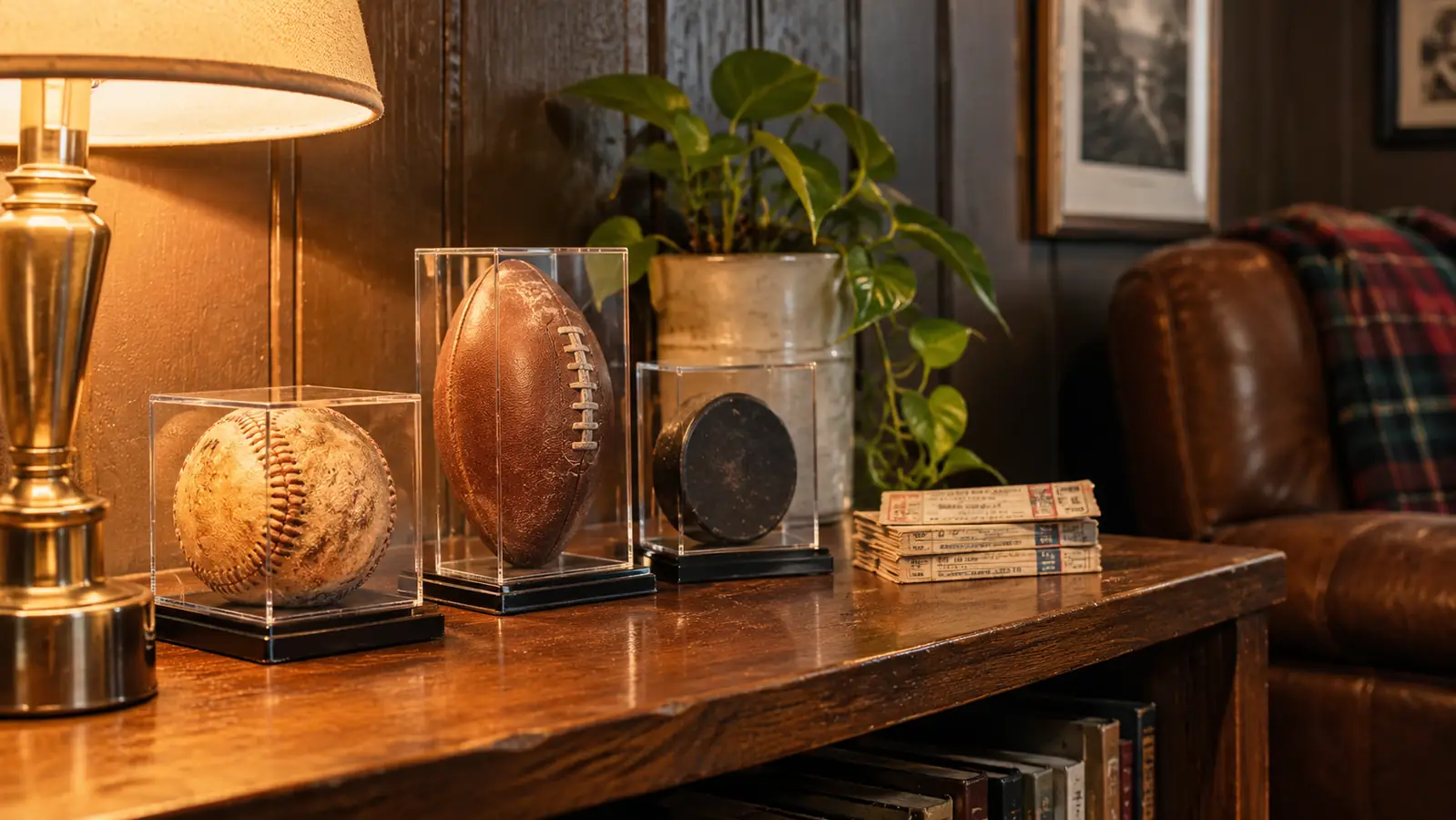
A signed baseball has two enemies, and neither one is gravity. Light fades the ink. Hands wear the leather right where the ink sits. Everything else about how you display one is a preference, and I have strong preferences about most things. I am Mitch Delaney. I taught history in Overland Park for a long time and coached football after that, and my basement den holds the things I would grab first if the house caught fire: a few signed baseballs, a couple of framed jerseys, ticket stubs from games I do not want to forget. Some of those balls sit in an Ultra Pro square UV holder. Two of them sat on an open stand for years before I moved them.
So here is the short answer. If the ball has ink on it that you would be sick to lose, put it in the Ultra Pro Baseball Clear Square UV Holder. If it is a ball with no signature, or one you take down and toss around every time your nephew visits, an open stand does the job and takes up less room doing it. That is the whole decision, honestly. The rest of this is the reasoning, because the reasoning is where people get talked into the wrong thing by a shelf display at a card shop.
| Ultra Pro UV Holder | Open Ball Stand | |
|---|---|---|
| UV protection | UV barriers built into the plastic, which is the reason the case exists | None. The ball sits in open air and takes whatever light the room gets |
| Dust and handling | The ball is not out where dust settles and where every visitor's thumb lands | Every hand that picks it up touches the leather and the ink |
| View of the ball | You look at it through plastic, and a nearby lamp can throw a reflection | Nothing between your eye and the leather, top and back included |
| Getting the ball out | You lift it out of the built-in cradle, which I do about twice a year | Reach in and pick it up in one motion, no frame to work around |
| Shelf footprint | 12.5 inches on each side and 2.5 inches deep, a real square of shelf | Roughly the ball plus an inch in any direction |
| Storing several | Archival safe and stackable, so four of them make a tidy column | Nothing to stack. Each ball needs its own square of shelf |
| Frame material | Polystyrene frame, 4.64 ounces, tabletop mount | Wood or wire depending on the maker, and quality varies wildly |
| Best for a signed ball | Yes, that is what it is for | Only if the room has no window and nobody touches it |
| Best for a ball you handle | It gets in the way of that | Built for it |
How These Two Ended Up Side by Side
I did not set out to compare anything. I had an open stand because that is what the shop had, and a ball sat on it in my den for years and looked fine. Then a friend who collects far more seriously than I do looked at that shelf and asked me one question: how much sun does this room get? The answer was a lot. The den has a window on the east side, and I am down there most mornings with coffee and the paper, which means that shelf gets hit with light for three or four hours a day, every clear day, all year.
The shelf itself is six feet of oak I put up myself in 2011, about four feet off the floor, which puts it right in line with that window. Before I bought anything I tried the free fixes. I turned the stand so the sweet spot faced the wall, which only meant I was hiding the thing I wanted to look at. I draped a dish towel over the ball for a month. It worked, and it looked like laundry. The towel is what convinced me. If my choices were a towel or buying something, I was going to buy something.
So I bought a holder, moved the signed ball into it, and left an unsigned ball out on the open stand to see whether I was being fussy. Four summers later I have an opinion, and it is not the opinion I expected. I assumed the case would be better across the board. It is not. It is better at exactly one thing that happens to be the thing that matters, and worse at several small things that matter more than people admit.
What the Ultra Pro Holder Actually Is
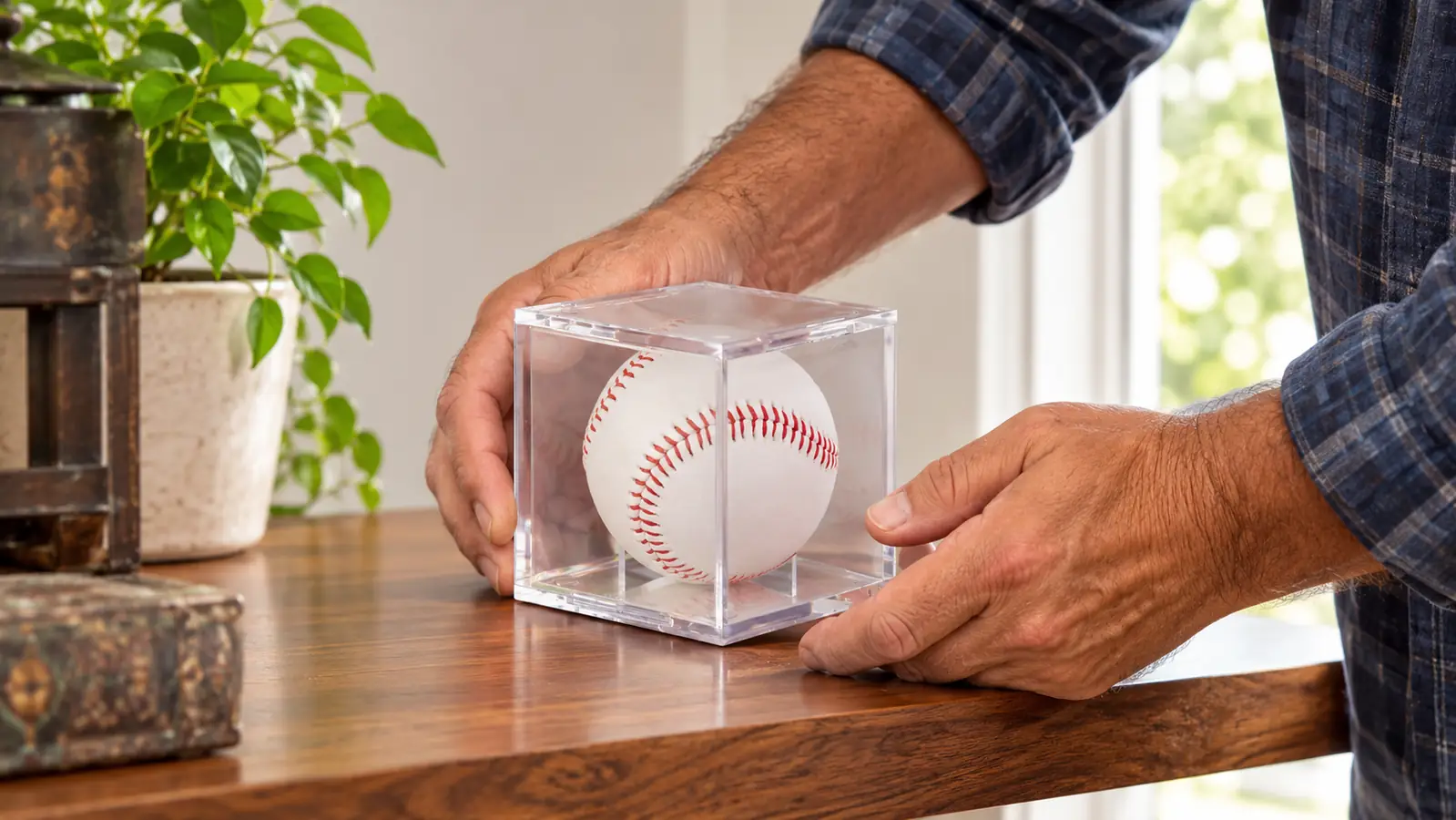
Strip the language off it and it is a square polystyrene case, 12.5 inches on each side and 2.5 inches deep, weighing 4.64 ounces. The ball sits down into a built-in cradle so it does not roll around or settle against a corner. The plastic carries UV barriers, which is the entire reason the thing exists and the only feature I would pay for on its own. It is archival safe, it mounts on a tabletop, and it is stackable.
The first one I opened, I expected the ball to rattle around in there. It does not. The built-in cradle holds it in place, and the ball stays put when you slide the case six inches down the shelf to make room for something else. The spec sheet lists a frame size down to six decimals, 3.203125 inches square, which is the kind of number somebody got by measuring an actual baseball and then measuring it again. Most listings round off and hope you do not notice. I appreciate a company that does not.
That stacking detail matters more than it sounds like it should. My den shelf is a fixed length of wood and I am not adding another one. Because the holders stack, four of them make a column instead of four separate objects all competing for the same twelve inches. I display more balls than that shelf had any business holding, and it still reads as a display rather than storage.
What it does not do is travel. This is a tabletop piece, sized to sit on a shelf and stay put. It is not something you drop in a bag for a card show, and I would not hand it to a kid to carry across a room. Mine has lived in the same spot on the same shelf since the day I set it down, and that is the correct life for it.
Where the UV Baseball Display Cube Wins
The UV barriers are the whole argument, and everything else is a bonus. Ink does not fail dramatically. It goes brown at the edges of the signature first, then the blue or black softens, and one afternoon you look at a ball you have walked past a thousand times and realize the autograph you could read clearly a decade ago is now a suggestion. A ball on an open stand in a room with a window takes that light every day. The Ultra Pro holder puts a filtering layer of plastic between the ball and the window and does it without you having to think about curtains.
The second win is that it ends the touching. People come down the stairs, they see a baseball sitting out, and they pick it up. It is a natural thing to do and I have done it myself. Every one of those pickups puts oil from a thumb onto the leather, and the ink sits right there on the sweet spot where a thumb goes. On an open stand the ball is an invitation. Inside the holder it reads as a display, and guests look at it instead of grabbing it. I have watched that happen at two family gatherings, and it is worth more than the feature list suggests.
Ink does not fail dramatically. It goes brown at the edges first, and one afternoon the signature you could read clearly a decade ago is a suggestion.
Where the Open Ball Stand Wins
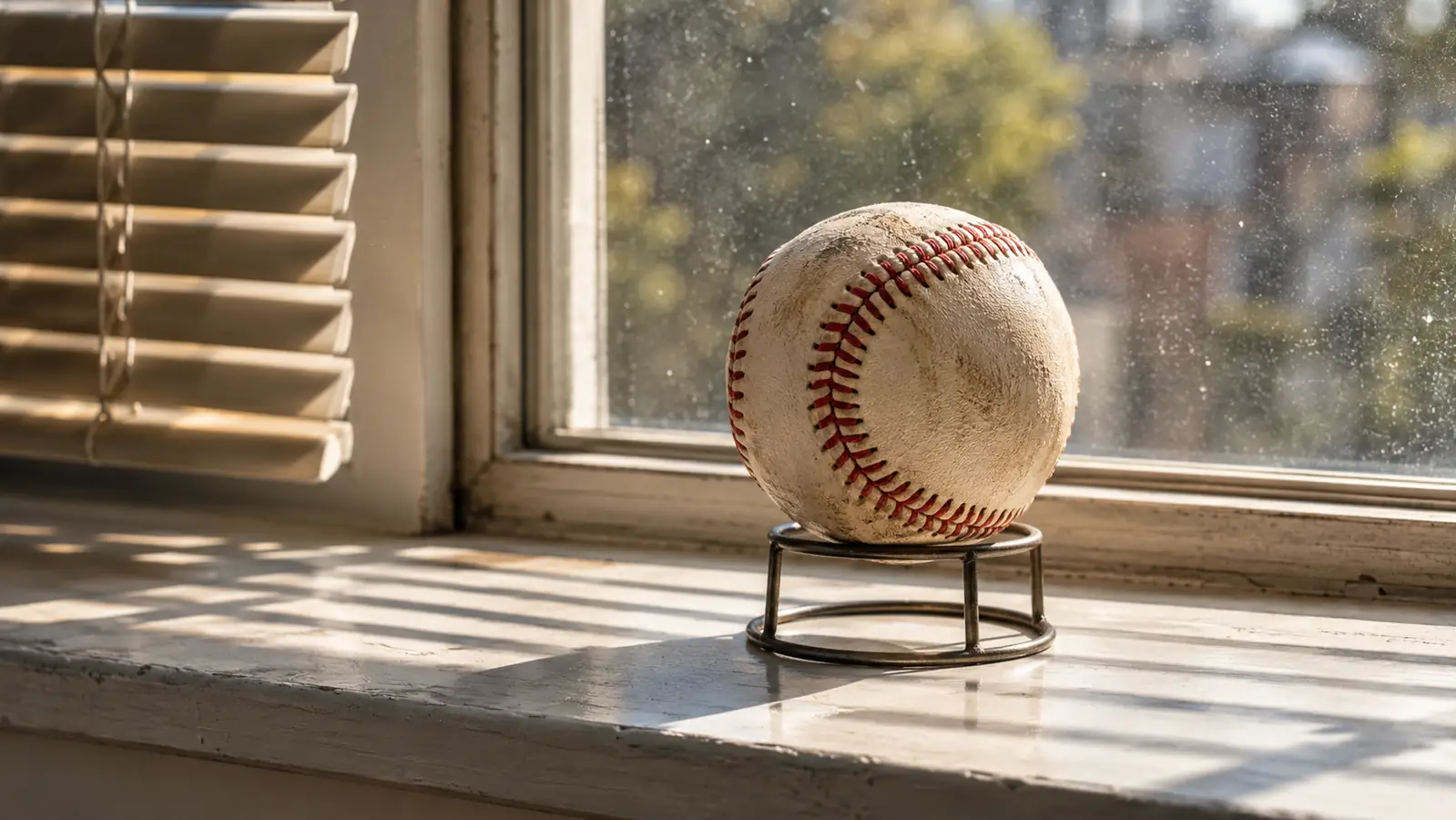
An open stand shows you the entire ball, top and back included, with nothing between your eye and the leather. You can see the ball fine through the case, but you are still looking through a layer of plastic, and with a lamp on that shelf you catch a reflection at exactly the angle you wanted to look from. If the pleasure for you is the object itself, the ball sitting out in the air on a simple ring, an open stand gives you more of it. There is no argument against that.
The open stand has one more thing going for it that took me a while to admit. It is honest about what it is. A baseball on a ring stand looks like a baseball on a shelf, and a ball in a case looks like a museum piece, and some rooms want the first thing. My den is a basement with a recliner and a television in it. It is not a museum. Two of the balls down there sit out in the open for exactly that reason, and the one with ink on it is the one in the case.
It is also the easier thing to live with in two ordinary ways. You can pick the ball up in one motion, which counts if it is a ball you actually handle rather than one you preserve. And the footprint is roughly the ball plus an inch. The Ultra Pro holder is a 12.5 inch square, and on a crowded shelf that is real estate you notice the first week. I had to move a framed photo to make room, and I liked that photo.
Then there is the cost. I am not going to pretend an open stand and a UV holder are the same purchase, because they are not, and the stand is less money by a wide margin. If you are displaying six balls and none of them carry a signature, six open stands do the job and you keep the difference. Spending holder money on unsigned balls is the most common mistake I see in a den like mine.
The Ball With Ink on It Belongs Behind the UV Barrier
The Ultra Pro Baseball Clear Square UV Holder holds one ball in a built-in cradle behind UV-filtering plastic. Archival safe, stackable, 4.8 stars across 5,457 ratings. Move the signed one in and stop thinking about the window.
Amazon Check Today's Price on Amazon →Who Should Buy Which
Buy the Ultra Pro holder if the ball is signed, if the room it lives in has a window, and if it is going to sit in the same spot for the next decade. Buy it if you have more than one signed ball and want them stacked in a column instead of scattered across a shelf at different heights. Buy it if you have guests who cannot keep their hands off things. And buy it if you have already noticed a signature softening and want to stop the bleeding, because that ball is not coming back but the fade can slow to almost nothing.
One note on shelf math before you order more than two. Each case is 12.5 inches on a side, so a row of four takes just over four feet of shelf, and a stack of four takes 2.5 inches of depth per case. I measured nothing and ordered anyway, and I ended up moving a framed photo of Joan and me at a ballgame up to the wall above the desk, where it has been ever since. She has opinions about that. Fair ones.
Buy the open stand if the ball is unsigned, if it comes off the shelf regularly, or if shelf depth is tight. Buy it if you are displaying a dozen balls and the money needs to go toward one good holder for the signed one rather than twelve cases for balls nobody signed. Buy it if you like the look of a ball sitting out in the open, which is a legitimate reason and not a compromise. Most collections I have seen would be better off with one UV holder and five open stands than with six of either.
What I'd Do Differently
I would have moved the signed balls into holders the year I got them, not four years later. I lost a couple of summers of light on one ball because I liked how it looked on the open stand, and that trade was not worth it. The open stand did not damage anything visible yet, but I was running an experiment on an object I cannot replace, which is a foolish thing to do when the case costs less than a decent dinner out.
And I would not buy a holder for a ball I plan to handle. The right number of holders in a house is the number of signed balls you intend to leave alone. Everything else can sit on a stand where you can reach it, and it will look better that way anyway. Both of these things are good at their job. They are just not the same job, and the mistake is buying one when you needed the other.
Keep the Signature, Not Just the Ball
One ball, one built-in cradle, UV-filtering plastic, archival safe and stackable on a shelf. If there is ink on the ball and a window in the room, this is the version worth having.
Amazon See Current Price on Amazon →