
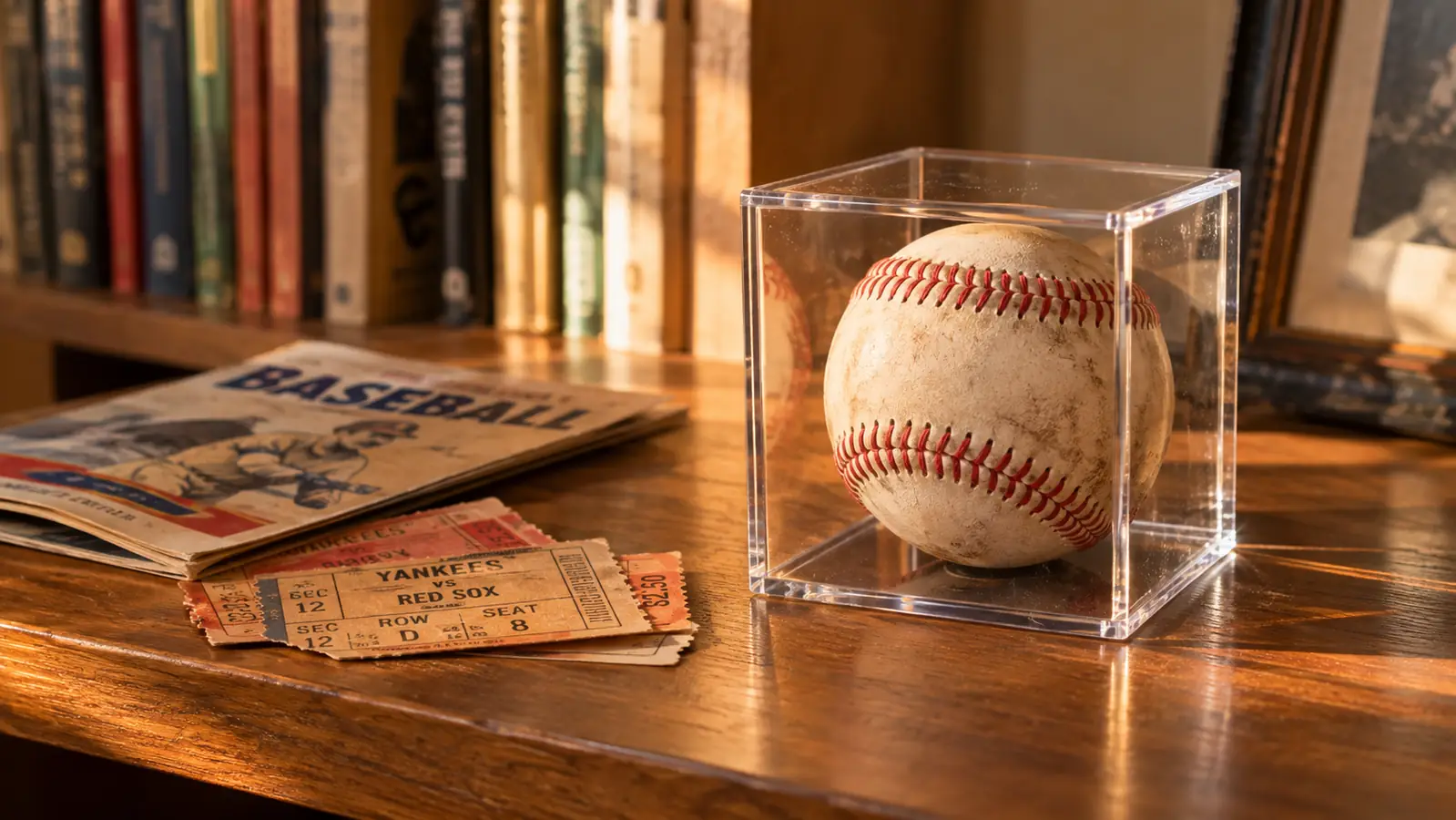
The first signed baseball I ever put on a shelf in my den went yellow in about four years. Not just the ink. The whole ball, turned the color of a newspaper somebody left out in a driveway. I had it on an open wooden stand facing the porch door, and I never gave it a second thought until the afternoon I picked it up to show my son Kyle and saw that the signature had faded down to a rumor of itself. That ball is still in the basement. I keep it as a reminder that air and light are not neutral parties.
That was close to fifteen years ago. Since then I have tried a wooden case with a glass front, a plastic cube from a craft store that cracked at the corner in one winter, and, briefly and without pride, a shoebox. The Ultra Pro Baseball Clear Square UV Holder is the one that ended up staying. I own six of them now. The oldest has held the same ball since the spring of 2019, through two Kansas summers, one dehumidifier replacement, and a paint job that required me to move every single thing in that room.
The Quick Verdict
The simplest protection I have found that a sixty-one-year-old can operate in a dim basement without instructions. It will not save a ball from a flooded floor and it will not make a common ball rare. For keeping a signed ball out of the light and off the dust, six years in, it has done exactly what it says.
Amazon Check Today's Price →Six Years on a Bright Shelf, and the Lettering Still Reads From Across the Room
I have six of these in a west-facing den and the oldest ball went in during 2019. Nothing to plug in, nothing to assemble, nothing to remember. If you have a signed ball sitting on an open stand right now, this is the fix and it takes about ten seconds.
Amazon Check Today's Price on Amazon →How I've Used It
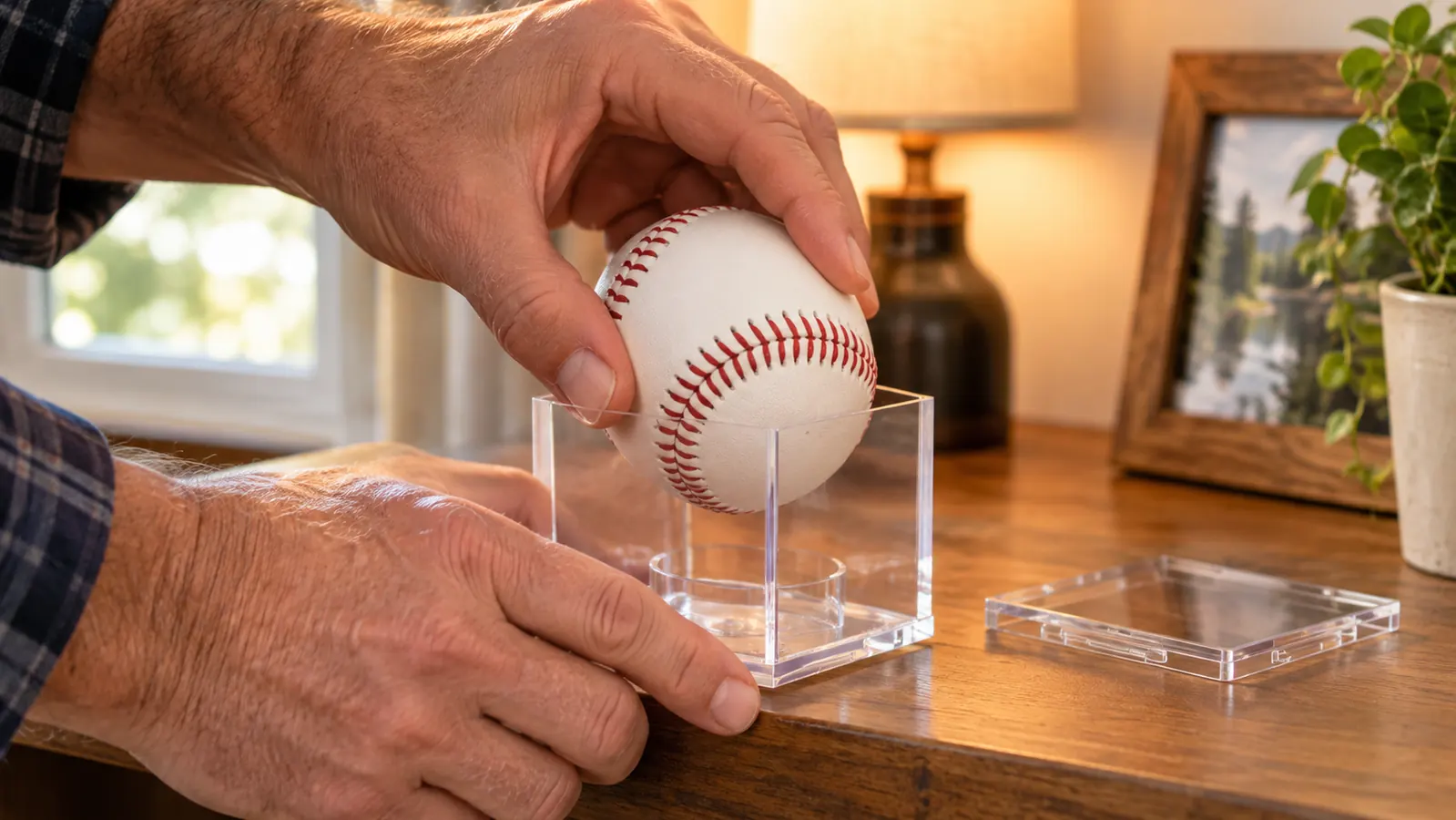
There is no assembly and no learning curve. You lift the lid, you set the ball on the cradle molded into the base, you set the lid back on. That is the entire procedure, and I have now done it six times without once looking anything up. For a man my age with a basement full of things that came with instructions, that counts for something.
My den takes a hard wash of afternoon light through a west window from about three o'clock until the sun drops behind the neighbor's maple. That is the light that killed the first ball. The six holders sit on a built-in shelf about four feet off the floor, off to the side of the window and out of the direct beam, but the room is bright for four or five hours a day and I am not going to brick up a window over baseballs. So the shelf has to defend itself.
Empty, one weighs 4.64 ounces. You can pick it up with two fingers. When you set it back down on a shelf it does not rattle or skate, which matters more than it sounds like it should when you have a row of them and you are reaching over the top of one to get at another.
The opening is about 3.2 inches square. A baseball is a hair under three inches across, so the ball settles into the well with a little daylight around the widest part and does not look wedged in there. It looks like it was made to sit in that spot, because it was.
I have moved the whole row twice now, once for the paint job and once when Joan decided she wanted the built-in shifted six inches to make room for a reading chair. Both times I carried the six holders down to the kitchen table, wiped each one, and set them back. Nothing came apart, nothing clouded, and no ball took a mark from the handling. The part that surprised me is how little there is to remember. There is no front and back, no hinge to line up, no lid orientation. You set it down and it looks the same from every side, which is more than I can say for the wooden case it replaced.
I should say up front what I am not measuring. I have not run a light meter, I have not compared a control ball in a lab, and I am not going to pretend six balls on a shelf is a scientific sample. What I have is one bad outcome and then a long run of ordinary ones, and the ordinary ones are the point.
What the UV Barrier Actually Does
Ultra Pro lists special UV barriers as the reason to buy this over a plain acrylic box, and the claim is that they reduce light exposure and therefore reduce signature fading. I am a retired history teacher, not a chemist, so I will give you the version I can actually vouch for. Six balls have lived in these cases for between one and six years in a bright room. None of them has yellowed, none has ghosted, and the lettering on the oldest still reads from the doorway. The balls that spent those same years on open stands did not come through it nearly as well.
Here is the part worth understanding before you buy anything. Light is only one of the three things that wear out a signature. The other two are heat and moisture, and a plastic box does nothing about either one. If your basement runs damp in July, no case on the market is going to save leather. What the case does is remove the light variable, and light is the one you can actually control without turning a spare room into a climate system.
I keep a written log in the back of a spiral notebook, because I am that sort of man. The oldest case is dated March 2019 in my own handwriting, with the month and the year and nothing else. The next two came in 2021, right after the craft-store cube split at the corner and I decided I was finished buying cheap. The last three came in 2023 when I finally gave up on the scattered approach and consolidated everything onto one shelf in one room. Six years, four purchase dates, and not one replacement because a case failed. The only thing I have replaced is the dehumidifier.
The second thing it does is keep dust off the lettering, and I did not appreciate that until I wiped down an open stand with a dry rag and watched a fleck of grit catch the corner of a signature. Dust is abrasive. Every time you dust an unprotected ball you are sanding it, gently, in the direction of your hand. Inside a closed case you are dusting flat plastic instead, which does not care.
So the honest case for these is not that they are archival grade in some laboratory sense. It is that they take the two variables you can control, light and dust, and move both of them off the object. For a shelf in a bright room, that is most of the problem.
The Cradle, and Why It Matters More Than It Sounds
The built-in cradle is the feature I did not know I wanted. It is a shallow ring molded into the base, so the ball rests on a ring of contact instead of sitting flat on its own leather. The ball does not roll. It does not shift when you slide the holder across the shelf or carry it to the kitchen table because somebody at dinner asked to see it.
It is a cradle, not a clamp. Turn the whole thing upside down and shake and the ball will come out. I learned that during the paint job, when I carried four of them up the stairs stacked in my arms like a man carrying four plates. No harm came of it, but do not treat one of these like a lunchbox.
An older, scuffed, game-used ball sits in there just as well as a clean one. The ring does not care. I have one ball in the row that is more scuff than leather at this point and it has never once shifted out of place.
Stacking, Dust, and the Cleaning Mistake I Made
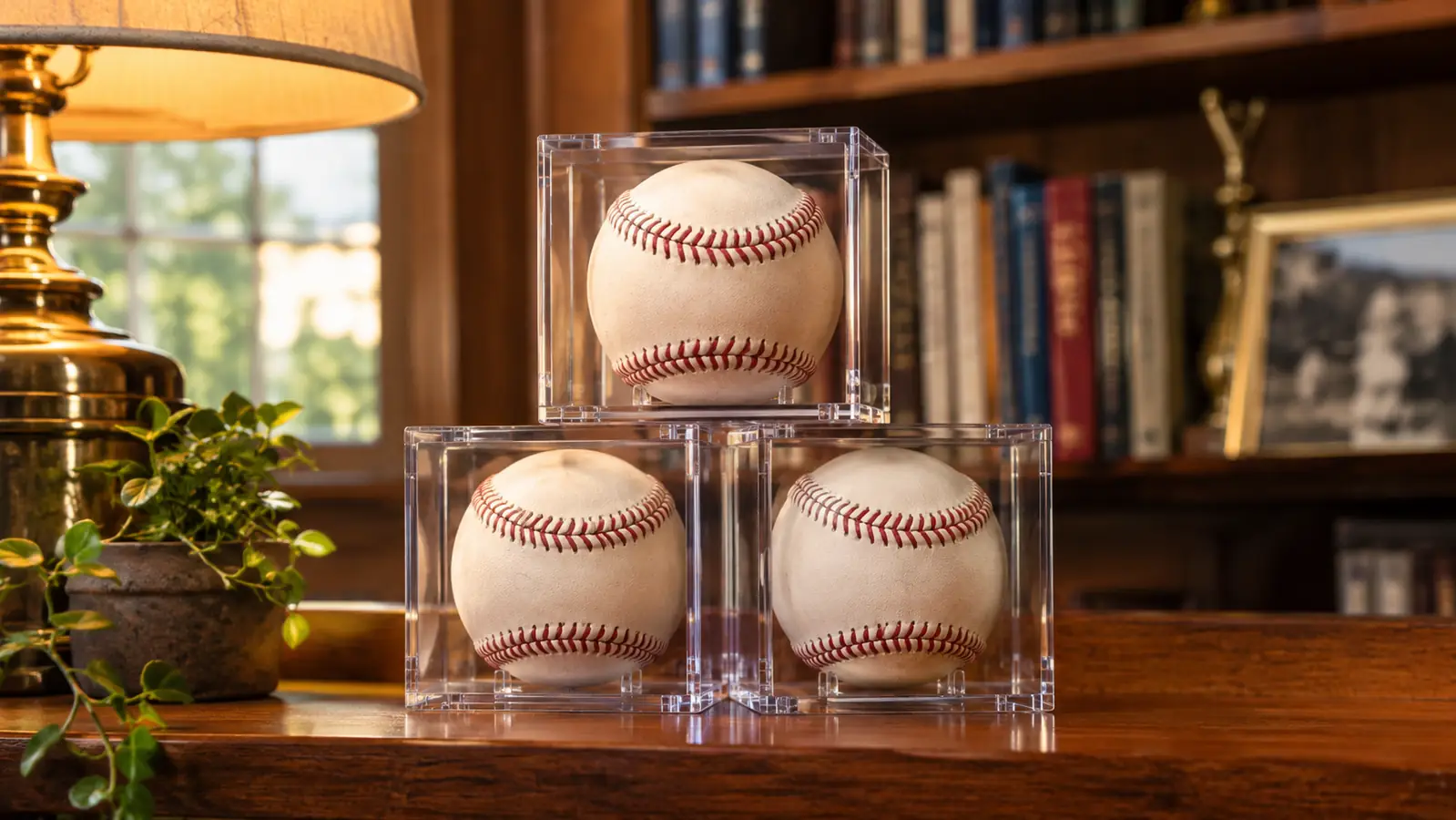
Ultra Pro calls them archival safe and stackable, and those two words turn out to be the whole reason I standardized on these instead of the odd collection of mismatched cases I had before. Stackable means three go on one shelf with one on top and the row stays a row. Archival safe, for my purposes, means the plastic is not going to off-gas something onto the leather. Nothing in my row has gone sticky or cloudy in six years.
The material is polystyrene, and polystyrene is not glass. It picks up fine scratches if you stack carelessly or wipe it with the wrong cloth. My oldest has a scuff across the top face from the evening I set a coffee mug down on it. That was pure laziness on my part and the ball underneath is fine, but the case wears its history the way the rest of us do.
I also keep a small index card inside each case, folded once, with the date and where the ball came from written in pencil. The card tucks under the cradle and does not touch the leather. Pencil and not pen, because thirty years of grading papers taught me that pen finds a way to bleed and pencil does not. Not one of those cards has ever interfered with the lid sitting down flush.
On cleaning: a soft cloth and warm water, wrung out until it is barely damp. Do not reach for the ammonia glass cleaner, and do not spray anything directly at the case, because liquid finds the seam and dries in a ring you will not get out. I learned that one on a picture frame and applied the lesson here.
The lid is a friction fit and it is not sealed. That has not let dust in on mine, but it does mean I would not store one in a garage, a shed, or anywhere a mouse has ever been. This is furniture, not storage.
What It Does Not Do
It holds one ball. That is the honest limit and it is the one that eventually catches up with you. Twenty signed balls is twenty cases, which is twenty times the shelf space and twenty lids to lift. I am at six and I can see the ceiling of this approach in a way I could not at two. If your collection is bigger than a shelf, you are shopping for a wall case, not a stack of these.
I did test the seal question one August, mostly out of stubbornness. I left one case open on the shelf for two full days beside a closed one and then looked at both in good light. The open one had collected a visible film of dust across the top curve of the ball, the kind you can see when you tilt it. The closed one had nothing. That is not a laboratory result and I would not present it as one, but it is the reason I stopped leaving lids off while I dust the shelf, which I used to do out of pure convenience.
It does not protect against a flood, a dropped box during a move, or a humid summer with no dehumidifier running. It does not make a common ball rare. It does not authenticate anything, which ought to go without saying, but I have read enough listings in my time to know it does not.
And it is not a museum piece itself. It is a clear plastic box. On a shelf in a finished basement it looks tidy and deliberate. In a living room with good furniture it looks like a clear plastic box. Joan has opinions about this and she is usually right.
I looked at the alternatives before settling. A glass-front wooden case is handsomer and costs more than I wanted to put into a basement shelf, and it does not stack. An open stand shows the ball better and protects it from nothing. A plain acrylic cube does most of the same job until you remember that acrylic and polystyrene are not the same thing and the UV claim is the entire point.
What I Liked
- Blocks the light that turned my first ball yellow
- The molded cradle keeps the ball from rolling or shifting
- Stackable, so a row of six stays a row instead of a pile
- No assembly, no moving parts, nothing to fail in a year
- Wipes clean in about ten seconds with a damp cloth
Where It Falls Short
- Friction-fit lid, not sealed, so not for a garage or shed
- Polystyrene scratches if you are careless with it
- One ball per case, and the shelf space adds up fast
- No protection at all from heat or damp
Six years in a bright west-facing room, and the lettering on the oldest ball still reads from the doorway. The one that sat on an open stand did not make it four.
Who This Is For
This is for the person who has one to six signed balls and no plan. You bought one at a charity auction, or a card show, or your kid caught a foul and somebody signed it afterward, and right now it is on a bookshelf or a windowsill doing nothing to protect itself. Put it in one of these and stop thinking about it.
It is also for the fan who wants the ball visible. That sounds like a small thing and it is not. A ball in a drawer is safe and unloved. A ball in one of these on a shelf is the first thing a visitor picks up and asks about, which is the entire reason you kept it.
Who Should Skip It
Skip it if you have more than a dozen balls and no more shelf. You will spend an afternoon stacking and then start pricing wall displays. Skip it if the ball lives in a garage, a shed, or a damp basement corner, because a friction-fit lid does nothing about moisture and you will blame the case for a problem it never claimed to solve.
Skip it if you want the ball shown off at an angle, under a light, on a stand. This is a flat square box that sits level. That is fine at shelf height where you are looking down at it anyway, and not much use on a coffee table where people are looking across.
The Ball on Your Shelf Is Not Getting Any Younger
Ten seconds to load. A wipe down twice a year. That is the entire maintenance schedule. Everything else in that room can take care of itself, but leather and ink cannot, and the damage does not announce itself until it is done.
Amazon Check Today's Price on Amazon →