
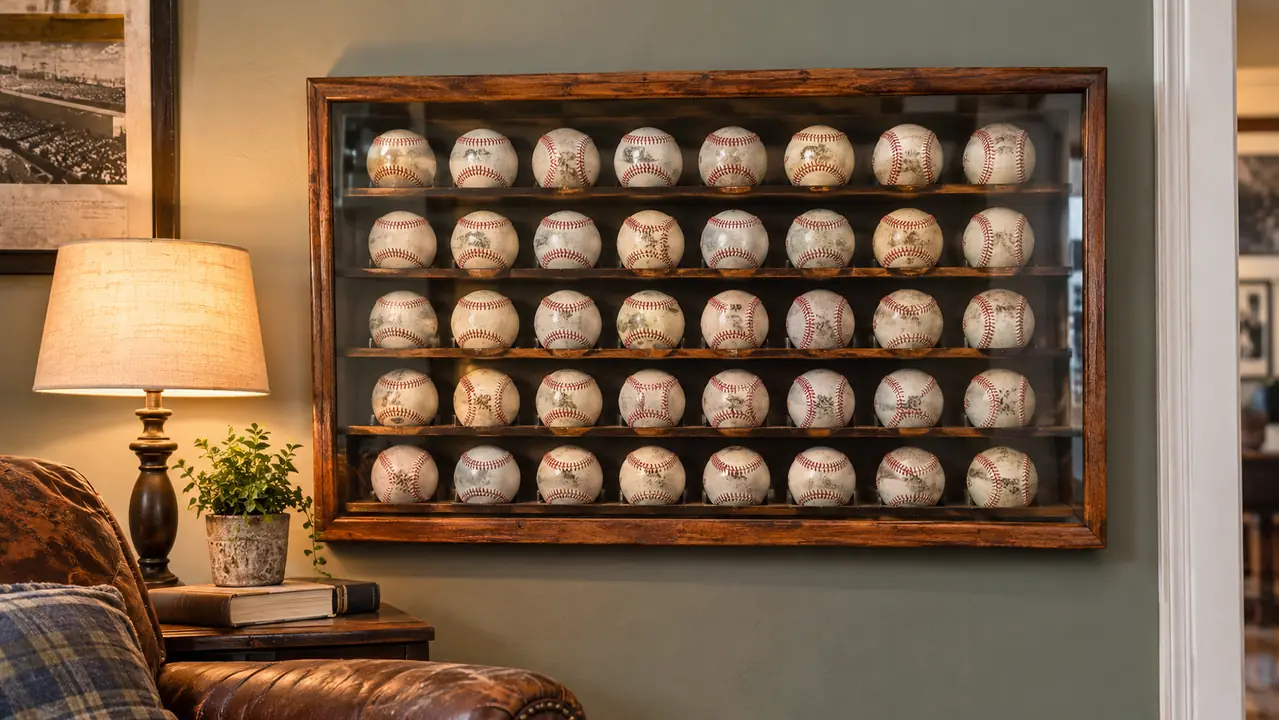
Here is the part of a display case review that usually gets left out. The case is the easy decision. The hard part is what happens to your wall, and to the balls that turn out not to be display-worthy after all. I bought the DisplayGifts 21-slot wall case for my den in Overland Park after ten years of keeping signed baseballs in a cardboard box on a shelf that nobody, including me, ever opened. This is the honest version of that purchase. Not the feature list. The parts I would tell a friend in the parking lot after a game, including the parts that irritated me.
You have already seen the product page. Twenty-one slots, 98% UV protection, a hardwood frame, locks, and a bag of wall mount hardware. All of that is accurate and none of it is the interesting part. The interesting part is that a case this size rearranges a room, and it will not fit where you assumed it would. I measured twice, wrote the number on a scrap of paper, and still ended up moving a framed jersey upstairs to make room for it.
The Quick Verdict
A genuinely protective case for a real collection, provided you already own the baseballs and about two feet of wall you are willing to give up for good.
Amazon Check Today's Price →Get the balls out of the box and onto the wall
The DisplayGifts case holds 21 baseballs behind a locking, shatter proof acrylic door with 98% UV protection and an anti-fade finish. Wall mount hardware is in the box. Check today's price and availability on Amazon.
Amazon Check Today's Price on Amazon →What Nobody Tells You Before You Buy a 21-Slot Case
First, the weight math. The case weighs 7.5 pounds empty. Twenty-one baseballs on top of that is a different structural question than the listing makes it look, and the whole thing hangs on your wall on four screws and whatever came in the bag. Most people plan the display and then think about mounting. Do it the other way around and the whole project gets easier.
Second, twenty-one slots is a lot of slots. When I ordered it I believed I had a collection. I had nine balls I actually wanted to look at, maybe six more worth keeping in the room, and a shoebox of ordinary foul balls I keep for reasons I could not defend to Joan if she ever asked me straight. Empty slots in a wall case are extremely visible. They look like missing teeth. That is not the case's fault, it is a planning failure on my end, and it is the thing I would warn somebody about before anything else on this page.
Third, depth. At 3.7 inches the case stands off the wall enough that you notice it in a narrow hallway. In my den, above a low bookshelf, it reads as furniture and I am happy with it there. In a stairwell it would read as an obstacle and I would have taken it back down the same afternoon. Where you hang it decides more about whether you like this thing than anything the manufacturer did. Before I drilled anything I cut a rectangle of cardboard to 19.25 by 17.75 inches, taped it to the wall where I thought the case should go, and left it there for six days. By the fourth day I had moved it eighteen inches to the right and down a hand's width. That piece of cardboard saved me four holes in the wrong place and a patch job Joan would have mentioned for years.
How I've Used It
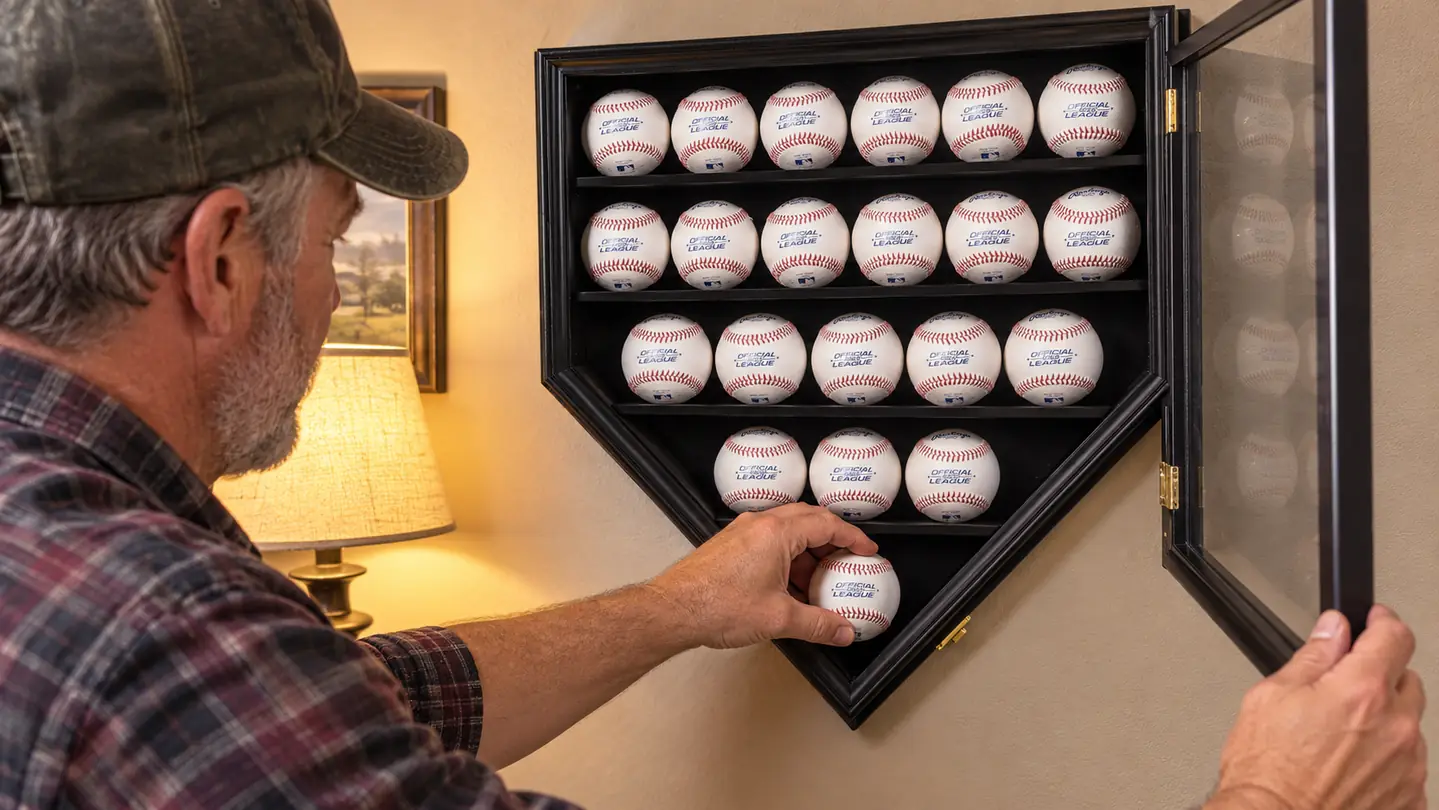
I mounted it in October on the wall between the television and the window, at roughly eye level standing. Sitting in my usual chair I am looking straight at the bottom row and up at the top row from below. If I did it over I would drop the whole thing four inches, because the balls I care about most ended up on the bottom and I am usually sitting down when I look at them. That is a small thing that took me a couple of months to notice. The day itself was a Saturday, the second week of October, windows open because it was seventy degrees out and I wanted a patch of touch-up paint to dry. I laid the case face down on an old blanket, marked the four hole positions in pencil, and carried those marks to the wall with a level borrowed from the neighbor across the street, mine having gone missing sometime in the 1990s.
Loading took two people for about five minutes and one person after that. The door opens and stays where you put it, the holders are spaced so a full size baseball clears its neighbors, and nothing had to be forced into place. I loaded it oldest to newest, left to right, a system that survived about a week before I rearranged the whole thing twice and settled on a different order entirely.
The lock is the feature I did not expect to use. I have a young nephew who visits and treats the den like a museum he has been told he may touch. Being able to close the door and turn the lock means the case stays a display instead of a caution zone. I do not touch it day to day. I use it maybe six times a year, and those six times are the reason I am glad DisplayGifts put a lock on it instead of a friction catch.
Twenty-one baseballs on top of 7.5 pounds of case, hanging on four screws, is a different structural question than the listing makes it look.
The UV Claim, and What It Actually Protects Against
The listing says 98% UV protection, an anti-fade lacquer finish, and a shatter proof acrylic panel instead of glass. I cannot verify 98% in a basement with a tape measure and a flashlight. What I can tell you is that my den takes direct afternoon sun through a west window for about three hours a day, and the case sits in the edge of that light. After a full summer, the ink on the oldest ball in the bottom left corner has not moved. Same signature, same contrast against the leather, no yellowing on the panel itself. I also ran a crude test of my own, because a percentage on a box is not something I take on faith. When I loaded the case I put an old newspaper clipping, a box score from a game I attended years ago, into one of the top slots where the light hits hardest. It has been sitting behind that door since October. Pulled it out in June and the paper was the same off-white it had been when I cut it, with no browning at the edges. That is not a laboratory result. It is enough for me to leave the case exactly where it is.
One summer in one room is not proof of anything. But the logic holds up. UV is what fades ink and dries out leather, and a door that blocks most of it does work that an open shelf cannot do no matter how nicely the shelf is made. If your collection hangs anywhere near a window, this is the feature worth paying attention to, more than the hardwood and more than the locks. I bought it for the UV, not for the frame.
The acrylic panel is the tradeoff that comes with it. It is lighter than glass and it will not shatter if something hits it, which matters in a room where a football gets thrown around on Sundays. It also collects fingerprints on the outside. A microfiber cloth handles that in ten seconds and I do it about once a month, usually the day before somebody comes over.
Mounting Is Where This Case Is Won or Lost
Wall mounting hardware is included and it is adequate hardware. Adequate is the word I want. What comes in the bag will hold an empty case against drywall. What comes in the bag plus twenty-one baseballs is a different job, and the difference between a case that hangs flat for ten years and one that sags in two is usually whether you found a stud and used it.
I caught one stud on the left side and used heavy toggle anchors on the right. That is the setup I would hand to anybody hanging something this size and this weight. Do not trust drywall on its own, do not trust the plastic anchors from a picture hanging kit, and do not hang it over a doorway where a tall person walks with a laundry basket twice a week. My first attempt was the wrong one and I will say so plainly. I used four plastic anchors from a picture hanging kit, no stud, because the wall felt solid under my knuckle and I was impatient to see the thing up. Two days later the right side had dropped about a quarter inch and the door would not close flush. I took the whole case down, filled the holes, found the stud on the left with a magnet, swapped in toggle anchors on the right, and it has not moved since. That afternoon cost me an hour and taught me more about hanging heavy objects than twenty years of owning tools had.
The frame is hand selected hardwood and all four corners met square out of the box. I have hung enough cheap frames in my life to know what a bad corner looks like, and this is not that. It has been up through a Kansas winter with the furnace running and a humid summer after it, and the door still closes without a fight or a shim. That is a longer test than most people will ever run on one of these.
How It Compares to a Wall of Individual Cubes
I considered the cube route first, and if you are weighing the two, here is the honest difference. Cubes let you buy four at a time and add as the collection grows, which is the right answer for somebody with nine balls and a habit of picking one up every season. They also let you scatter a display around a room instead of committing two feet of one wall to it forever.
Twenty-one slots in one frame does something cubes cannot, which is make the collection read as a collection instead of a shelf of separate objects. The case has one door, one lock, one UV barrier and one thing to dust. Fourteen cubes means fourteen open fronts, fourteen surfaces to wipe, and fourteen chances for light and dust to get at the leather. The single barrier is the whole argument, and it is a good one.
The tradeoff is commitment. With cubes you can stop at nine. With this case you have already decided, and the empty slots are going to sit there until you catch up. I do not regret the choice and I would make it again. But I made it with a shoebox of balls on the shelf behind me, and somebody reading this might not be at that point yet.
What I Liked
- The door blocks UV and keeps ink from fading near a west window
- The lock turns a display into something safe around kids
- Hardwood frame arrived square with no shipping damage
- Twenty-one slots puts an entire collection in one place
- Shatter proof acrylic instead of glass, which matters at chest height
- Wall mount hardware comes in the box
Where It Falls Short
- Empty slots are painfully visible, so buy it with the balls already in hand
- 3.7 inches of depth stands off the wall more than you expect
- The included hardware is adequate, not generous
- At 19.25 by 17.75 inches it needs wall space most rooms do not have spare
- Fingerprints on the acrylic door need a wipe every few weeks
The Parts That Annoy Me
The empty slot problem is first and it is the one I would fix by buying later rather than buying bigger. Twenty-one holders is a commitment. If you own eleven baseballs, this case will spend a year telling you so every time you walk past it. I filled mine slowly and the last four slots sat empty until this spring.
The footprint is second. At 19.25 inches long and 17.75 inches high it wants a wall section roughly two feet wide and a foot and a half tall with nothing else competing for it. That rules out most of the wall space in a normal house. It worked here because I was willing to move a framed jersey to another room, and I want to be honest that I moved something to make this fit. I laid a tape measure against the bookshelf twice and talked myself out of it twice before I finally admitted the shelf was going to have to move instead, which it did, one Sunday afternoon in November, with help.
The third is small. There is no ledge and no shelf on top. It is a flat rectangle on a wall, which is exactly what it should be, but it means you cannot set anything on it. I put a small ticket stub frame beside it instead and that arrangement has held up fine for two years.
Who This Is For
This is for the collector who has already accumulated more than a handful of balls and wants them out of a box. It suits a den, a basement, an office, or any room where a collection is allowed to be part of the furniture. It suits a house with a west facing window, a house with kids in it, and a house where somebody has opinions about clutter. If you actually look at your collection instead of storing it, a wall case is the format that makes looking possible.
It also works as a gift for the fan who has a shelf of signed balls and no plan for them. DisplayGifts ships the case with the mounting hardware, so the person receiving it does not have to go find anchors before they can hang it, which is more than I can say for most of what I have been given over the years.
Who Should Skip It
Skip it if you have fewer than about fifteen baseballs and no realistic plan to get there. The case will look half finished for a year and you will start buying balls to fill slots, which is a poor reason to buy a baseball and an expensive way to decorate a wall.
Skip it if your wall space is tight, if you rent and cannot put four holes in drywall, or if you want to pick a ball up without opening a door every time. Skip it if you rearrange your collection often, because a wall case is a decision you make once and then live with for a long while.
One more. Skip it if what you are displaying is not standard baseballs. Twenty-one round holders are built around baseballs, and an oversized or oddly shaped item is not going to sit right in one no matter how you angle it.
Buy it when the collection is ready, not before
Twenty-one slots, 98% UV protection, a locking acrylic door and a hardwood frame, with the wall mount hardware in the box. If you have the baseballs and you have the wall, this one earns the space it takes. Check today's price on Amazon.
Amazon Check Today's Price on Amazon →