
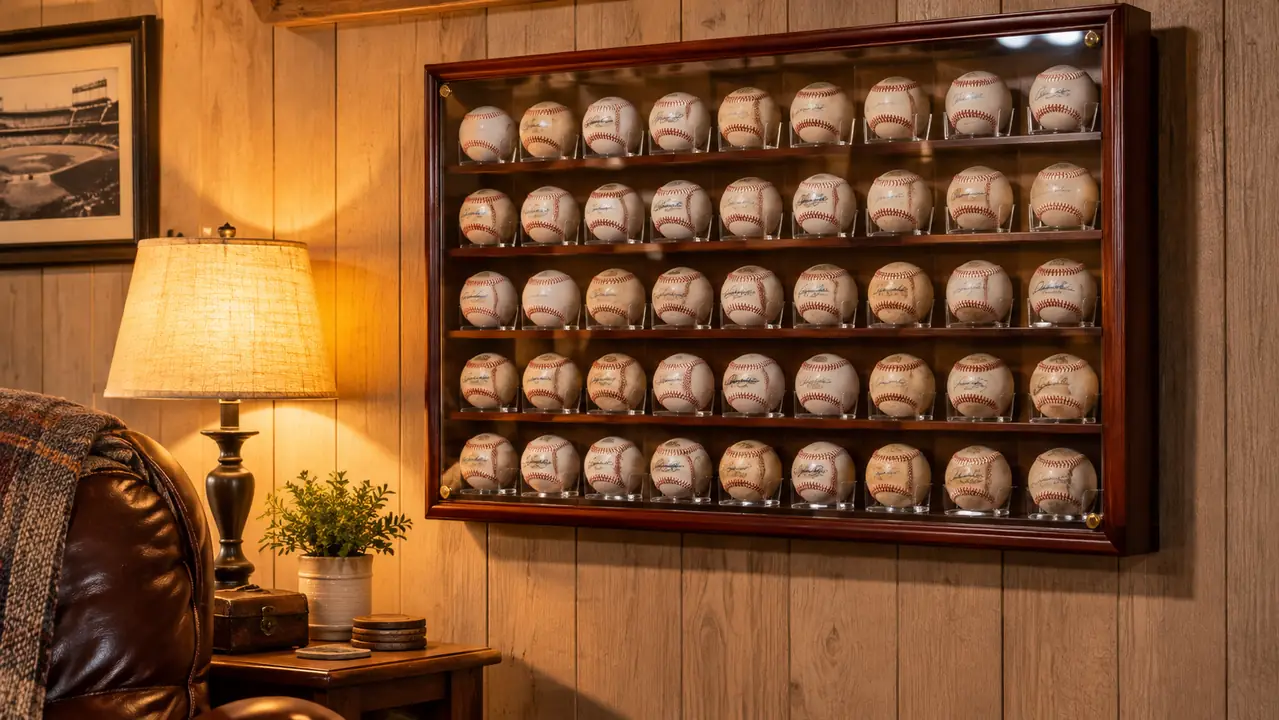
Twenty-one baseballs is not a collection. It is a decision you keep putting off. Mine lived in a cardboard box on a basement shelf for the better part of a decade, and every time I slid that box out I told myself the same thing. I will get around to it. What finally moved me was not nostalgia. It was a ball I had kept since a summer game in the late seventies, sitting where the afternoon light reached it, going from white to a shade I did not care for. Sun does that. It does it slowly enough that you never catch it happening.
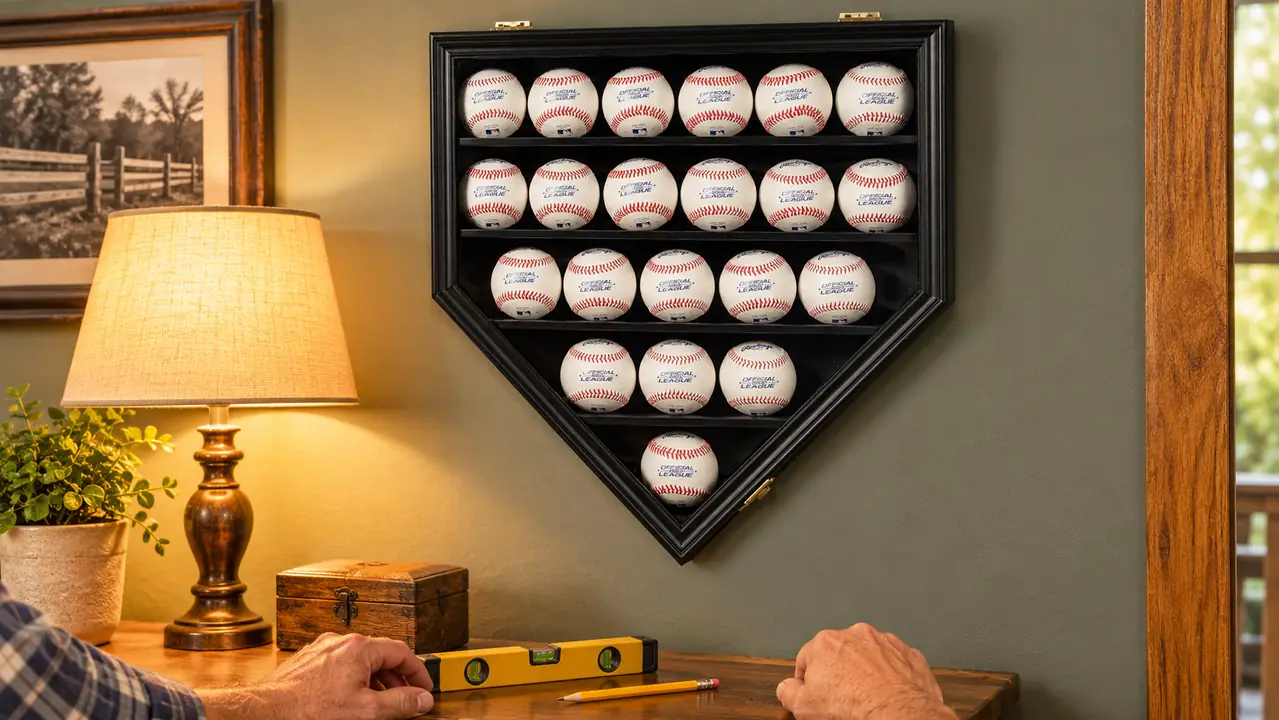
That box is the reason I ended up mounting a DisplayGifts case on the den wall instead of buying another shelf. It holds 21 baseballs, which turned out to be almost exactly what I had, with a slot or two left over for whatever comes next. The door is 98% UV protection acrylic, the frame is hand selected hardwood, and the whole thing measures 19.25 inches long, 3.7 inches deep, and 17.75 inches high. It weighs 7.5 pounds before you put anything in it. Those numbers matter more than they sound like they do, and I will get to why.
Twenty-one slots, one wall, and a door that blocks 98% of the UV
The DisplayGifts case hangs with hardware that is already in the box and puts a full collection behind shatter proof acrylic. If your balls are still in a shoebox on a shelf, this is the shortest way out of that.
Amazon Check Today's Price on Amazon →Step 1: Sort the balls before you buy anything
Empty the box onto the dining room table and look at every ball in daylight. You are not appraising them, because you are not a dealer and neither am I. You are sorting on three things: condition, whether the signature is still readable without tilting it toward a lamp, and whether the ball means anything to you. That last one carries more weight than the first two, and nobody has to agree with your reasoning.
I came out of that afternoon with four piles. Two balls were scuffed badly enough that I did not want them behind glass, so they went into a small cube on the desk where I can pick them up. Three had yellowed far enough that a case would only make the yellow more obvious, and those went into a drawer. The remaining sixteen were the ones I actually wanted on the wall. Sixteen, not twenty-one, and that was fine.
Somewhere in the middle of that afternoon I found a ball with a signature I could not read at all. Smudged, faded, and no memory of who signed it. I nearly dropped it in the drawer pile and then did not, because the day I got it was a good one and the ball is the only thing left from that day. It went into the case reading nothing. Not every slot has to be a piece of history. Some of them are a receipt for an afternoon you want to keep, and that is a perfectly good reason to put a ball behind glass.
Here is where the slot count earns its keep. A 21 slot case holding sixteen balls is not wasted space. It is room. Over the following year I added three more, including one from a cold late-season football weekend that has nothing to do with baseball and everything to do with the people I stood next to. A case sized to exactly what you own today is a case you will outgrow by spring.
Step 2: Pick the wall that never gets direct sun
The den has a west wall that catches afternoon light for about two hours in the summer, and it is the best looking wall in the room. It is also the wall I could not use. UV damage is cumulative. A case with a UV door does not stop that process, it slows it down, and slowing it down only helps if you are not stacking the deck against yourself.
So I walked the room with a cheap light meter app on my phone, which is not scientific but beats guessing. I took readings at eight in the morning, at noon, and again around four in the afternoon, standing where my eyes would be when I looked at the case. The west wall ran two to three times brighter than the wall behind the chair at four o'clock and about the same at eight. On a bright July afternoon the difference was plain enough that I did not need the app at all. I hung the case behind the chair, where it gets lamp light in the evening and almost no sun at any hour. You will look at it less often there than on the show wall. You will also have readable signatures in twenty years, which is the whole point. A collection you can still read beats one you showed off for eight summers and then could not.
Two practical cautions. Do not hang it above a heating vent or a radiator, because repeated hot and cold cycles are unkind to leather and stitching. And do not hang it where a door swings or where a chair back can reach it. A case knocked off a wall takes the collection with it, and the drywall repair is the cheap part of that afternoon.
Step 3: Measure the footprint and mark your studs
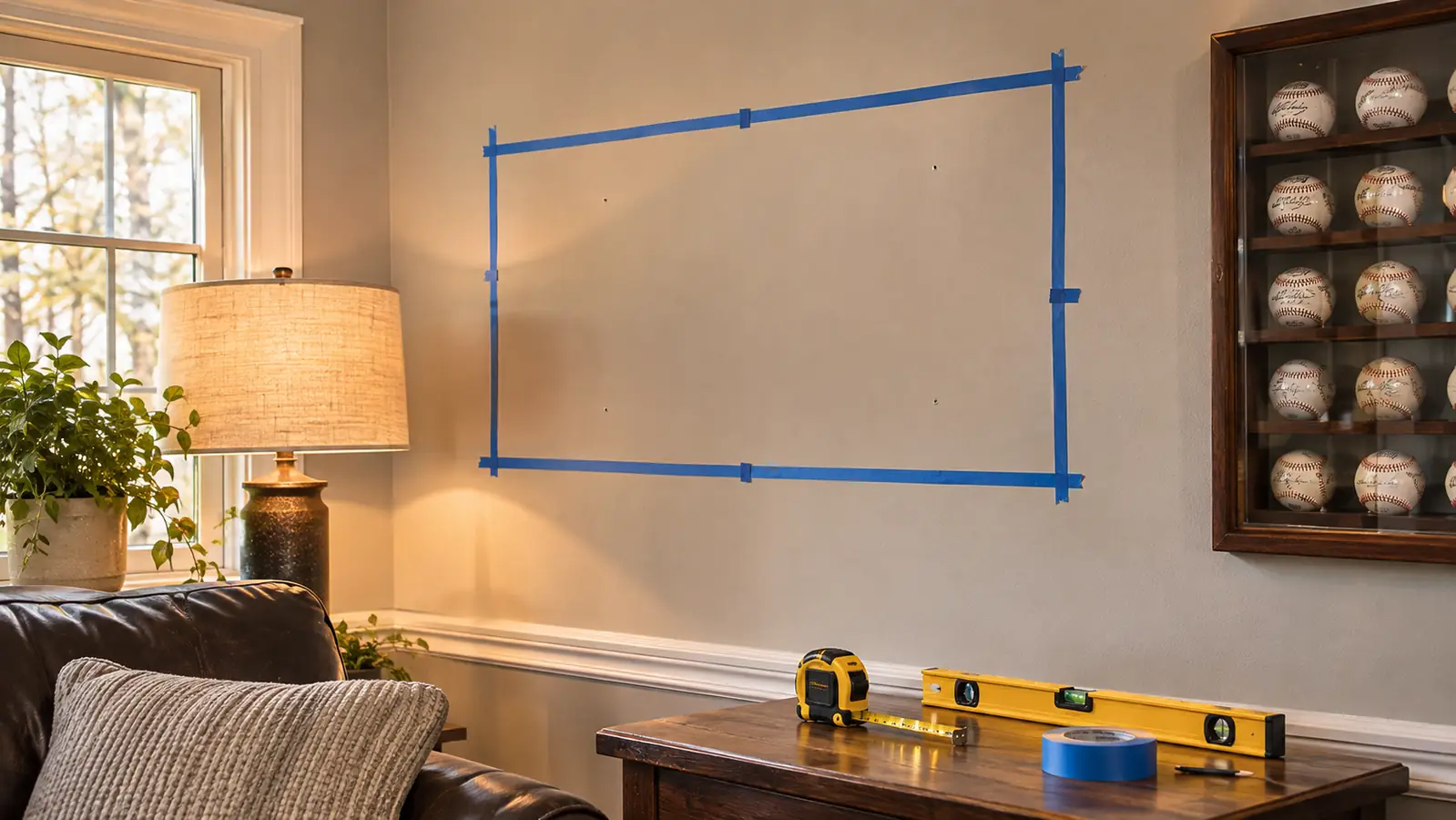
The case is 19.25 inches long, 3.7 inches deep, and 17.75 inches high. On a wall those numbers sound small in your head and look considerably larger once the thing is up there, so mark the rectangle out with painter's tape before you commit to a height. Stand back. Sit in the chair. Look at it from the doorway. Move the tape up two inches and look again. I settled on the bottom edge at 48 inches off the floor, which put the top edge near 66 inches, chest high on me and clear of the chair back. I taped that rectangle in three different positions before I liked one, and each move meant pulling tape and starting over. Your number will differ. What surprised me was how much of that decision was about the chair and the doorway and not the wall at all.
Then find the studs. A stud finder is faster, and the knuckle method works if you are stubborn like me. The wall mount hardware comes in the box with the case, and the case weighs 7.5 pounds empty. Loaded with 21 baseballs it will be heavier than that, and I would much rather you catch two studs than trust drywall anchors with something you cannot replace.
Get a second person for the next part. The tape marks tell you where the case is supposed to go. They do not tell you whether it is level, and the gap between level and almost level is a thing you will notice every time you walk into that room for the next fifteen years. My wife Joan held the level while I held the case, and that arrangement worked better than anything I would have tried alone.
A ball that has spent ten summers near a window has already lost the argument. The 98% UV door is a hedge, not a force field, and it only works if you put the case somewhere sensible.
Step 4: Hang it with the hardware that came in the box
Mount the case before you put a single ball in it. Empty, it weighs 7.5 pounds and it is easy to lift, shift, swear at, and re-set. Loaded, it is not, and you do not want to be adjusting a hook with a decade of collecting sitting behind shatter proof acrylic. This is the one sequencing rule in the whole job that I would call non-negotiable.
Set the first attachment point, hang the case, check it with a level, then finish the rest. When it is up, press gently on each corner in turn. If anything moves, stop and fix it now. A wall mount that feels solid while empty will tell you the truth under load, and it will tell you by dropping something.
Check the door clearance before the case goes on the wall, not after. The door needs room to swing open, and how much room depends on where you hang it relative to the next wall or the edge of a window frame. I did not check, and I now own a lamp that lives two inches to the left of where it used to live. DisplayGifts gives you the dimensions. The room gives you the constraint.
Step 5: Load the balls, lock the door, and stop handling it
Decide the order before you start loading. I went roughly oldest at the top left and then broke my own rule twice, because two balls looked better next to each other than the chronology allowed. Nobody grades this. What matters is that you are not rearranging a full case twice a month, because every rearrangement is another hour with the door open. I laid all sixteen out on the dining table in the order I wanted first, then carried them over four at a time. It took about twenty minutes and saved me from hanging over an open case with a ball in each hand trying to make up my mind. The other five slots stayed empty that day. Three have filled since.
The DisplayGifts case uses a 98% UV protection door, an anti-fade lacquer finish on the frame, and a shatter proof acrylic panel. That combination is a hedge against time, not a suit of armor. Keep it out of direct sun anyway and the finish will outlast the leather on the balls inside. Treat the acrylic like a window, because that is what it is.
The case locks, which in a basement den has less to do with theft than with grandchildren and the movers who show up every few years. Close it, turn the lock, and then leave it alone. Every time that door comes open you are letting in light and dust and the temptation to handle a signed ball with hands that just finished a sandwich. The lock is a boundary you set for yourself.
What Else Helps
Lighting. A small picture light above the case does more for a collection than anything else you can add, and a warm LED does it without adding UV to the room. I used a battery unit because the den has no outlet on that wall, and it has run for two years on the same set of cells. Light the case, not the balls directly, and keep the bulb a few inches back from the acrylic. Mine is dim enough that it does not wash the signatures out when you are standing right at the case, which is the test I would apply to any of them.
Records. I typed out what I know about each ball, printed it small, and slid the cards into the case behind the balls where they cannot be read from the front. If someone asks about one, I have the answer. If nobody asks, there is no clutter on the wall. Do this while the case is empty and you still remember which ball is which, because in five years you will not.
An annual look. Once a year, unlock the case, take the balls out, dust the slots, and turn each ball over in your hand. Things happen that you cannot see through acrylic from three feet away. DisplayGifts builds the case to protect what is behind the door, but protection and maintenance are two different jobs, and only one of them is done for you.
Your collection is already fading. The only question is how fast
Measure the wall this weekend, mark the studs, and hang the case before another summer goes by. The DisplayGifts 21 slot case is 19.25 inches long and 17.75 inches high, which fits a den wall and a whole box of baseballs at the same time.
Amazon Check Today's Price on Amazon →