
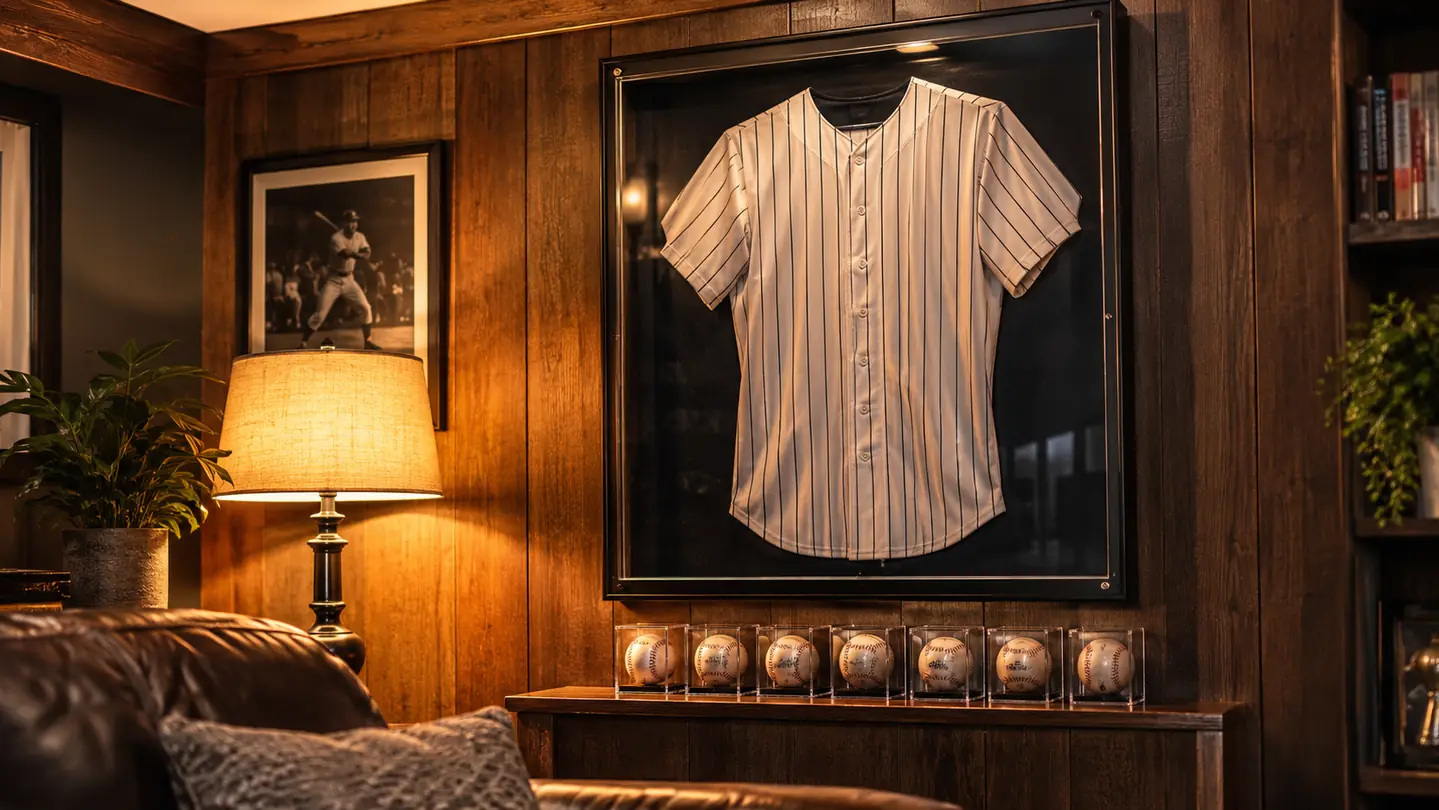
Fifteen years ago I hung a jersey on a wire hanger in the basement, tied a ribbon around the collar and called it displayed. By the next season the shoulders had two soft dents in them that never did come out. A wire hanger will do that. So will folding a jersey flat in a drawer for a decade, or leaving it on a rod where one sleeve presses against the wall. Fabric does not spring back. I learned that the slow way, one crease at a time, and since then I have framed four jerseys and reopened two of them to fix mistakes I made on the first pass. This is the process I wish somebody had handed me before I started. The case I use now is the IHEIPYE jersey display frame case, and most of what follows is specific to how that one goes together.
Here is what nobody tells you about creasing. Almost none of it happens while the jersey is hanging on the wall. It happens in the twenty minutes before that, when you wrestle a stiff jersey into a frame that is slightly too small, or pin it straight through the front of the lettering, or leave a fold in one sleeve because you were in a hurry and the game was starting. A display case does not fix a bad fold. It freezes it, and then it charges you rent on it for the next ten years. So the work is front-loaded, and the five steps below are in the order I do them now.
The frame that holds the shoulders, not just the collar
The IHEIPYE case is 31.25 by 23.25 by 1.5 inches, wall mounted, with a wood hanger, a metal hanger and a pin board in the box. That is three different answers to a crease instead of one.
Amazon Check Today's Price on Amazon →Step 1: Wash and press the jersey before it goes near the frame
Whatever creases are in the fabric when you close the case are the creases you will be looking at for as long as the jersey is on that wall, so start here and do not rush it. Read the care tag first. Most modern replica and game jerseys are polyester and will come through a cold, gentle cycle without trouble, but anything with a stitched felt patch, a leather conference patch or hand-painted lettering needs a professional and I do not argue with that. When in doubt, hand wash in cool water with a drop of mild detergent and rinse until the water runs clear.
Skip fabric softener and skip the dryer entirely. Softener leaves a film that dulls the sheen on synthetic mesh, and a dryer will set wrinkles in place better than anything you could do by hand. Roll the jersey in a clean towel to press the water out, then lay it flat on a second dry towel, reshape the shoulders with your palms and let it sit overnight. Do not hang it wet. Wet fabric on a hanger stretches at the shoulder points and stays stretched, which is the same problem you were trying to avoid in the first place.
If it comes out of the wash with a fold across the chest, iron it on the lowest setting with a thin cotton cloth between the iron and the jersey. Work in small sections and keep the iron moving. Never put an iron directly on a number, a nameplate or a heat-pressed logo, and never hold it in one spot over mesh, because polyester will take a shine or a melt mark and neither one comes off. If the lettering is stitched, turn the jersey inside out first so the plate does not press a ridge through the front.
Step 2: Pick one of the three display methods before you open the box
The IHEIPYE case ships with a wood hanger, a metal hanger and a pin board, and it is worth five minutes of thinking to decide which one your jersey actually wants. They are not really interchangeable after the fact. Once the case is closed and up on the wall, changing your mind means taking the whole thing down, pulling the mounting hardware out and starting over, and most people do not, which means most people live with whichever one they grabbed first.
The wood hanger gives you the shape of a jersey on a person: shoulders sloping naturally, sleeves falling at an angle, the whole thing looking like it is being worn by somebody invisible. It is the right choice for a light or medium jersey and it is the one I reach for with baseball. The metal hanger is stiffer and carries more weight, which matters for a heavy football jersey with stitched numbers or anything with a thick ribbed collar. Reach for the metal one when the wood hanger starts to sag in the middle under the load.
The pin board is the one people skip and then wish they had not. It lets you pull the jersey flat against a backing and hold it there, which is the only honest answer for a jersey that will not hang straight, a jersey with a large chest crest you want sitting flat instead of curving, or a youth jersey small enough to swim inside a 31.25 inch frame. Pinning takes more patience than hanging and about twice as long. It also gives you the cleanest result of the three, and it is what I would use on anything I actually cared about.
Step 3: Load the jersey without stretching the shoulders
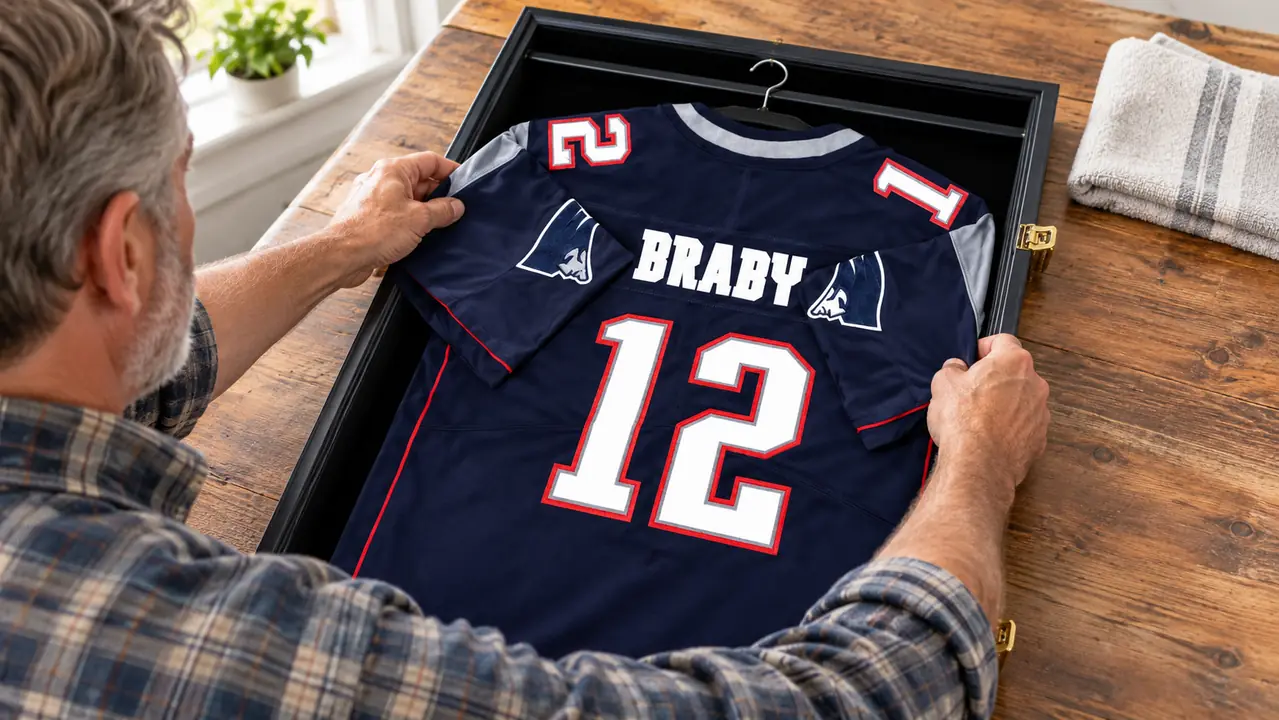
Lay the case face down on a table with the front panel protected by a towel, and work from above where you can see what you are doing. Turn the jersey face down, find the hanger, and ease the ends of the hanger inside the shoulder seams rather than pulling the shoulders up over it. That is the whole trick, and it is the step people get wrong. A jersey dragged onto a hanger stretches at exactly the two points where the fabric has the least give, and it does it in about a second.
Once the shoulders are seated, lift the jersey by both shoulders at the same time, never by one, and set it down into the case. Fold the sleeves back at their natural angle instead of forcing them straight down the sides, and check that no sleeve is trapped behind the frame edge. If you are using the pin board, pin through the seam allowance at the sides and shoulders rather than through the face of the fabric, and use the silver thimble that comes in the box to push the pins home. A pin through mesh leaves a hole you cannot close, and it will be the first thing anybody notices.
Give it a look from a few feet back before you close anything up. Step back, squint a little and check that the two shoulders are level with each other. Small differences look enormous through a frame, because a frame gives the eye a straight line to compare against. Nudge now, while you can still reach in with two fingers, because a shoulder that is half an inch low will bother you every single time you walk past that wall.
Step 4: Mount it on the wall at the right height, into studs
The case weighs 10.6 pounds empty and a jersey does not add much to that, but it is a 31.25 inch tall panel hanging off a wall in a room where people walk, and it will get bumped. Use the hanging hardware that comes in the box and find two studs. If the studs do not line up where you want the case, use proper wall anchors rated for the weight rather than the little plastic plugs that come taped to the back of a picture hook. I have seen a framed jersey come off a wall. It is not a quiet sound.
Height matters more than I expected. The center of the case should sit close to eye level, roughly 60 inches off the floor in a normal room, so you are looking straight at the chest of the jersey rather than up at the collar. In my basement I hung the first one too high because it looked right from the top of a step stool, and then I spent two years looking up at the number from below. Measure twice, mark with a pencil, drill pilot holes, and have somebody hold the case steady while you drive the screws.
Before you commit to a spot, hold the case against the wall and think about what is behind it. An exterior wall in Kansas sweats in February, and anything hanging on it picks up that moisture from the back where you cannot see it. An interior wall shared with a bathroom is worse. If the only wall that works is an exterior one, leave a small air gap behind the case so air can move, and check the back of the frame once a year for any sign of damp.
Step 5: Keep it out of direct sun and dust it like furniture
Sun is the quiet killer. It fades a jersey unevenly, and it does it fastest on the front where the light actually lands, which leaves you with a pale rectangle where the number used to be and a dark one where a fold shadowed it. Keep the case off any wall that takes direct afternoon light. If the only wall you have gets sun, a curtain or a blind costs a lot less than replacing a jersey you cannot replace anyway.
Dust the frame and the front panel with a dry microfiber cloth every couple of months, which is roughly how often you dust the shelf under it. Do not spray cleaner onto the case, and do not spray anything at all near an open one, because overspray lands on the fabric and there is no way to get it off without taking the whole thing apart again. A barely damp cloth followed by a dry one handles fingerprints on the panel; just keep the moisture away from the jersey itself.
Once a year, put a hand on the bottom corner of the case and press gently. You are checking the mounting, not the jersey. Screws work loose in a house that moves with the seasons, and that five second check is the difference between a framed jersey on a wall and a framed jersey on the floor with a cracked corner. Do it when you change the furnace filter. You will remember it that way.
What Else Helps
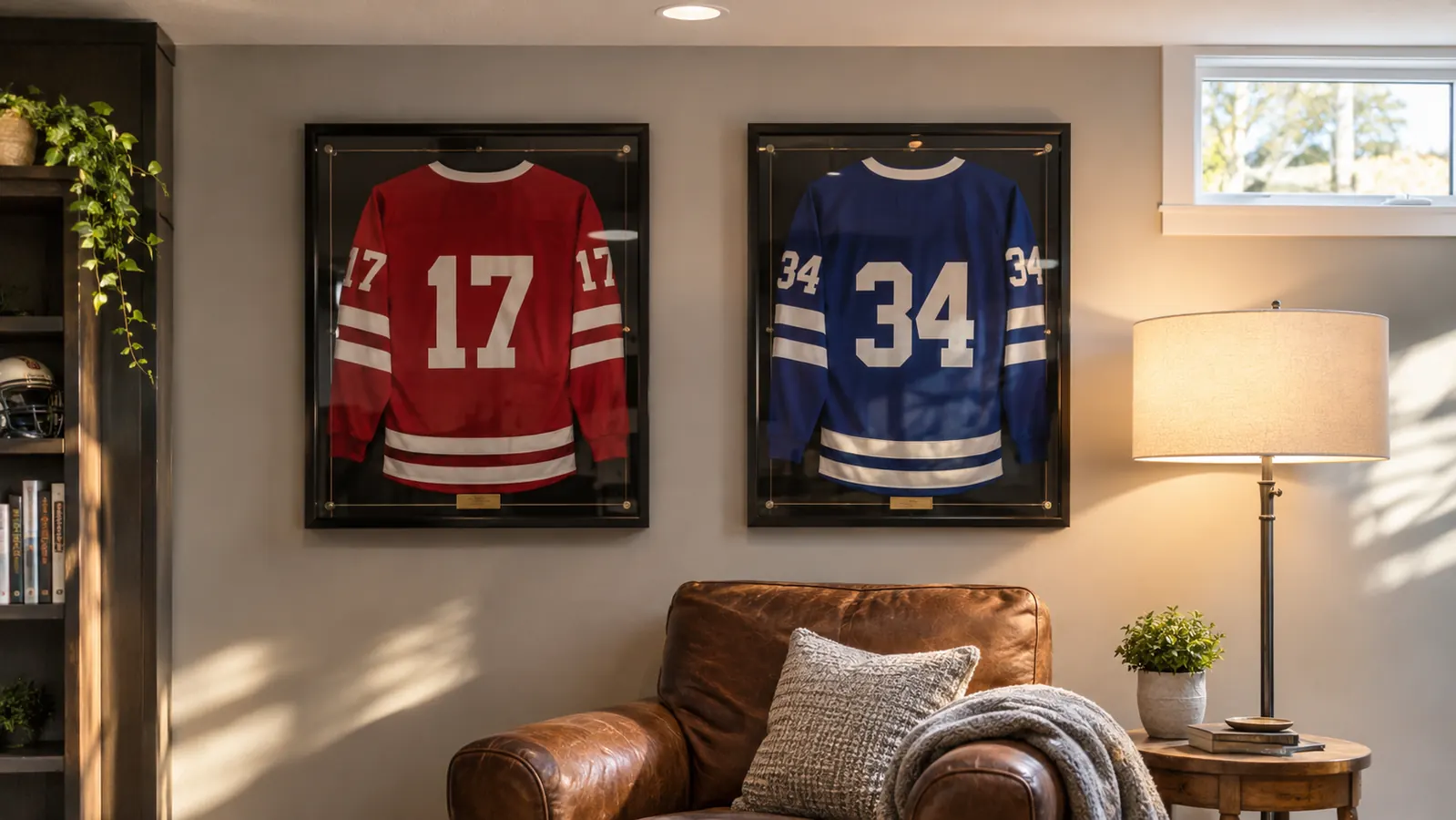
Group them. One framed jersey reads like a single item on a wall. Three of them hung at the same height with even gaps read like a collection, and the wall starts to look intentional instead of like something you finally got around to. I space mine about four inches apart and keep the centers on one line. The IHEIPYE cases are all the same listed size, 31.25 by 23.25 by 1.5 inches, so the spacing holds and you do not have to re-measure every time you add one.
Put the ticket stub or the program in the room, not in the case. A folded program wedged behind a jersey presses a ridge into the fabric over the course of a few seasons, and by the time you notice it, the ridge has set. Frame the ticket separately, or leave it on the shelf underneath. Same goes for a lanyard, a wristband, a signed photo or a media guide. The case holds a jersey and holds it well, and that is the job it was built for.
Watch the humidity if the wall is in a basement. Mine runs damp from March through May, and a jersey that goes into a case damp will smell like a basement for as long as it stays in there. Run a dehumidifier in the room during the wet months, and if you are putting a jersey up in spring, let it sit in the dry upstairs air for a day first. That is not fussy. It is the difference between a case you open in ten years and one you throw out.
Finally, write the date and where the jersey came from on a scrap of paper and tape it to the back of the case. In ten years you will not remember whether it was the home opener or the playoff game, and the person who inherits it will remember even less. A framed jersey without a story is just fabric behind a panel. Two lines on an index card fixes that.
A wire hanger left two dents in the shoulders of a jersey that never came out. The case has held the replacement flat for four seasons.
One case, three ways to hang it, no creases
The IHEIPYE jersey display frame case comes with a wood hanger, a metal hanger, a pin board, hanging hardware, a silver thimble and pins. Everything the five steps above call for is already in the box.
Amazon Check Today's Price on Amazon →