
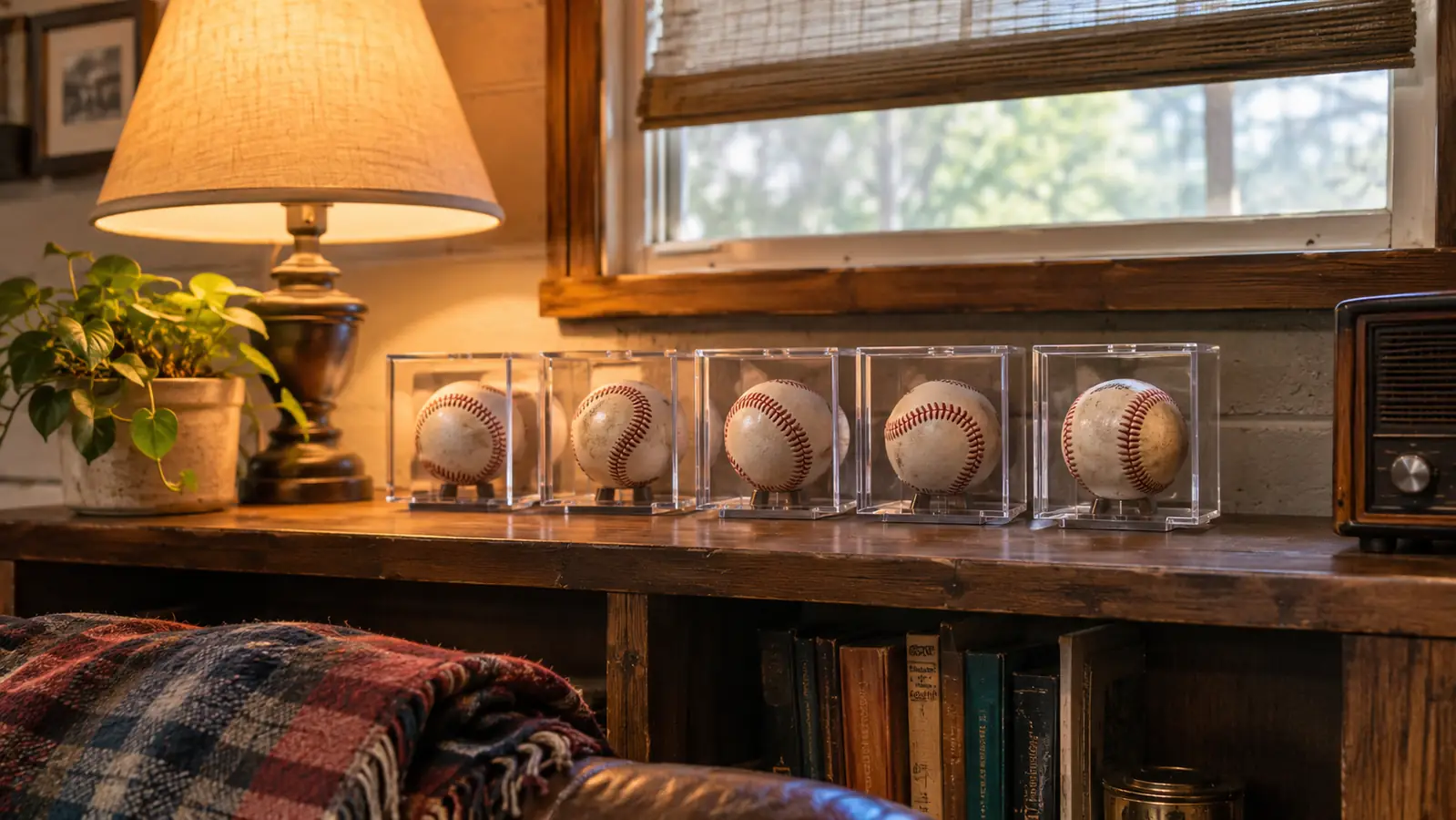
The first signed baseball I ever owned sat on an open wooden stand on my desk for four years, directly under a fluorescent ceiling tube, and by the time I noticed, the ink on the sweet spot had gone from dark blue to a washed-out gray. Nobody warned me. The ball was still round. It still had the leather and the seams and the stamp. It just did not say anything anymore.
That is how autographed baseballs fail. Not with a bang, and not because you dropped one. Light does it, quietly, over years, and it never sends a notice. Ultraviolet light breaks down the dye in the ink, and a den gets UV from the window, from the tubes overhead, and from the lamp on the end table. The fix is boring and it works. Put the ball behind something that blocks UV and then leave it alone. That is what a UV display cube is for. The one I have used the longest is the Ultra Pro Baseball Clear Square UV Holder, a square polystyrene case that holds one ball on a built-in cradle behind a UV barrier, and it has been on the market long enough to have more than five thousand reviews behind it.
Stop Letting the Light Edit Your Autographs
The Ultra Pro cube puts a UV barrier and a built-in cradle between your signed ball and everything that fades it. Set it on the shelf, face the signature out, and leave it there.
Amazon See the Ultra Pro Cube on Amazon →Step 1: Take an Honest Inventory of Where the Balls Actually Sit
Walk through the room where the collection lives and be honest about what each ball is sitting in. I did this with a clipboard one Saturday, which Joan found funny right up until she saw the list. Three balls were within six feet of a south-facing window. Two were under the fluorescent tubes I leave on for four hours every Sunday during football season. One was on the open stand that started this whole mess.
You are looking for three things. Direct sun at any point in the day, which means you have to check at nine in the morning and again at four in the afternoon, because the angle changes and the patch of light moves across the room. Overhead tubes, especially the old magnetic-ballast fluorescent fixtures a lot of basements still have. And hands, meaning the balls that get picked up and turned over every time somebody comes downstairs to watch a game.
Then sort the collection into two piles. Balls nobody touches, which can stay out in the open if the spot is genuinely out of the light. And balls that get handled, which need to be closed up, because a signature rubs off on fingers long before the ink fades. Ultraviolet is the slow killer. Skin oil is the fast one.
Step 2: Prep the Ball and Handle It One Last Time
A cube seals a ball in whatever condition it is in, so get the ball right first. Wash your hands with plain soap, dry them completely, and wait a few minutes. No lotion, no hand sanitizer residue, nothing that will transfer onto the leather and then sit against the signature for the next ten years.
If the ball was signed recently, give the ink a couple of days to cure before it goes behind plastic. Ink on a leather baseball is not like ink on paper. It sits on the surface and it needs air. I watched an assistant coach box a signed ball the same afternoon it was signed and pull it out a week later with a smear across the sweet spot.
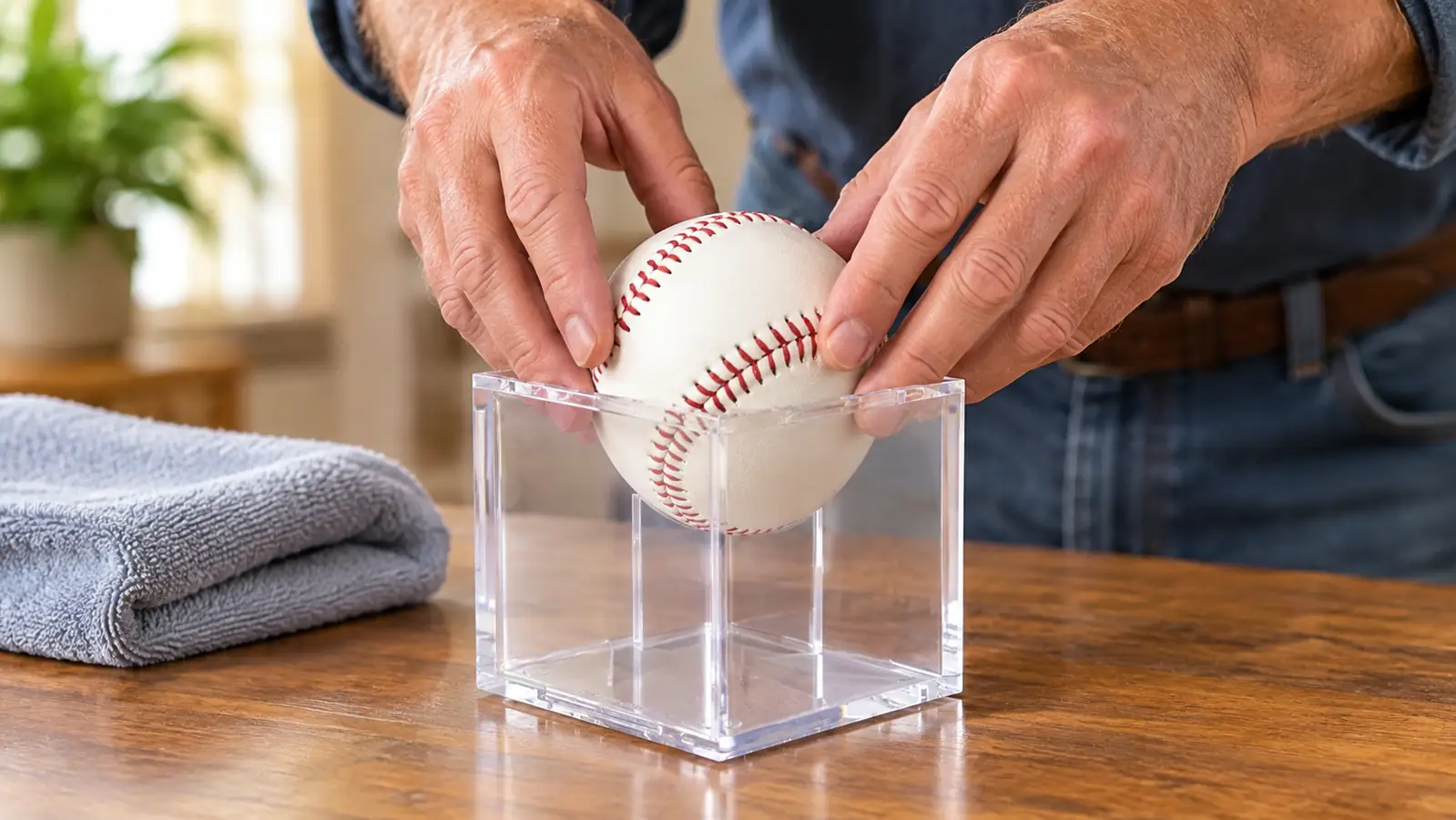
Handle the ball by the seams and never by the sweet spot. Set it down on a towel while you get the cube open, and do the whole job over a table, not over a concrete floor. A baseball is a hard object with a soft cover, and a two-foot drop onto basement concrete will flatten a seam and take a chip out of the leather. No display product protects against gravity.
Step 3: Seat the Ball in the Cradle and Face the Signature Out
The Ultra Pro cube has a built-in cradle, and the entire point of it is that the ball does not roll. Set the ball into the cradle with the signature facing you and the sweet spot centered, so the panel you care about is not touching anything and not resting against the inside of the plastic.
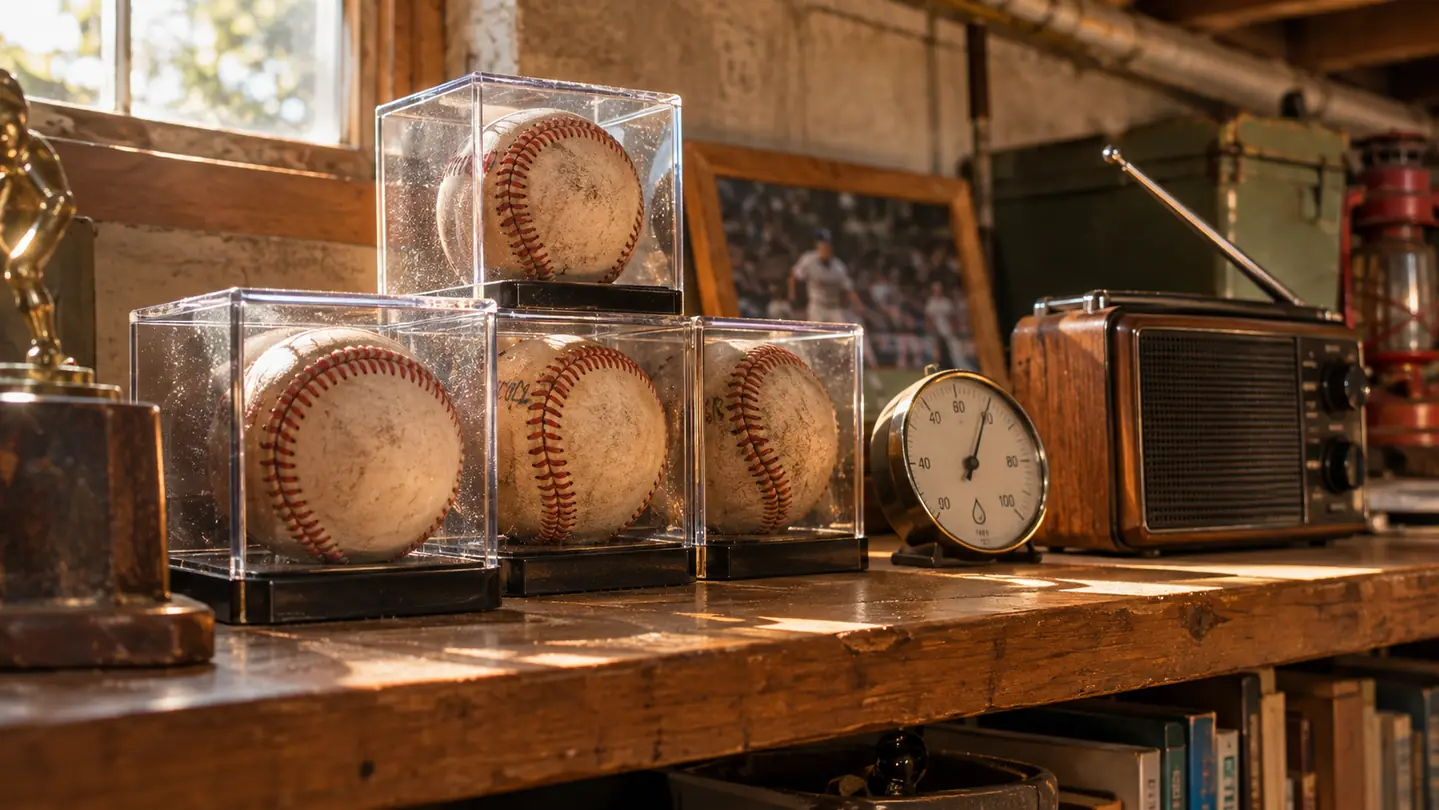
The frame opening on this one is about 3.2 inches square, which is sized for a standard baseball and not much else. It weighs 4.64 ounces empty, so it sits flat on a shelf without tipping and does not need to be screwed down or anchored. It is a tabletop mount and it is square, and if you own several of them they stack. Keep the stack to three or four, and put the heaviest at the bottom.
Be deliberate about which panel faces front. The front is the side that gets looked at, and it is also the side that takes the most light through the plastic. If a ball has one signature on the sweet spot and a second one on a side panel, put the more important of the two toward the front before you close it up. Then leave the ball oriented that way. Twisting it around every few months to show a different panel just means you keep handling it.
A signature does not fade because the baseball got old. It fades because the ink was left in the light. Take the light away and the clock mostly stops.
Step 4: Pick a Spot That Respects What the UV Barrier Can and Cannot Do
A UV barrier reduces exposure. It does not eliminate it, and the product description says so in plain language: special UV barriers to reduce light exposure, reducing signature fading. Reduce is the word. So placement still matters, and a cube is not a license to park a signed ball on a windowsill and forget it.
The worst spots in a house are usually the ones that look the best. A south or west window ledge. The top of a bookcase directly under a ceiling tube. A shelf above a heat vent or a radiator, where the leather goes through a dry and cool cycle every day. A garage or an attic beats all of them, because the temperature there swings forty degrees between July and January. My den holds between sixty-five and seventy-five year round, and that steadiness is a big part of why the things down there have survived.
In a basement, keep the cube off the concrete and off the bottom shelf. Concrete wicks moisture, and moisture is what turns leather soft and ink cloudy. Two feet up on a wooden shelf is plenty. If your basement smells like a basement, run a dehumidifier and actually empty it. That one habit does more for a collection than any display product on the market, including the good ones.
Step 5: Dust It, Check It Twice a Year, and Photograph It Every January
Dust the outside with a dry microfiber cloth. Do not use glass cleaner, and do not use anything with ammonia or alcohol in it on polystyrene. Those solvents cloud the plastic, and a cloudy cube over a signed ball is worse than no cube at all. A dry cloth and a little patience is the entire maintenance routine.
Twice a year, take the cube down, hold it under a lamp at an angle, and look at the ink through the front panel. Angled light shows fading before straight-on light does, the same way raking light shows a dent in a car door. If the ink is going brown or gray at the edges of the letters, that ball has been getting light and it needs to move to a darker spot. Leave it in the cube while you check. There is no reason to take it out.
Take one photo of each ball every January with your phone, from the same spot and under the same lamp. Keep them in a folder on the phone. Two years from now you will not be able to tell by eye whether the ink changed, but you will be able to flip between two photos and see it in five seconds. I started doing this after the ball on my desk, and it is the only reason I trust my own memory about the rest of the collection.
What Else Helps
A cube like the Ultra Pro holder solves the ball problem. It does not solve the room. If the collection is bigger than a couple of balls, deal with the light source itself. Swap the old fluorescent tubes over the shelves for LED tubes in a warmer color temperature, or just leave them off when nobody is down there. Put a blind on the window that throws a patch of afternoon sun across the shelves. These are twenty-minute jobs and they protect everything in the room.
Framed jerseys are the other half of it. Ask for UV-filtering glass or acrylic when you have one framed, and keep the frame out of direct sun even then, because a jersey is dyed fabric and it fades on the same schedule as ink. Ticket stubs, programs and photos belong in an album or a box in a closet, not taped to a wall where paper goes yellow inside two summers.
Humidity control matters more than most collectors admit. A basement in this part of Kansas runs dry in February and swampy in June, and leather does not like either extreme. A cheap hygrometer on the shelf will tell you what you are actually dealing with, and a dehumidifier set to keep the room under fifty percent will outperform any single display product you can buy. I check mine when I change the furnace filter, which is the only way I remember to check it at all.
Keep the display somewhere you walk past. A cube on a shelf in a room you never enter is a cube you never dust, never check, and never enjoy. Mine sits next to the radio I listen to summer games on, which means I look at it sixty times between April and October. That is the real argument for a display over a box in a closet. You see it, so you maintain it, and you catch a small problem while it is still small.
One Ball, One Cube, One Less Thing to Regret in Ten Years
The Ultra Pro Baseball Clear Square UV Holder holds one ball on a built-in cradle behind a UV barrier, and it stacks if you have more than one. Put the ball in, face the signature out, and get on with the season.
Amazon Check Availability on Amazon →