
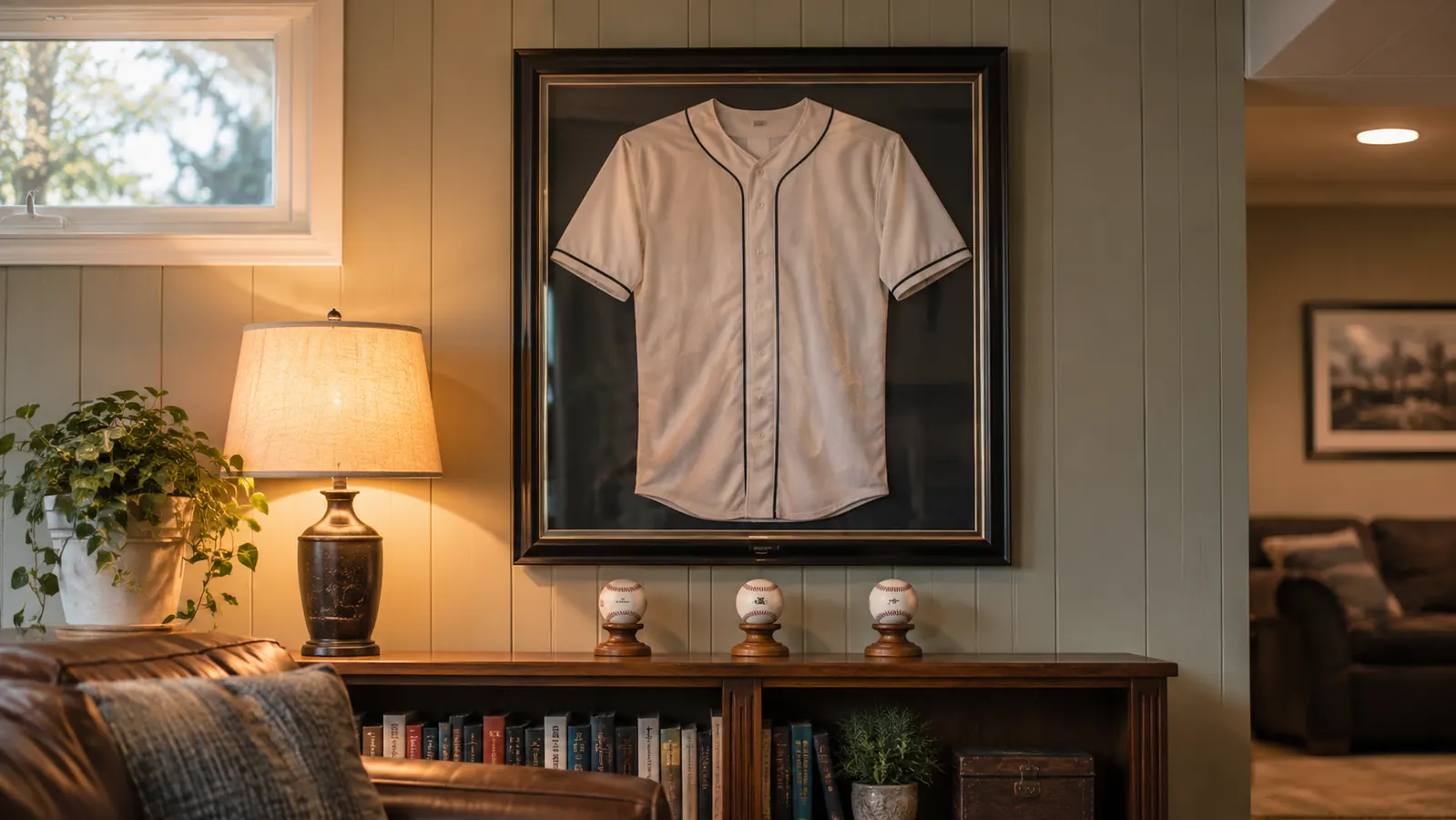
The jersey I wanted to hang never got ruined on a wall. It got ruined in a closet. Twelve years on a wire hanger, the shoulder seams pulled into points, the number on the back creased down the middle where the door kept catching it. I had a couple of signed balls on a shelf and a framed photo of the home team, and the one thing I actually cared about was folded up in the dark behind a coat. So I finally bought a proper case, the IHEIPYE Jersey Display Frame Case, and hung it in the basement den. That was a little over a year ago. Here is what I learned, including the parts I would have wanted somebody to tell me first.
The short version: it does the job, and it does it well enough that I bought a second one for a baseball jersey. But it is not a hang-it-and-forget-it purchase, and the listing photos do not say so. The case is 31.25 inches tall by 23.25 inches wide by 1.5 inches deep, wood frame, wall mount, and it weighs 10.6 pounds before you put anything in it. That last number is the one nobody mentions. Ten and a half pounds of frame on drywall is a different project than a poster frame, and how you hang it matters about as much as what you put inside it.
The Quick Verdict
A solid, honest display case that will outlast the jersey inside it. The 1.5 inch depth and the 10.6 pound weight are the two things to think about before you buy. The look is not one of them.
Amazon Check Today's Price →Your jersey spent a decade in a closet. Give it a wall.
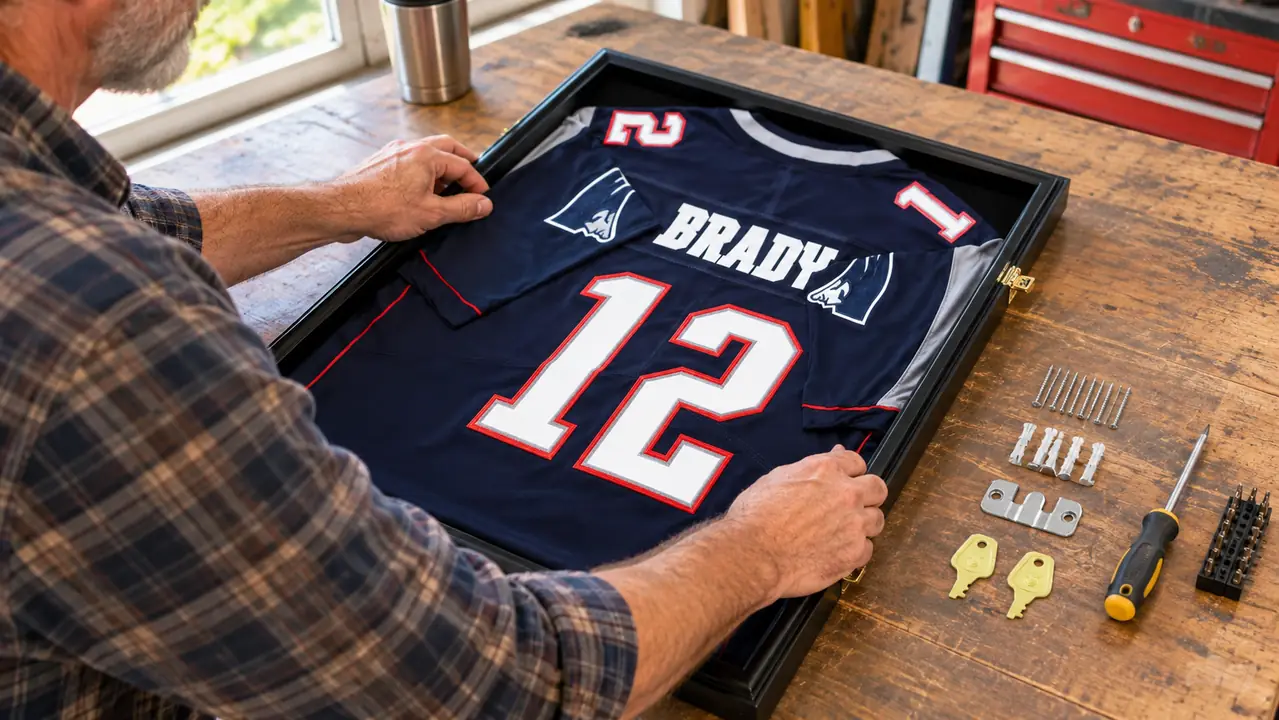
The IHEIPYE case ships with two hangers, a pin board, hanging hardware, a silver thimble and pins, and a visual guide. Budget a stud finder and twenty minutes.
Amazon Check Today's Price on Amazon →What Nobody Tells You Before You Buy One
Here is the number that matters most and gets the least attention: 1.5 inches deep. Every case like this is a shallow box, and shallow is fine for a jersey laid flat. It is not fine for everything you might want to put in there with it. A thick embroidered patch on the sleeve. A folded collar that will not press down. A game program you assumed you could tuck behind the shoulder. I tried to add a lanyard from a late-season game and gave up on it. Measure the stack you intend to put in, not just the jersey, and do that before you order rather than after.
The listing says three selectable display methods, and the box backs it up: a wood hanger, a metal hanger, and a pin board, with a silver thimble and pins to go with the board. That is more flexibility than I expected at this size. The two hangers do the same basic job in different materials, so the real choice is hanger versus pin board. Hangers are faster and they let the jersey hang the way it hangs on a body. The pin board lets you open the shoulders wide and square the number up so it reads from across the room. I have used both now. I do not think one is better. I think one is better for a jersey you want to look worn and one is better for a jersey you want to look new.
The box shows up heavier than you expect, and the corners are the part to check. Mine came with the frame corners wrapped and the hangers and pin board loose inside, so nothing was pressing on the face. I still walked mine out to the garage and set it face up on the bench before I opened anything, because the one thing you cannot fix later is a dent in the frame at eye level. Both of mine arrived square. If yours does not, that is a return, not a repair, and you will know it in the first thirty seconds of looking at it. Empty the box onto a towel, keep the hardware bag with the guide, and do not throw the foam away until the case is on the wall. I threw the foam away on the first one and then spent a week with the second case leaning against a bookcase where it could get knocked over.
Ten and a half pounds, empty. Add a jersey and you are hanging a small television on the wall. The package includes hanging hardware and a visual guide, and both are adequate. What the package cannot do is find a stud for you. My den wall had one in a useful spot and I got lucky. If yours does not, this is a two-anchor job and you should not talk yourself out of that step because you are impatient. A frame that comes off the wall at three in the morning takes the jersey with it, and the jersey is the part you cannot replace.
How I've Used It
The first case went up in the den with the wood hanger and a football jersey, the kind with the numbers sewn on rather than printed. The hanger holds it by the shoulders the way a person would, which is what I wanted. It took me one try to get it centered and one more try to notice it was not centered. The metal hanger is the same job in a thinner profile, and I could not tell you which one is in the box behind me right now without opening it up to look.
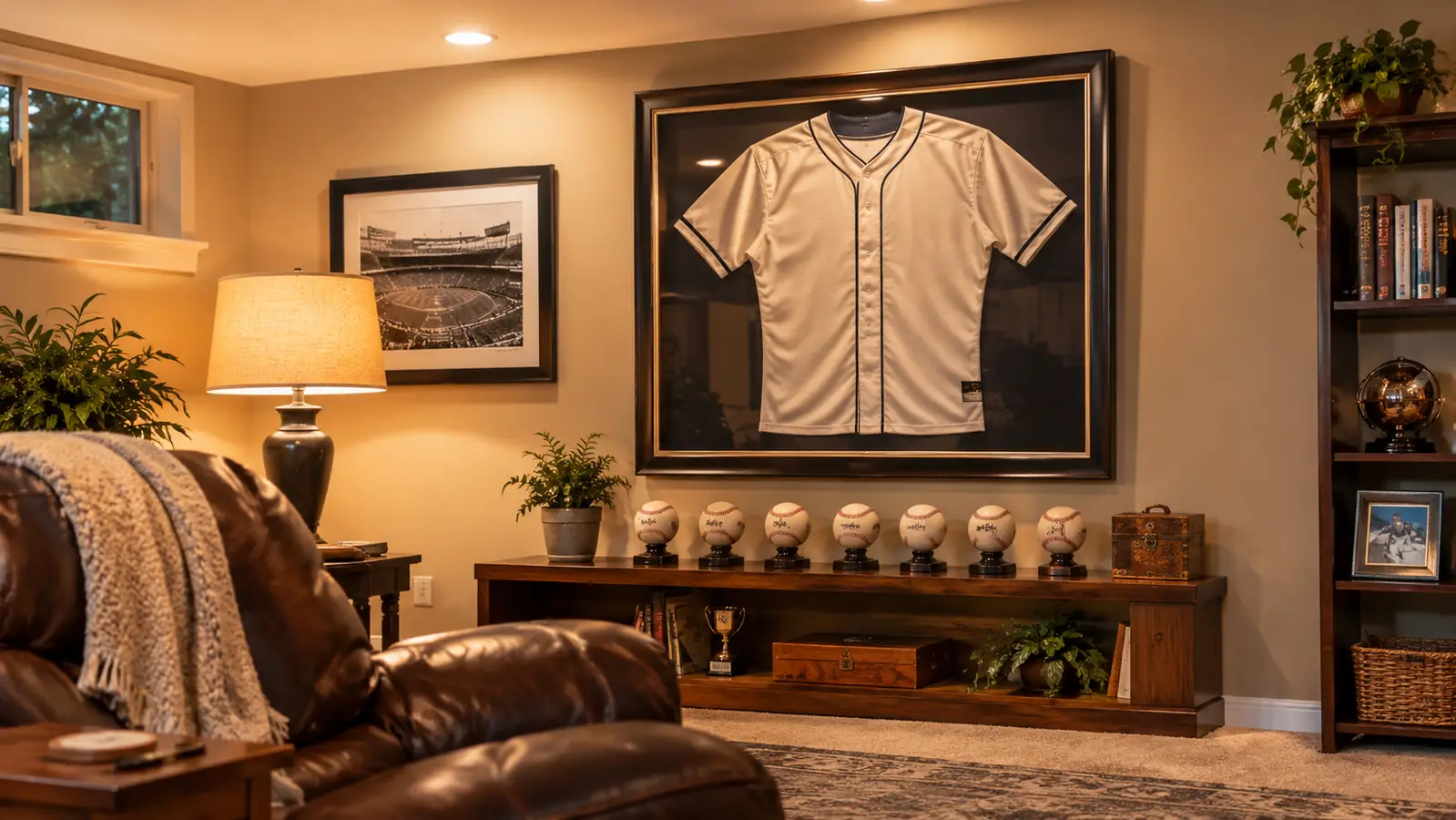
The second case, the baseball jersey, I did on the pin board. That was the right call. A baseball jersey is a boxier cut, and hung loose it slumps into a shapeless rectangle. Pinned flat with the shoulders squared and the buttons in a line, it looks like it belongs in a clubhouse. It took me about forty minutes and most of that was standing back and looking at it, which is not work, it is the reason you bought the thing.
The first install was a Saturday in early October, and I will tell you how it actually went. I picked the wall, held the case up, decided it was too high, held it up again, decided it was too low, and then did the thing I should have done first, which was measure from the floor to the middle of the wall and work from that number. The level on my phone read true against the frame edge, and then read a bubble off against the wall trim, which is how I learned that the trim in my den was hung by a man having a bad day in 1994. Trust the frame, not the trim. I marked the holes, drilled them, and had the case hanging before the second cup of coffee went cold. Getting the jersey centered after that took longer than the hanging did.
A year in, both cases are still square to the wall and the IHEIPYE case has not budged a fraction of an inch since the day I leveled it. The fronts wipe clean with a dry cloth every few weeks. Guests notice them. Not in a look-at-my-collection way, in a way where somebody stops mid-sentence and walks over. My wife Joan, who has watched more baseball with me than either of us will admit, said the den finally looks like a room instead of a storage unit. That is the whole review, honestly. Everything after this is housekeeping.
Ten and a half pounds of wood frame, one stud, and twenty minutes. That is the entire install, and it is the step people skip to their regret.
Measure Twice, and Other Boring Advice
The footprint is 31.25 by 23.25, and a jersey on a hanger fills it. What surprised me is how much wall the case eats once it is up. It reads bigger on the wall than it does in your hands. Hold a tape measure against the spot you picked, both directions, and then hold a piece of cardboard that size against the wall for an afternoon before you commit. I skipped that and ended up moving a shelf six inches, which meant patching two holes and repainting a patch of wall I did not want to repaint.
Mind the light. Not because the case cannot take it, but because direct afternoon sun through a west window will fade fabric over years, case or no case. My den has one small window and the case sits on the wall opposite it. That was deliberate. If your only open wall faces a window, think about a shade before you think about a different frame.
The hardware that comes with the case is fine for a wood stud. It is not fine for drywall alone, and the box does not pretend otherwise. My den wall is paneled over drywall, so I had to find the stud through the paneling, which meant a stud finder, a small finish nail, and a certain amount of muttering. When I moved the shelf and had to redo one anchor, I swapped in a heavy-duty toggle rated well above the weight of the frame and the jersey together, and I slept better for it. If you are hanging this on masonry or on a wall you do not understand, get somebody who does. Twenty minutes of an electrician's time is cheaper than a jersey with a torn shoulder. Joan watched me do the second one and asked whether I was overthinking it. I was not. Ten and a half pounds plus a jersey is not a picture frame.
Get a second set of hands for the last five minutes. Getting the jersey arranged inside is a two-hand job and getting the case on the wall while you can still see straight is a two-person job. Kyle was home for a weekend when the first one went up and I have never been so glad to have a grown son standing next to me holding a level. If nobody is around, do it in the morning when your shoulders still work.
The Parts That Frustrated Me
A large jersey is a tight fit. I wear a 52 and the shoulders on mine needed some convincing before they would sit flat against the backing. Not a defect exactly, and it did settle, but if you are hanging something in a bigger size or a cut with long sleeves, expect to spend real time on the shoulders. The sleeves are the fussy part. Nobody warns you about the sleeves.
The pin board is a one-shot layout unless you like pinholes. That is the tradeoff with pins. Reposition the jersey because a shoulder was off by an inch and you have left a small mark in the fabric. On an older jersey with a loose weave, that mark is going to be permanent. Pin it once, pin it carefully, and if you are the type who will rearrange it in three months, use the hanger instead and save yourself the regret.
The glare is the one thing I did not think about. A jersey behind a clear front on a wall opposite a window will show you the window in the afternoon, and if the numbers are dark against a light body you will spend the first month moving your head around to see them. I shifted a floor lamp four feet and it stopped mattering. If you have a lamp near the wall you picked, walk around the room at the time of day you actually use the den and look at the spot before you commit.
Dust collects along the top rail where you cannot see it from standing height, so get a step stool twice a year and run a dry microfiber cloth along that top edge. That is the entire maintenance routine, and I have not needed anything wet on the front. The fabric inside is a different story, because it will pick up whatever the room has in it. If the den smells like a basement in July, the jersey will too. A small dehumidifier did more for mine than any cleaning product ever could, and it was cheaper than replacing a shirt I cannot replace.
The visual guide is a page of pictures. Pictures are fine until you need a sentence, and there was one moment during the first install where I wanted a sentence. I figured it out in a minute. I am also a man who reads instructions for sport, so take that for what it is worth. The hardware that came in the box did everything it was supposed to do, and I did not have to make a second trip to the hardware store, which is the highest compliment I can pay a box of parts.
What I Liked
- Three ways to mount the jersey, so the same case works for a worn gamer and a crisp replica
- Large 31.25 by 23.25 footprint holds a full jersey without folding anything
- Wood frame looks like furniture, not like a plastic box
- Hardware, thimble, pins and guide all included, no second trip to the store
- Second one went up in under half an hour because I knew what I was doing
Where It Falls Short
- 10.6 pounds empty means you need a stud and a helper, not a nail
- 1.5 inch depth leaves little room for patches, programs or a folded collar
- Pin board leaves small marks if you reposition, which is permanent on loose fabric
- Wide shoulders in a big size need real time to sit flat
- Glare off the clear front on a bright wall will make you move a lamp
Who This Is For
If you own one jersey you actually care about and it is currently living on a hanger in a closet or draped over a chair, this is the fix and you will not think about it again for years. The IHEIPYE case is sized for a real jersey, it mounts flat against a wall, and it gets the thing out of the dark. It suits a den, a home office, a hallway, or a basement wall that currently holds nothing. It suits a gift for a fan who has everything except somewhere to put it.
It also suits the person who wants options. Three display methods in one box means you can hang a football jersey loose today and pin a baseball jersey flat next month without buying a different product. If you are the sort who rearranges the den every couple of years, that flexibility is worth more than the depth limitation costs you.
Who Should Skip It
Skip it if what you are displaying is not a full jersey. A framed photo, a ticket stub collage, a signed ball, a warmup jacket with a bulky collar: none of those belong in a 1.5 inch deep case built around a hanging shirt, and you will be fighting the box the entire time. Skip it too if your only wall is drywall over furring strips with nothing solid behind it. And if you want to layer a patch, a program and a lanyard in with the jersey, you need a deeper shadow box than this one. Buying this and being disappointed would be a failure of expectation, not of the product. Know what you are hanging before you hang it.
One last thing, and then I will get out of your way. The jersey in my den spent twelve years folded in a closet because I kept telling myself I would deal with it later. It took one afternoon. Whatever the version of that is in your house, it is one afternoon too.
One afternoon now, or twelve more years in the closet.
Two hangers, a pin board, and every piece of hardware in the box. You bring the stud finder and a second pair of hands.
Amazon Check Today's Price on Amazon →